What is crisis communication and why is it important?
25 May 2025

Most businesses arrive at reputation work the same way. Something goes wrong, or a competitor starts appearing everywhere, and somebody decides the company needs a strategy. Then the question becomes what a strategy actually is, and the answer turns out to be surprisingly hard to find.
If you are still deciding whether this work is worth doing at all, our complete guide to reputation management covers why it now shows up in financial terms. This guide assumes that a decision is made.
Search for a reputation management framework and you will find plenty, almost all published by companies selling reputation software. No open-source, independently governed framework exists for reputation specifically, so practitioners adapt communications frameworks instead. Three are worth knowing.
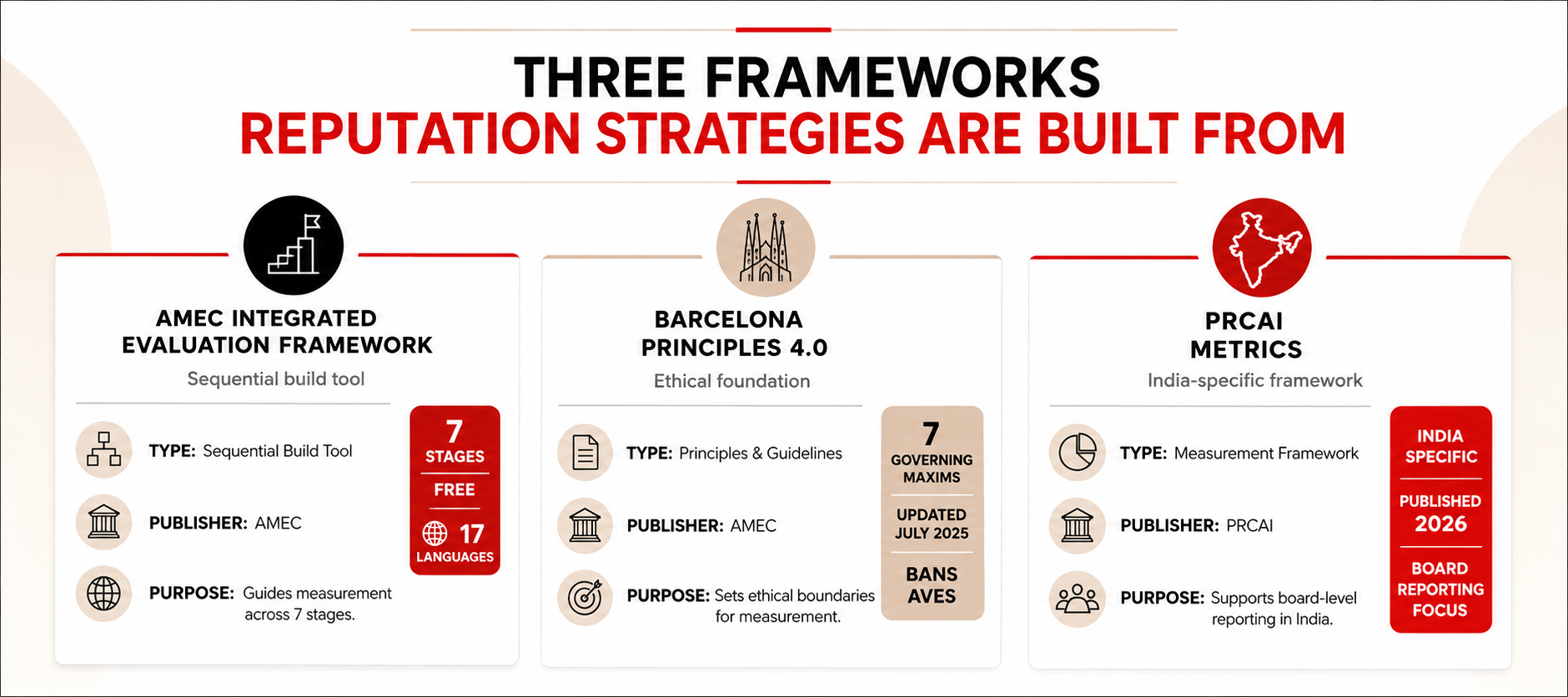
The AMEC Integrated Evaluation Framework is the closest thing to a global standard. It is free, available in 17 languages, and prescribes a sequential build running through objectives, inputs, activities, outputs, outtakes, outcomes and impact. AMEC is currently reviewing it to fold in generative AI variables, so expect movement during 2026.
The Barcelona Principles 4.0, updated in July 2025, are not a build tool but seven governing maxims. Three changes in the 4.0 version matter for anyone starting now. Objective setting is treated as a prerequisite rather than a step. Static “audiences” become dynamic “stakeholder ecosystems” that influence one another. And Advertising Value Equivalents are explicitly prohibited as a measure of value.
The PRCAI METRICS framework, published in India in 2026, is the domestic addition, built to demonstrate PR outcomes to Indian boards. It sits inside PRCAI’s Client-Consultancy Partnership Charter, which is freely available and includes standardised RFP guidance most businesses do not know exists.
None of the three was designed for reputation as such. What follows is the sequence they agree on.
Almost everyone skips this step, and skipping it has a specific consequence. Without a documented record of where you started, no later measurement can prove that anything you did caused anything to change. The strategy becomes unfalsifiable, which sounds academic until a board asks what the retainer bought. Research calls this formative evaluation and treats it as non-negotiable. It has four parts.
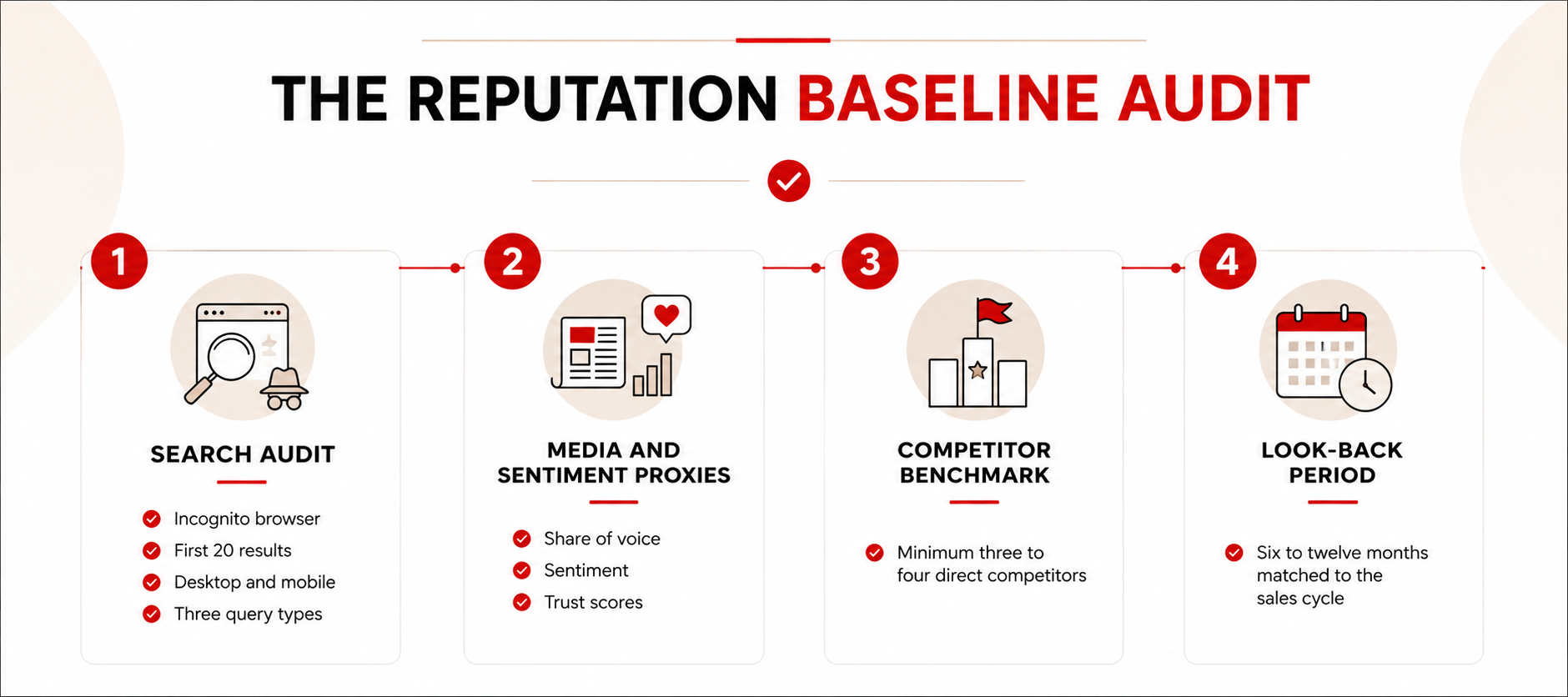
Run it in an incognito or private browsing window. This is not a detail. Your normal browser has months of history telling the search engine you like your own company, so an audit run on it shows you a version of the results almost nobody else sees. Practitioners invalidate their own baselines this way constantly.
Cover the top twenty results on desktop and mobile, since the indices differ. Run three query types: the exact company name, the name with the word reviews, and your senior leadership. Record what appears, in what order, and who controls each result.
Primary survey research is the right way to establish how stakeholders feel, and most businesses cannot fund it. Indian communicators substitute three proxies: share of voice at 84%, sentiment at 57%, and brand trust scores at 50%. Use them, but know the weakness. Coverage volume and tone are output metrics that do not reliably predict shifts in attitude. A proxy tells you what the media environment looks like, not what anyone believes.
Apply the same proxies to three or four direct competitors, the minimum credible sample. An absolute score means little, while a percentile position within your category means something.
For the look-back period there is no agreed standard. Frameworks suggest six to twelve months matched to your operating cycle rather than the calendar, so a business with an eighteen-month sales cycle should not baseline on a quarter.
Once you know where you stand, the next question is with whom. Most businesses answer too broadly, listing customers and investors and employees, then building messaging for all of them at once.
The Barcelona Principles 4.0 push against that, mandating a shift from static audiences to ecosystems where each group influences the others. Industry analysts pressure procurement buyers, employees shape what candidates believe, and regulators respond to what appears in the press. A map that misses those connections misses most of how reputation travels.
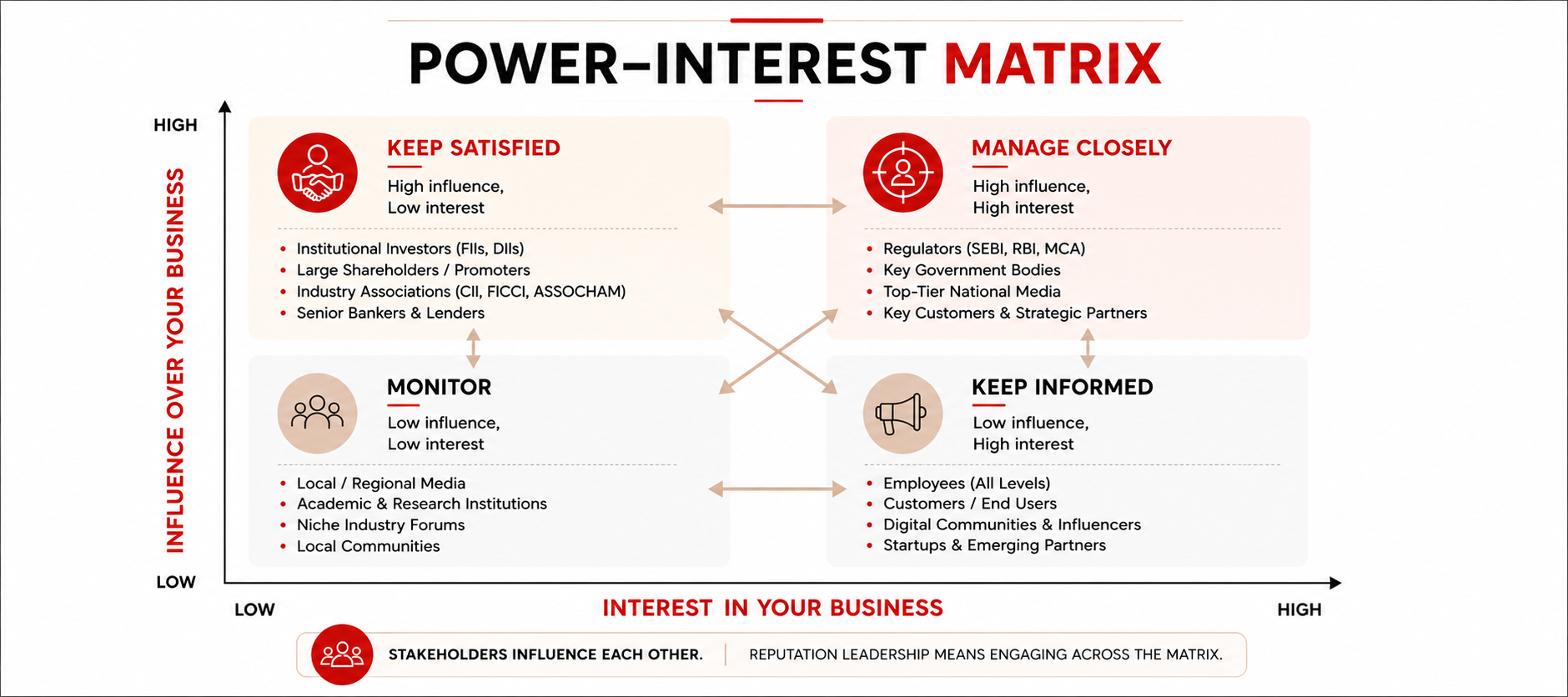
The power-interest matrix remains the standard tool. Plot each group by influence over your business against interest in it, then concentrate resources on the high-influence, high-interest quadrant first.
Two Indian shifts should inform where groups land. Regional PR spend has climbed from 15% to a projected 25% of consultancy budgets, pushing Tier 2 and Tier 3 audiences up the matrix, and government spending has risen from 4% to 11% of the market between 2022 and 2026. Stage matters too: early-stage businesses concentrate on venture capital and talent, while listed mid-caps weigh regulators and institutional investors because compliance gives them direct leverage.
The distinction that causes most trouble is between outputs and outcomes.
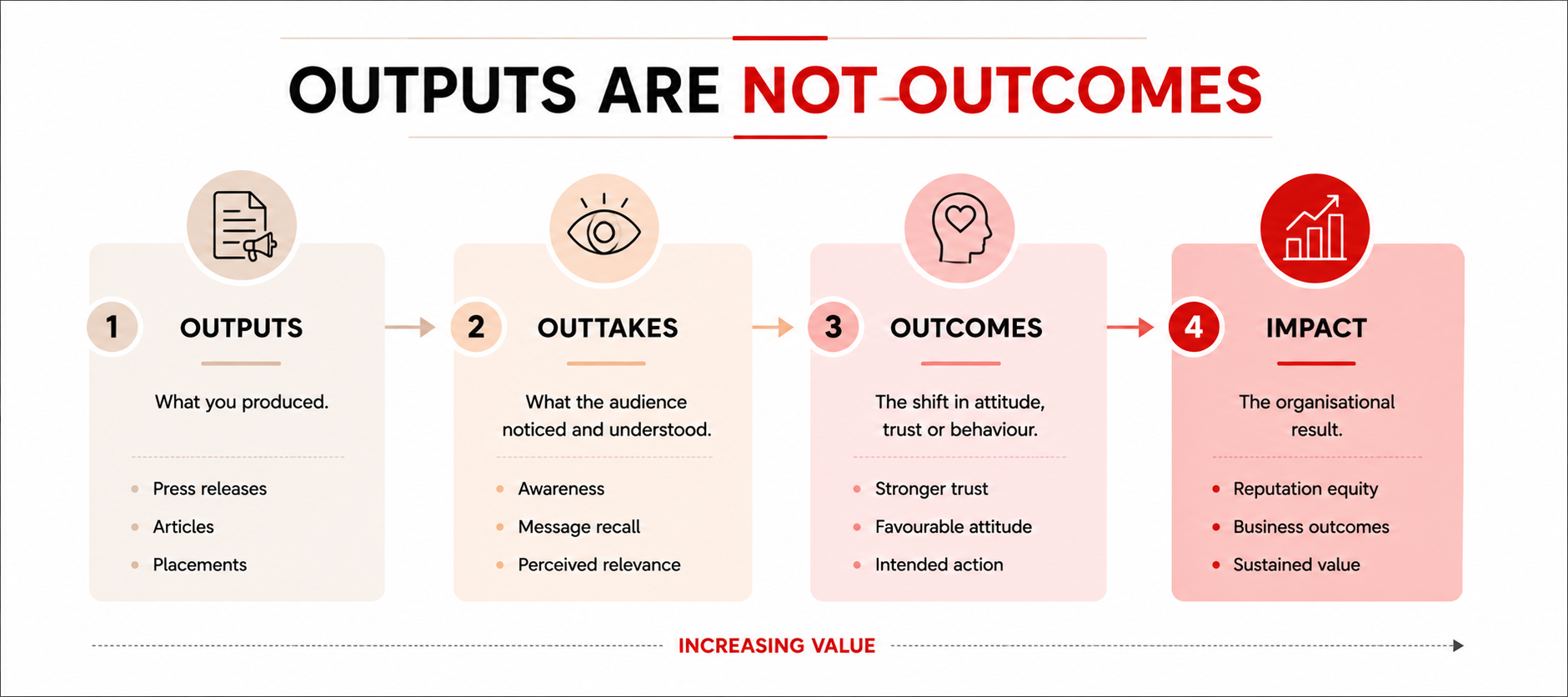
Outputs are what you produced: releases issued, articles placed, posts published. Outtakes are what the audience noticed. Outcomes are the shift in attitude, trust or behaviour, and impact is what that does to the organisation. Conflating the first with the third is the most persistent error in the field, surviving on an outdated assumption that exposure equals persuasion.
The metric that operationalises this is Return on Objective, now used by 41% of Indian communicators. It measures the percentage change against your documented baseline, which is precisely why Step 1 cannot be skipped.
On what counts as a realistic first-year target, no cross-industry benchmark exists. Anyone quoting one is describing their own experience rather than published evidence, so set year one conservatively and treat it as the period that produces your real benchmarks.
Message architecture is where a strategy becomes documents rather than intentions. It produces three artefacts, and credible sources separate them clearly, because businesses routinely build one and assume it covers the others.
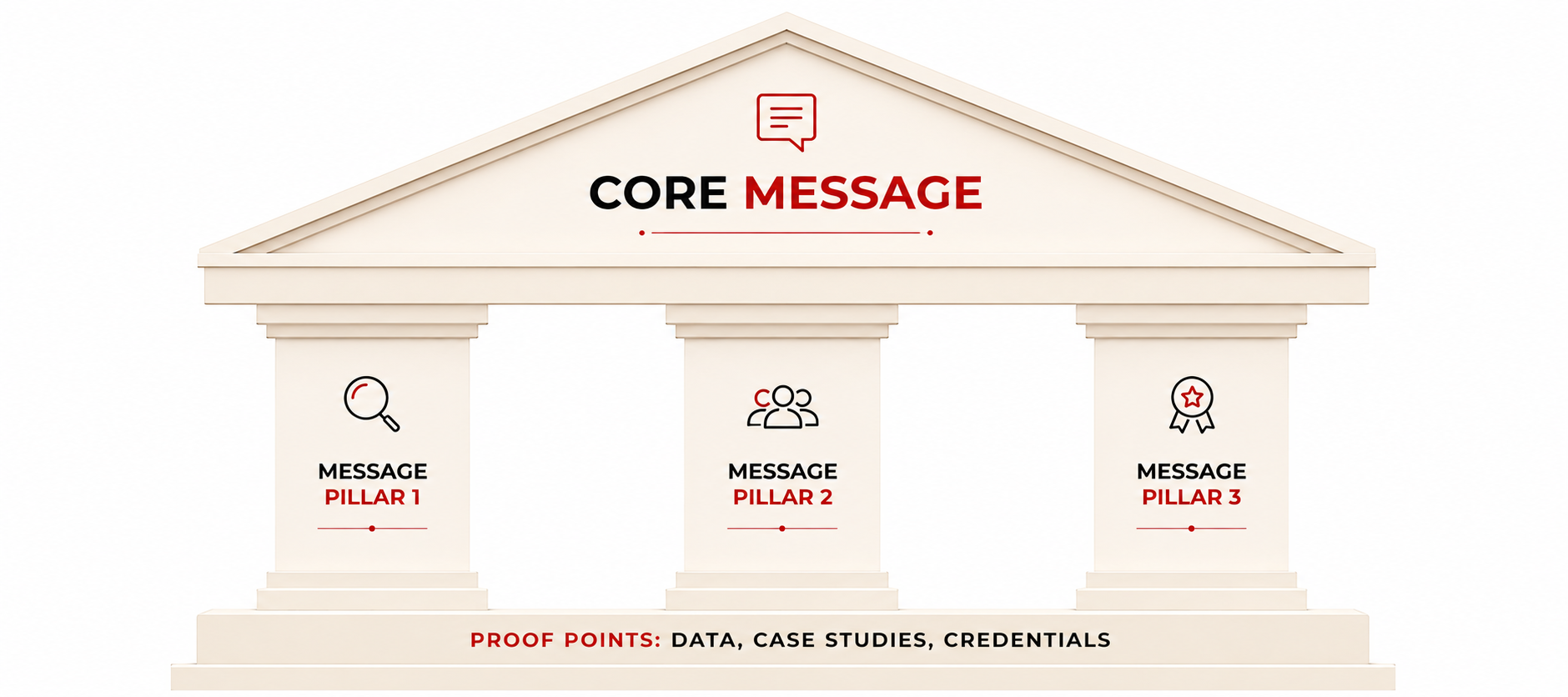
Three or four pillars is the working limit. No peer-reviewed research establishes how many messages an organisation can sustain, so treat that as accumulated practice, though the reasoning holds. A spokesperson who cannot recall the pillars under pressure will improvise, and improvised messaging is how architecture quietly stops existing.
For Indian businesses operating across regions, translation is not enough. With regional work approaching a quarter of Indian PR budgets, message architecture increasingly requires transcreation, meaning the pillars themselves are rebuilt for regional cultural context rather than rendered into another language. A proof point that persuades in Bengaluru may carry no weight in Indore, and translating it faithfully changes nothing about that.
For listed Indian companies, that migration is no longer optional.
Even without that obligation, every strategy needs four governance artefacts: an escalation matrix defining who is told what and when, spokesperson authorisation, an approval workflow with named holders rather than job titles, and a risk register.
No standard template exists for a reputation risk register, so most organisations adapt their enterprise risk matrix, scoring each vulnerability by likelihood and severity, then deciding which scenarios warrant a pre-drafted response. That decision is the useful output, because pre-drafting for everything is how the register becomes shelfware.
Two questions determine whether any of this happens. Indian PR retainers in 2026 fall into recognisable bands.
Six months is the standard minimum commitment, and it is not arbitrary lock-in. Reputation compounds, so a programme cut at three months produces outputs without ever reaching outcomes. Shorter engagements typically carry a 15% to 25% premium, which tells you what agencies make of them.
Carve out a measurement budget separately and protect it. Indian communications has a structural problem here: 92% of corporate communicators agree the industry needs a clear measurement standard, while only 46% allocate any dedicated budget to it. A strategy without a measurement line is one that will be defended on anecdote. The wider direction is encouraging though, with PR’s share of client marketing budgets rising from 10% to 17% in recent years.
A strategy is not a state of mind. When the build is complete you should hold five documents, and if any is missing, that part of the strategy does not exist.
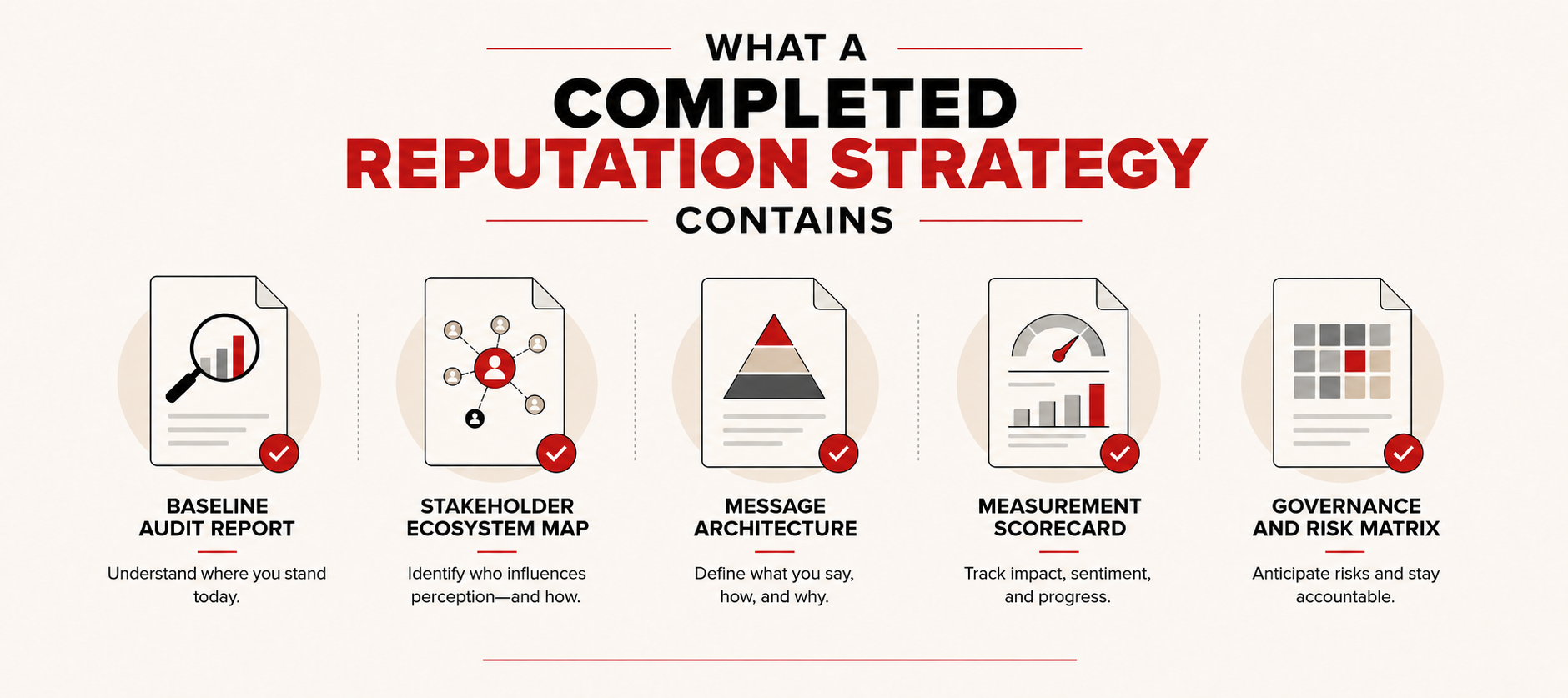
Baseline audit report. Search results, media sentiment, proxy metrics and competitor position, dated and recorded before any work began.
Stakeholder ecosystem map. The power-interest matrix, prioritised, with the influence relationships between groups marked.
Message architecture. Positioning statement, narrative framework and message house, with regional transcreation where relevant.
Measurement scorecard. SMART objectives, KPI definitions and the ROO formulas you will calculate against.
Governance and risk matrix. Escalation protocols, spokesperson authorisations, approval workflow and risk register.
PRCAI’s Client-Consultancy Partnership Charter is freely available and includes standardised RFP guidance and a client service toolkit. If you are about to appoint an agency, reading it first will materially improve the brief you write.
Execution failure is rarely tactical incompetence. The research points consistently at structural causes, and two dominate.
Measuring outputs and calling them outcomes. Teams count placements, reach and impressions, and never evaluate whether anything shifted. Share of voice remains the most-used metric in India at 84%, well ahead of any outcome measure, which shows how entrenched this is despite a decade of guidance saying otherwise.
Skipping formative evaluation. Rushing into tactics without a baseline makes causality impossible to demonstrate later. It is the same point as Step 1, worth repeating only because it is the most consequential shortcut available.
There is also a distinctly Indian pressure on continuity. The PR industry here runs roughly 20% annual attrition against talent development investment of about 1.5% of agency revenues, and reputation programmes depend on institutional memory. Ask about team continuity before committing to a multi-year programme. One honest gap: nobody publishes data on how many strategies are abandoned mid-execution, or why.
If the full sequence looks like more than you can take on, do the first step and stop. Open an incognito window, search your company name, and write down the top twenty results across desktop and mobile. That costs nothing and usually produces the strategy’s first real finding, which for most businesses is not that people are saying bad things. It is that the second result for their own name is a profile nobody has updated since 2019.
Everything in a reputation strategy is downstream of knowing where you actually stand. Build that first and the rest of the sequence has something to work from.
Want help building this properly?
At Bridgers, we run reputation audits and build strategies for Indian businesses across media, search and stakeholder perception. If you want a clear picture of where you stand before deciding what to change, that is where we would start too.
Get in touch with Bridgers
Six steps in sequence: establish a documented baseline through a reputation audit, map and prioritise your stakeholder ecosystem, set SMART objectives tied to organisational goals, build your message architecture, establish governance and escalation protocols, then begin execution and measurement. The order matters, because objectives cannot be measured without a baseline and messaging cannot be targeted without a stakeholder map.
A reputation audit documents where you currently stand so that later change can be attributed. It covers a search audit run in an incognito window across the top twenty results on desktop and mobile using at least three query types, perception proxies such as share of voice and sentiment, a benchmark against three or four direct competitors, and a look-back period of six to twelve months matched to your operating cycle. Outsourced in India it runs from roughly ₹25,000 with a freelance consultant to ₹3,00,000 or more with a large agency.
Monthly retainers in 2026 run from ₹25,000 to ₹60,000 for a freelance consultant, ₹60,000 to ₹1,50,000 for a boutique agency, ₹1,50,000 to ₹3,00,000 for a mid-tier agency, and ₹3,00,000 upward for large or specialist firms. Six months is the standard minimum commitment, and shorter engagements typically carry a 15% to 25% premium.
Return on Objective measures the percentage-point change in a non-financial objective against a documented baseline. The formula is the objective after activity minus the objective at baseline, so unprompted awareness moving from 20% to 35% is a ROO of 15 points. It is now used by 41% of Indian communicators, and only works if the baseline was recorded before the programme began.
Most Popular Blogs
Newsletter
Categories
About the author
Anubhav Singh: Founder & Managing Director, Bridgers
Anubhav Singh is the Founder and Managing Director of Bridgers, with over 15 years of experience in media relations and strategic corporate communications. He has worked with leading Indian brands across sectors and holds a degree in Mass Communication & Video Production along with an MBA in Marketing. Under his leadership, Bridgers has grown into one of India’s leading PR agencies, known for transparency, innovation, and quality.
Related Articles


