
What is crisis communication and why is it important?
25 May 2025

Somewhere right now, a potential customer is deciding whether to trust your company. They are not on your website, reading the copy you approved. They are looking at a review left eighteen months ago, a news article you never asked for, or a comment from somebody who used to work for you. By the time they speak to anyone at your business, the decision is largely made.
That judgment, formed almost entirely out of your sight, is your reputation. It also accounts for roughly 30% of the market value of a listed company, according to research cited by the International Public Relations Association. Very little else that determines so much of what a business is worth sits so far outside its direct control, and that gap is the subject of this guide.
Despite that, reputation management remains one of the least understood functions in Indian business. Ask ten owners what it means, and you will hear damage control, or a more expensive word for public relations, or paying somebody to push unflattering search results onto page two. Those answers are partial rather than wrong, and mistaking a part for the whole is why most companies only think seriously about reputation once it starts costing them something.
The definition that holds up is broader than any of them. Reputation is the aggregate judgment that customers, investors, employees, regulators and the public have formed about your company over time. You cannot issue a press release to change it, but you can influence what goes into it. This guide covers what reputation management actually is, why it now shows up in financial terms, how it forms differently in India, what the law here allows against damaging content, how to measure it, and where the honest limits sit.
Reputation management is the practice of deliberately shaping how your organisation is perceived by the people whose opinion affects your business, and protecting that perception under pressure. The definition only becomes useful once you separate reputation from two things it gets confused with.
Identity is what you project, meaning your logo, your messaging, your stated values and your website, all of which you control completely. Image is the immediate impression someone forms from that communication, which is external to you but still something you created. Someone who has seen a single advertisement already has an image of your brand.
Reputation is what people conclude after multiple encounters over time, filtered through what others told them, what they read, and what they experienced. The academic literature describes it as the enduring perception stakeholders hold, formed through repeated interaction rather than a single message.
That distinction is practical rather than academic, because each of the three moves at a different speed. You can change your identity in a week and shift your image within a quarter with enough spending behind it. Still, reputation moves on a scale of years, which is exactly why it is valuable and exactly why losing it hurts.
It also explains where reputation management sits relative to public relations. PR is one of several disciplines that build reputation, working alongside product quality, customer service, employee experience and corporate conduct, which makes reputation the outcome and PR one of the inputs feeding it. We unpack that relationship properly in our guide on reputation management versus PR.
Reputation was long treated as a soft concern that communications teams cared about and finance teams tolerated. That has changed, because it now has numbers attached in four distinct places.
That 30% figure is an aggregate across US and European listed companies rather than an India-specific measure, so treat it as directional. The direction holds regardless: a substantial portion of what a company is worth exists because of what people believe about it rather than what it owns.
A study of 383 BSE 500 companies covering 2011 to 2021 found that corporate reputation significantly moderates the effect of capital costs on firm performance, meaning well-regarded Indian firms are partly shielded from the damage expensive financing does to their results. International research across twenty countries points in the same direction. For a founder planning a fundraise or a listed company managing its borrowing, that is a line item rather than an abstraction.
Employer reputation is now a primary differentiator in Indian hiring rather than a tiebreaker, with Randstad's research placing the Tata Group, Google India and Infosys as the country's most attractive employers and finding job-switching intent rising among younger workers actively seeking employers they consider credible.
Among Indian consumers who shop on ecommerce apps, 60% say they are likely to buy more from apps with high-quality ratings, and 41% always check ratings before purchasing, which makes reputation a step inside the purchase funnel rather than a background influence.
How reputation works at the enterprise and listed-company level, including board responsibility and investor perception, is covered in our guide to corporate reputation.
Most reputation management advice is written for Western markets and assumes conditions that do not hold here, and four features of the Indian environment change how reputation is built. Ignoring them produces strategies that look sensible on paper and fail in practice.
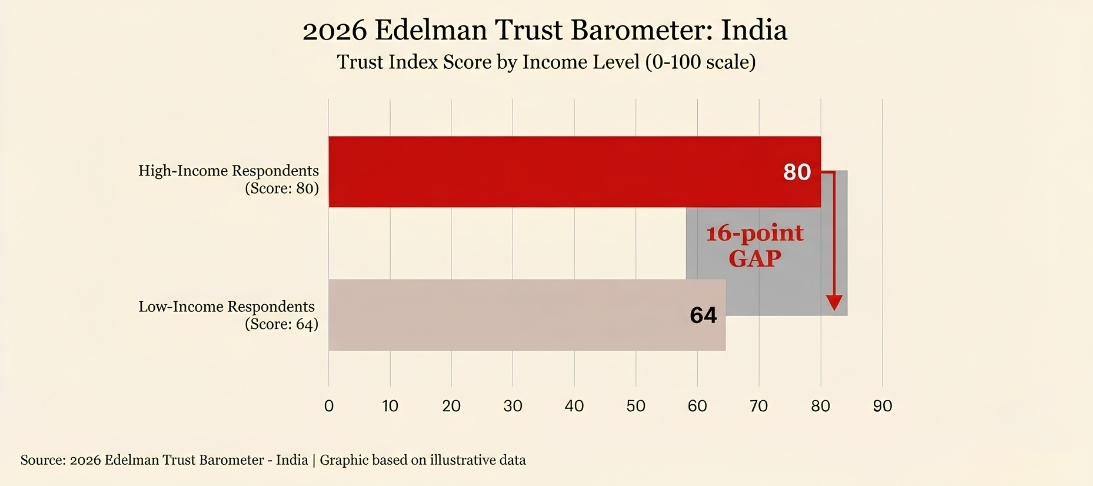
The 2026 Edelman Trust Barometer puts India's overall Trust Index at 74, which is strong by global standards. Underneath that number sits a 16-point gap between high-income respondents, who score 80, and low-income respondents, who score 64.
On specific measures, the gap widens considerably, with low-income Indians rating business institutions at 10 on net competence and 31 on net ethics against 32 and 55 from high-income respondents. A company reading only the national average is looking at a number that describes almost none of its customers. If your market spans income segments, as most Indian consumer businesses do, you are managing at least two reputations at once.
The same research found that 89% of Indian respondents trust companies headquartered in India. In comparison, only 37% of global respondents trust Indian-headquartered companies operating in their own markets, leaving a deficit of 52 points between how Indian business is seen at home and how it is seen abroad.
For a domestic business, that is a tailwind. For any Indian company expanding abroad, raising foreign capital, or selling to global enterprise buyers, it is a quantified problem that domestic standing does nothing to solve. The reputation you built in India does not travel with you.
This is the strangest finding in the Indian data, and the most useful. Among Indian ecommerce shoppers, 72% believe fake reviews are the norm, and 65% say they do not trust ratings on these sites. Yet 60% still say strong ratings make them more likely to buy.
Consumers know the system is manipulated and rely on it anyway because nothing better exists, which means volume is a weak signal to a sceptical audience while specificity is a strong one. A hundred generic five-star ratings persuade less than a dozen detailed reviews describing a real experience.
Dealing with negative and manipulated reviews is covered in online reputation management and handling negative press and reviews.
Regional and vernacular work has risen from 10% of Indian PR industry revenue three years ago to 19% in 2026, on a projected path to 25%, and nearly two-thirds of Indian communicators now name Tier 2 cities as their primary growth market.
At the same time, 48% of Indians show what Edelman calls an insular mindset, preferring to trust people who share their values and their media, which means reputation is steadily fragmenting into communities rather than forming nationally. A campaign that runs only in English reaches a narrower slice of the country every year, and whatever trust it builds does not transfer to the audiences it never spoke to.
Every reputation management strategy divides into two activities with different mindsets, timelines and often different people, and most businesses only think about the second, usually once it is too late for the first to help.
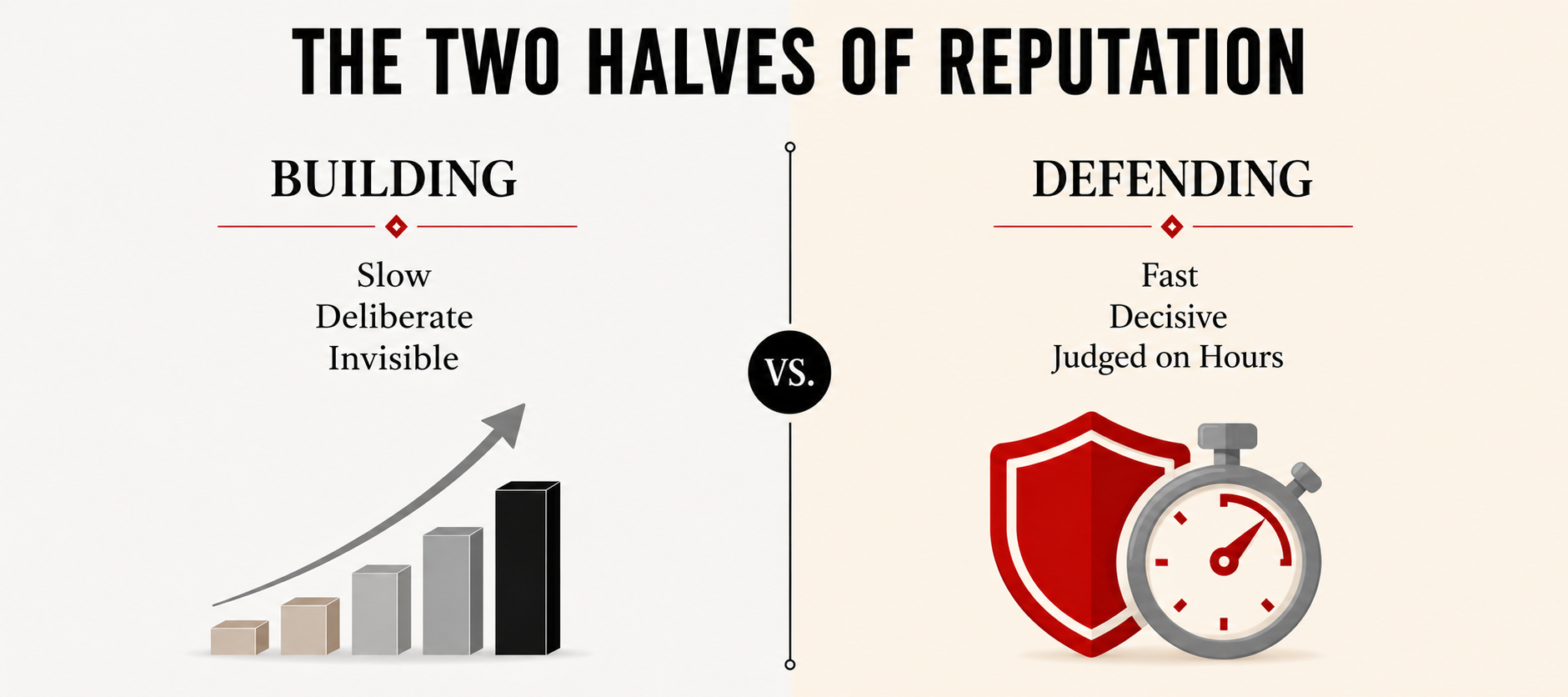
Reputation building means accumulating evidence, over years, that your company is competent, honest and worth dealing with, through consistent conduct, earned coverage, thought leadership that shows real expertise and customer outcomes that generate advocacy. None of it produces a visible result in the quarter you do it, and that is precisely why it works, because a reputation built in three months can be dismantled in three.
The Tata Group is the standing Indian example, with a reputation resting on decades of governance and community conduct rather than campaign activity, and a payoff that shows up as employer attractiveness and market resilience that competitors cannot buy their way into.
Defence is what happens when something goes wrong, and the variable that matters most is speed combined with honesty, as two recent Indian examples make clear.
When Zomato announced a green-uniformed fleet for vegetarian orders in March 2024, the backlash over caste implications and rider safety was immediate. The company reversed course within eleven hours, keeping the part of the feature that solved a genuine customer need and dropping the part that created the harm, and the whole crisis was effectively over within a day.
Ola Electric took the opposite path when comedian Kunal Kamra criticised the company’s servicing in late 2024, meeting the complaint with a combative response from the top rather than a corrective one. What began as a customer service issue turned into a national story about the company’s attitude, drew fresh scrutiny to systemic service failures, and fed into a falling share price. The original complaint was something the business could have absorbed easily, whereas the response to it was not.
The pattern is consistent enough to be treated as a rule, which is that defensiveness converts small problems into expensive ones. Our guide to protecting reputation during a crisis covers how to prepare before you need it, and how to build a reputation management strategy from scratch, which walks through the practical sequence if you are starting from nothing.
For most Indian businesses, reputation is now mediated by a search box, with customers, job candidates, journalists and investors all forming a first impression from the same set of results that none of them controls.
With India's internet user base passing 900 million, the first page of results for your company name has become your de facto reputation, combining your own properties with news coverage, review platforms, employer review sites and social content. Improving it is slow work: publishing credible material, earning genuine coverage and maintaining accurate profiles until the good outweighs the bad.
What reliably fails is any attempt at manipulation. Review gating, the practice of routing happy customers towards public review pages while diverting unhappy ones somewhere private, violates Google’s policies and can get your Business Profile suspended altogether, which is considerably worse than the reviews you were trying to avoid because it removes you from local search entirely.
The specifics are covered in our guide to Google reputation management.
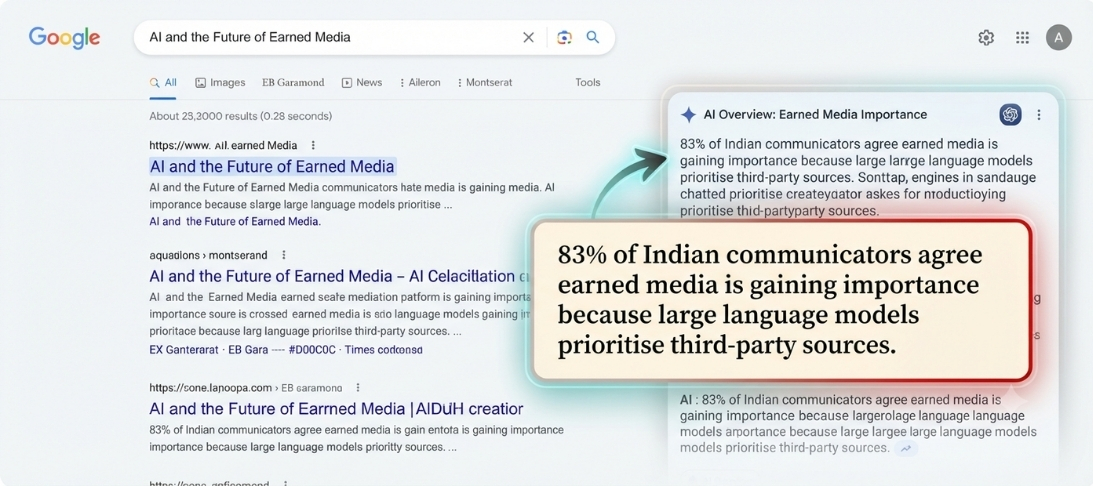
A growing share of first impressions now form inside AI assistants rather than search results, and when someone asks a chatbot about your company, the answer is synthesised from sources the model treats as authoritative, which skew heavily towards independent third-party coverage rather than your own website.
Indian communicators have already registered the shift, with 83% agreeing in the PRCAI SPRINT 2026 survey that earned media is gaining importance specifically because large language models prioritise third-party sources, and 70% now treat generative engine optimisation as a distinct strategy. The practical consequence is that earned coverage in credible publications has become more valuable rather than less, because it now feeds two discovery systems instead of one.
The same technology has created an entirely new category of risk. In 2024, deepfaked audio and video of Mukesh Ambani and N. R. Narayana Murthy were used to promote fraudulent investment schemes, with neither man having said any of it, and both having their credibility borrowed without consent.
Reported incidents of fake news affecting Indian corporate communications nearly doubled between 2024-25 and 2025-26, rising from 28% to 46%, and 80% of communicators now flag AI-generated misinformation as a top risk. If your founder is publicly visible, and in India, that is increasingly the whole point, this needs an active monitoring plan rather than a hope.
Managing an individual leader's public reputation is covered in personal reputation management for founders and CEOs.
Most reputation management advice skips the legal question entirely, which leaves businesses guessing when something false or damaging appears. The Indian position has shifted significantly in the past two years.
The honest summary is that Indian law gives you real recourse against falsehood and synthetic media, and very little against criticism you simply dislike. That distinction is worth understanding before you instruct a lawyer, because the second kind of action tends to create the story it was meant to suppress.
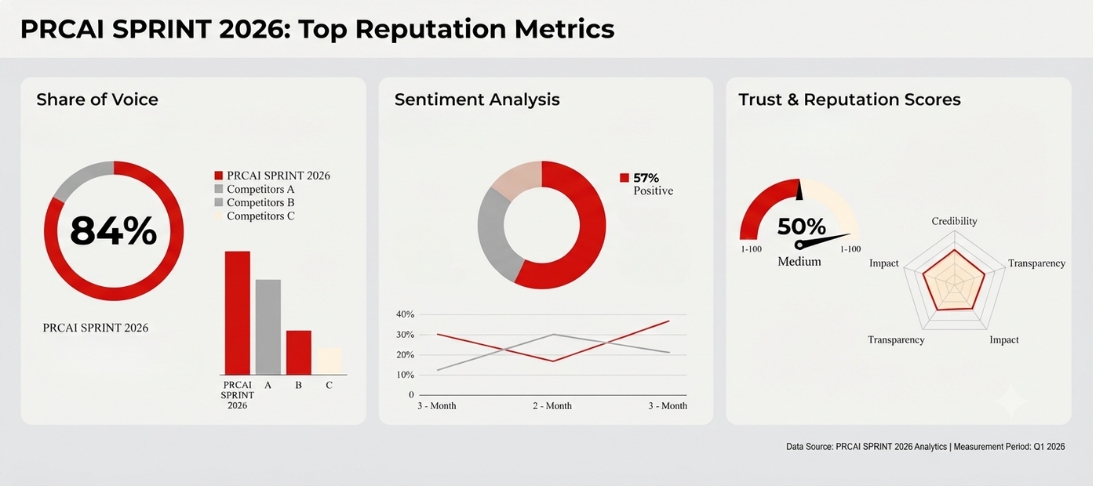
The metrics themselves are improving even where the budgets are not, with output measures still dominant but outcome measures gaining ground quickly. The table below sets out what each one tells you and where each falls short.
One structural point from the RepTrak framework is worth carrying into any measurement work, which is that emotional connection drives behaviour. Where people do not feel favourably towards a company, strong scores on competence and performance do not rescue the commercial outcomes, because being respected is not the same as being recommended. Our guide to measuring reputation goes deeper into frameworks and tools.
The industry rarely writes this section, and that omission is why expectations around reputation work are so often wrong.
It cannot substitute for conduct. LG Polymers had a communications problem in May 2020, only because it had an industrial safety problem first, and no messaging could close that gap once footage emerged of directors acknowledging operational lapses. Byju’s spent heavily on visibility while leaving governance and customer complaints unaddressed, and that visibility eventually amplified the criticism rather than offsetting it. Reputation management amplifies whatever reality already exists rather than replacing it with a better one.
It cannot survive being caught manufacturing itself. Two-thirds of Indian corporate communicators, 66%, now say presenting paid content as earned media is actively damaging audience trust. The tactic works until it is noticed, then damages the credibility it was meant to build.
It cannot suppress its way out of a problem. Consumers already assume suppression is happening, with 59% of Indian online shoppers reporting that a negative review of theirs was blocked or never published in the past year, and 80% wanting review standards made mandatory. Against an audience that already expects manipulation, suppression is never a neutral act, and once it is detected, it tends to become the story itself.
It cannot move quickly in the direction you want. Reputation is lost in a day and rebuilt over the years. Adani Enterprises regained ground over roughly fourteen to twenty-six months as investigations concluded counts as fast, given the scale of the damage. Most businesses do not have that balance sheet to fall back on.
Reputation management is not a single programme, and what a seed-stage startup needs has almost nothing in common with what a listed mid-cap needs. The useful question is therefore not what the discipline involves in general, but which part of it applies to your business right now.
Stage-specific guidance is covered in reputation management for startups, reputation management for D2C and consumer brands, and thought leadership as a reputation-building tool.
The uncomfortable asymmetry at the centre of this subject is that reputation takes years to build and can be revalued in an afternoon, and that is as true for a small business as it is for a listed conglomerate.
What the Indian data makes clear is that this is no longer a concern sitting at the edge of the business, because it affects what capital costs you, who accepts your job offers, whether a customer completes a purchase, and how an AI system describes you to somebody who has never heard your name. Those are business outcomes being decided by perceptions that most companies are not actively managing. The organisations that handle this well are rarely the loudest ones, but the ones that behaved consistently for long enough that the reputation formed on its own, and that were ready when it came under pressure.
You cannot control your reputation, but you can decide whether you are shaping it deliberately or discovering it by accident.
Want to understand where your reputation actually stands?
At Bridgers, we work with Indian businesses to build and protect reputation across media, search and stakeholder perception, starting with an honest read of what people currently find, believe and say about you and a clear view of which parts are worth changing first.
Reputation management is the practice of deliberately shaping how your organisation is perceived by customers, investors, employees, regulators and the public, and protecting that perception when it comes under pressure. It covers both proactive building through conduct, earned media and thought leadership and reactive defence during a crisis.
Four conditions set the Indian market apart from the ones most reputation advice is written for. National trust scores are high but conceal a 16-point gap between high and low income groups. Indian consumers trust Indian companies at 89%, while global respondents trust the same companies abroad at only 37%. Consumers here largely distrust online reviews yet continue to rely on them when deciding what to buy. And reputation is shifting steadily towards regional and vernacular media, which has grown from 10% to 19% of Indian PR industry revenue in three years.
Most Popular Blogs
Newsletter
Categories
About the author
Anubhav Singh: Founder & Managing Director, Bridgers
Anubhav Singh is the Founder and Managing Director of Bridgers, with over 15 years of experience in media relations and strategic corporate communications. He has worked with leading Indian brands across sectors and holds a degree in Mass Communication & Video Production along with an MBA in Marketing. Under his leadership, Bridgers has grown into one of India’s leading PR agencies, known for transparency, innovation, and quality.
Related Articles


