What is crisis communication and why is it important?
25 May 2025

In 2024, the 127-year-old Godrej conglomerate did something Indian family businesses rarely manage cleanly: it split a multi-lakh-crore empire between two branches of the family, and nothing bad happened. Share prices across all five listed entities stayed stable. The Competition Commission of India approved it quickly. Proxy advisors, who make a living finding things to criticise, praised the process instead.
Nothing about that outcome was accidental, and we return to exactly how they managed it later in this piece, alongside a very different outcome at another well-known Indian company facing a similar kind of moment. For now, the point is simpler: the people who noticed and rewarded Godrej’s discipline were not customers. They were regulators, institutional investors and the analysts who cover the stock.
That is what this article is about: how corporate reputation actually works once the audience shifts from consumers to institutions. Our complete guide to reputation management covers reputation broadly. This piece is narrower: who the institutional judges are, what the law now requires of an Indian board, how promoter-led companies handle this differently, and how boards measure it.
Consumer reputation and corporate reputation are often treated as the same thing measured at different scales. They are not. They are judged by different audiences using different evidence, and a company can hold one while badly damaging the other.
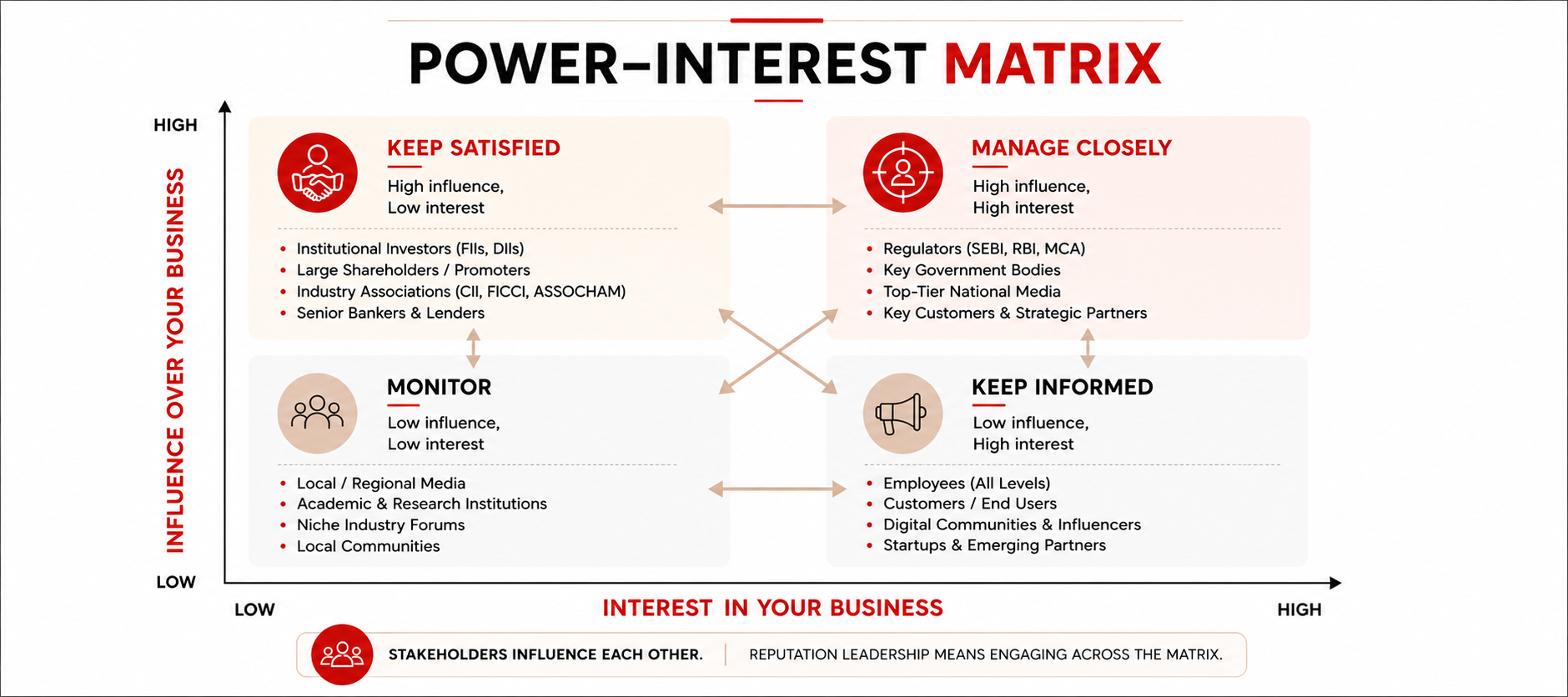
A viral product complaint can dent a quarter’s sales and recover within weeks. A governance failure works differently. It can trigger a rating downgrade, raise the cost of borrowing, and erase market value overnight, without a single unhappy customer. That is the enterprise lens: reputation as a balance-sheet asset, not a marketing metric.
A retail customer judges a company on price and experience. The audiences that decide corporate reputation judge it on trustworthiness as a counterparty, and in India that group is specific and identifiable.
SEBI and its disclosure machinery, which treats reputation risk as a formal, board-level compliance category.
Credit rating agencies such as CRISIL, ICRA and CARE, which build governance quality directly into their rating models.
Institutional investors including mutual funds, insurance companies and pension funds, who read governance disclosures before they read a press release.
Proxy advisory firms such as IiAS and SES, whose voting recommendations shape how institutional shareholders act at every AGM.
An institutional investor evaluating a BSE 500 company looks at audit committee independence and related-party transparency well before a marketing campaign enters the picture. That is because these signals predict whether a governance failure is coming, and governance failures move share prices fastest.
For a listed Indian company, reputation is no longer something the communications team owns informally. It is a documented legal responsibility of the board.
Under SEBI’s LODR Schedule II Part D, the Risk Management Committee must monitor named risk categories, and reputation risk sits explicitly among them. V-Mart Retail’s board risk matrix names it directly, with escalation straight to the board. IndiGo’s framework does the same for operational failures, and JSW Infrastructure links reputation directly to cost of capital, naming weak governance as a barrier to green and investor funding.
The Institute of Company Secretaries of India puts it more plainly: maintaining a reputation stakeholders can be proud of is a fiduciary duty of the board, and directors can carry personal liability for failing at it.
Related-party transactions are where Indian boards most often lose institutional trust. Under Regulation 23(2), only independent audit committee directors can approve one, and deals above 2% of turnover or ₹50 lakh face heavy scrutiny, because a promoter quietly directing value to a connected entity is one of the fastest ways to destroy confidence.
Shareholder voting looks, at first glance, like proof that Indian boards face little accountability. Of 4,840 resolutions put to NIFTY 500 companies in 2025, only 24 were defeated. That number is close to meaningless on its own.
Kotak’s fall is the clearest single-day example, but it is not isolated. Two more recent cases show the same pattern: a governance failure at board level, followed swiftly by a financial consequence that has nothing to do with the product.
Paytm Payments Bank is the starkest of the two. The RBI ordered it wound up in 2024 after years of unresolved KYC and anti-money-laundering gaps the board had failed to close despite repeated warnings, eventually replacing the board’s authority with an official liquidator. The parent, One97 Communications, took an immediate credit rating hit. Hyper-growth had not compensated for compliance failure, and the market treated the two as entirely separate questions.
The Zee Entertainment and Sony merger shows the same dynamic inside a deal rather than a business unit. The $10 billion combination collapsed in 2024 after Sony’s due diligence ran into SEBI’s investigation of Zee’s promoters over alleged fund diversion, and CARE Ratings placed Zee on credit watch with negative implications soon after. Zee’s consumer dominance was never in question. Its governance was, and that decided the outcome.
None of these companies had a customer-facing crisis. All had a board-level one, and in each case the financial market moved before the consumer market noticed anything was wrong.
Until recently, ESG disclosure functioned mainly as reputation-building content, a sustainability report companies used to look good. SEBI’s BRSR Core framework has converted it into something closer to a financial audit.
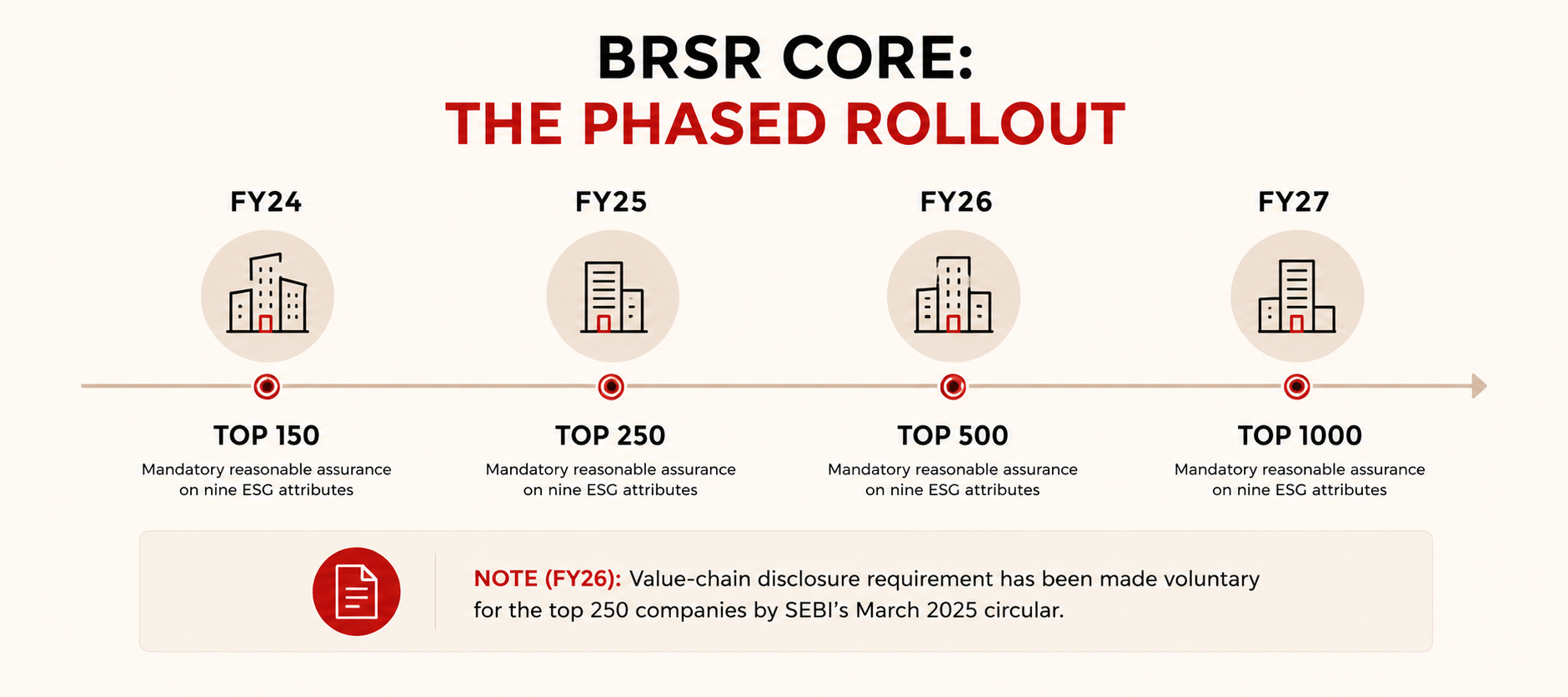
The nine core BRSR attributes now require “reasonable assurance,” the rigour applied to financial statements. Every data point must trace to a source document, so a company can no longer publish a favourable emissions number without showing where it came from. Failing that can mean losing a spot in a large buyer’s supply chain or facing exposure under carbon border rules.
SEBI eased one part of this in March 2025, making value-chain disclosure voluntary for the top 250 entities. Many consultants are still working from the stricter 2023 rule and over-investing in audits not yet required. Knowing the current version is a small competitive advantage on its own.
India’s corporate landscape looks structurally different from most Western markets, and that changes how reputation works here. The country’s top 300 family-run businesses were worth roughly ₹138 lakh crore in 2026, comparable to the world’s eighteenth-largest economy, and 70% are now run by a second generation or later.
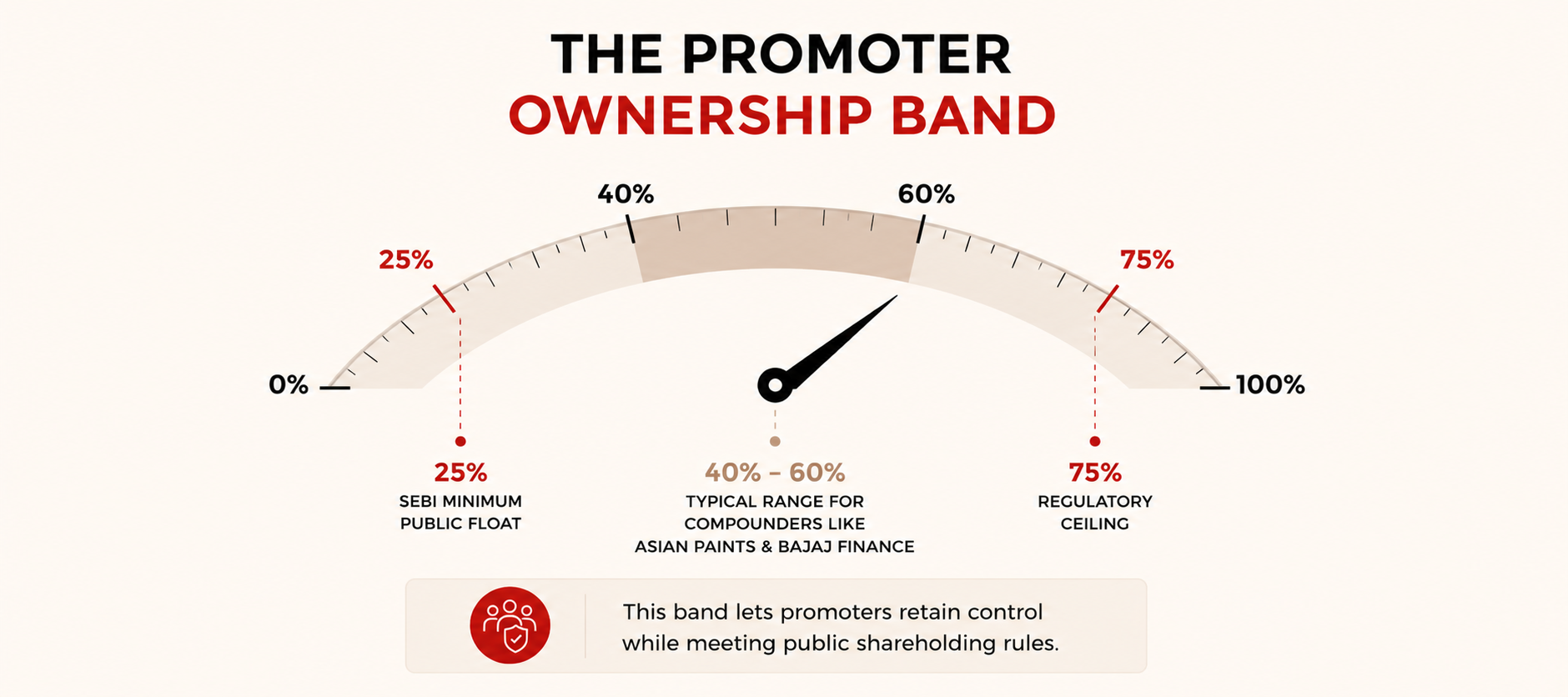
Listing rules cap promoter holding at 75% and require at least 25% public float. Family-run compounders typically cluster between 40% and 60%, comfortably enough to outvote institutional dissent while satisfying the public shareholding rule. In the BSE 100, executive chairperson roles are held by 25 promoters against only 15 professional appointees, so the preference for a family member at the top has not faded.
This creates a genuine structural difference in how reputation risk behaves. In an institutionally governed company such as HDFC Bank or Larsen & Toubro, where promoter holding is effectively zero, a crisis is usually attributable to management and the board can remove a CEO to contain the damage. In a promoter-led company such as Reliance, Adani or Godrej, the promoter often is the reputation, and a personal or family issue can bypass every safeguard the company has built. Two recent Indian cases show both directions this can take.
The mechanism behind the calm outcome mentioned earlier was a formal Family Settlement Agreement, worth roughly ₹2.4 lakh crore, paired with a Brand and Non-Compete Agreement that clearly separated which businesses each branch of the family would keep for the next six years. That is what let the CCI wave it through as a routine reorganisation rather than a contested restructuring. The family treated a deeply personal decision as a governance exercise with legal documentation, not a private matter that happened to involve a public company.
Around the same period, a public dispute involving Raymond’s CMD Gautam Singhania and fellow board member Nawaz Modi escalated into allegations of assault and misuse of company funds. IiAS published an open letter demanding Raymond’s independent directors investigate and consider asking both parties to step back during the inquiry. The board’s prolonged silence, not the dispute itself, is what the market punished: the stock fell more than 16% over ten trading days despite no change in underlying financial performance.
Godrej treated a personal matter as something the board needed to formally manage. Raymond’s board, by staying quiet, let a personal matter become a governance failure in its own right. Founder and CEO reputation specifically is covered in our guide to personal reputation management for founders and CEOs.
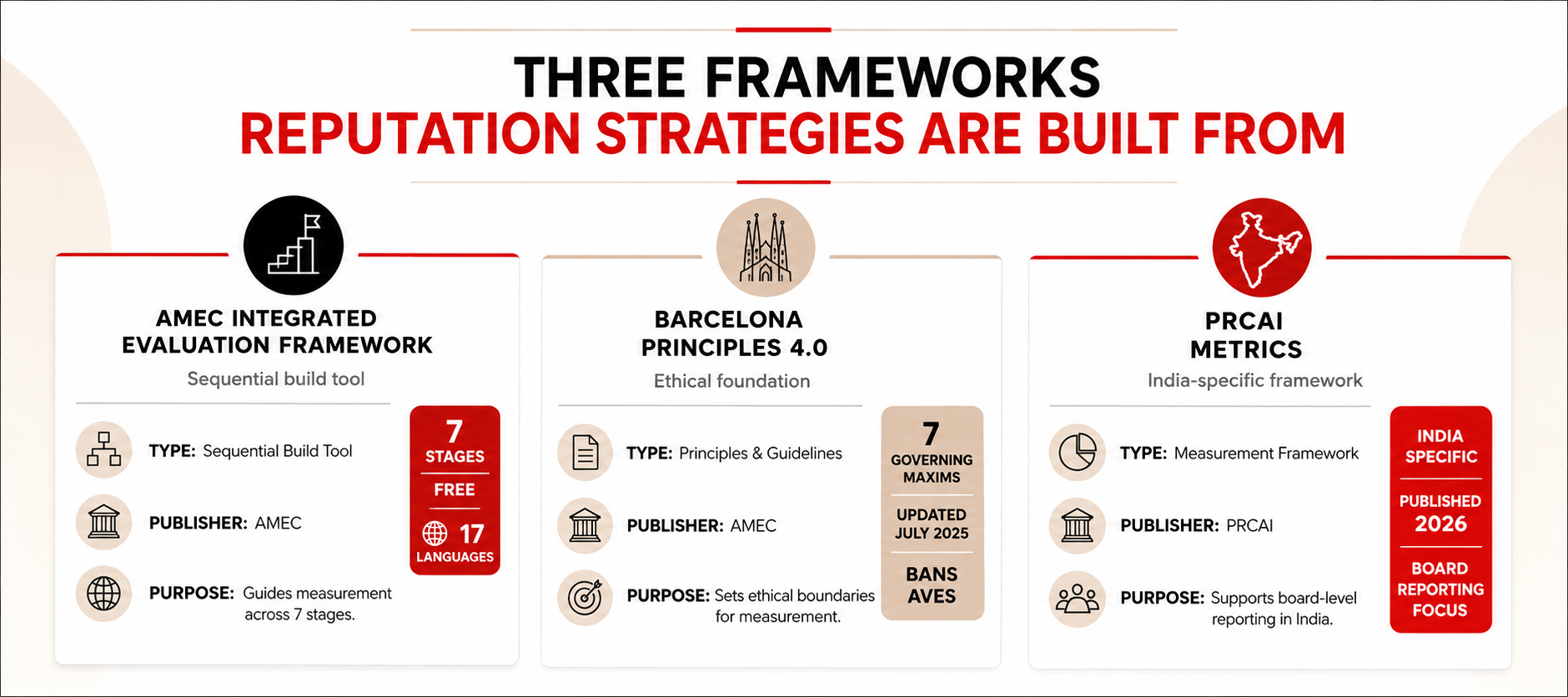
Public relations teams track share of voice and sentiment. Boards and institutional investors use a different instrument, and it is worth knowing it exists.

Jointly developed by the IFC, BSE and IiAS, the Corporate Governance Scorecard assesses BSE 100 companies across four equally weighted pillars. The 2025 edition put the median score at 63 out of 100, up from 61 the year before, and a score of 75 or above earns a place in the “Leadership” category. Infosys, Tata Power and HDFC Life have all issued press releases specifically to publicise their inclusion in it.
One caveat matters: IiAS states plainly that a high governance score measures resilience, not performance. It tells an investor a sudden collapse is less likely, but says nothing about whether the stock will outperform. A company can score well and still take a consumer-facing hit on social media while retaining full institutional confidence, because its disclosures and board independence remain intact. That is the clearest illustration of how separate these two reputations really are.
Everything above scales down even before the formal machinery applies, since the moment outside capital enters a business, similar questions start getting asked.
Angel investors and venture funds increasingly ask who sits on the board, how related-party dealings are handled, and whether a founder’s personal conduct could become the company’s problem. Building those habits early is cheaper than retrofitting them under a SEBI deadline. Our guide to building a reputation management strategy from scratch covers how to sequence that work.
A product problem is a business problem. A governance problem is a trust problem, and trust is what institutional capital is actually pricing when it decides what your company is worth.
Want an honest read on where your governance and reputation stand?
At Bridgers, we work with Indian companies on the disclosure and stakeholder communication that sits alongside formal governance, particularly through funding rounds, leadership transitions and periods of investor scrutiny.
Get in touch with Bridgers
Corporate reputation management is the practice of building and protecting how a company is perceived by regulators, credit rating agencies, institutional investors and proxy advisors, as distinct from how it is perceived by consumers. It centres on governance quality, disclosure and board independence, because these are the signals institutional stakeholders use to judge whether a company can be trusted as a counterparty.
Brand reputation is judged by consumers on product quality and experience, and measured through tools like Net Promoter Score. Corporate reputation is judged by regulators and institutional investors on governance and compliance, and measured through credit ratings and governance scorecards. A company can hold strong brand reputation while facing a serious corporate reputation problem, and the reverse is equally possible.
The most authoritative instrument is the Corporate Governance Scorecard, jointly developed by the IFC, BSE and IiAS, which assesses BSE 100 companies across four equally weighted pillars: shareholder rights, stakeholder sustainability, disclosures, and board responsibilities. The 2025 median score was 63 out of 100, and a score of 75 or above places a company in the Leadership category. This is entirely separate from consumer sentiment tracking.
BRSR Core is SEBI’s framework requiring reasonable, audit-grade assurance on nine ESG metrics, phased in by company size from the top 150 in FY24 to the top 1,000 by FY27. It matters for reputation because it removes the ability to make unverified ESG claims. Data on emissions, water and wages must trace back to source documents, converting ESG from a reputation narrative into a compliance obligation.
Indian listing rules cap promoter shareholding at 75% and require a 25% public float, and family-run companies typically cluster between 40% and 60%, enough to outvote institutional dissent on most resolutions. This means a promoter’s personal reputation and the company’s corporate reputation are often functionally inseparable. In an institutionally governed company, a crisis is usually attributed to management and contained by removing an executive. In a promoter-led company, a personal issue can bypass governance entirely, as seen in the contrasting outcomes at Godrej and Raymond.
Most Popular Blogs
Newsletter
Categories
About the author
Anubhav Singh: Founder & Managing Director, Bridgers
Anubhav Singh is the Founder and Managing Director of Bridgers, with over 15 years of experience in media relations and strategic corporate communications. He has worked with leading Indian brands across sectors and holds a degree in Mass Communication & Video Production along with an MBA in Marketing. Under his leadership, Bridgers has grown into one of India’s leading PR agencies, known for transparency, innovation, and quality.
Related Articles


