
What is crisis communication and why is it important?
25 May 2025


TL;DR: Most founders treat PR like a marketing campaign. It is not. PR is a long-term strategy for earning credibility, and the biggest mistake beginners make is jumping to tactics before they have a clear narrative, a target audience, and a goal. This guide walks through everything: the three questions that anchor every PR strategy, how to choose the right PR services for where your business is right now, a phase-by-phase action plan to get started, and what good PR ROI actually looks like over time. If you have been putting off building a PR strategy because it felt too complicated, it is simpler than you think.
Most founders approach PR the way they approach a performance marketing campaign. They want to know the cost, the expected output, and the timeline to results. When PR does not answer those questions the same way a Google ad does, many conclude it simply does not work for them.
That is rarely a PR problem. It is almost always a strategy problem.
A PR strategy is a clear plan for how your brand will earn credibility with the people who matter to it, consistently over time. Without that plan, every PR activity becomes a one-off effort with no compounding effect. With it, each piece of coverage, each spokesperson placement, and each thought leadership article builds on the last. If you are still getting clear on what public relations is and how it differs from marketing, start with our complete guide to public relations first. Come back here when you are ready to build.
The most common mistake is treating PR as a campaign rather than a programme. A campaign has a start date, an end date, and a specific output. A PR programme has a direction, a narrative, and a long-term goal. Campaign sprint. Program build.
Three specific patterns come up repeatedly with first-time PR builders:
Showing up only for big moments. A product launch, a funding announcement, a new hire, then silence for months. The relationships a PR team maintains when they are not pitching are exactly what make journalists respond when you actually have news. Sporadic activity does not build credibility. Consistent presence does.
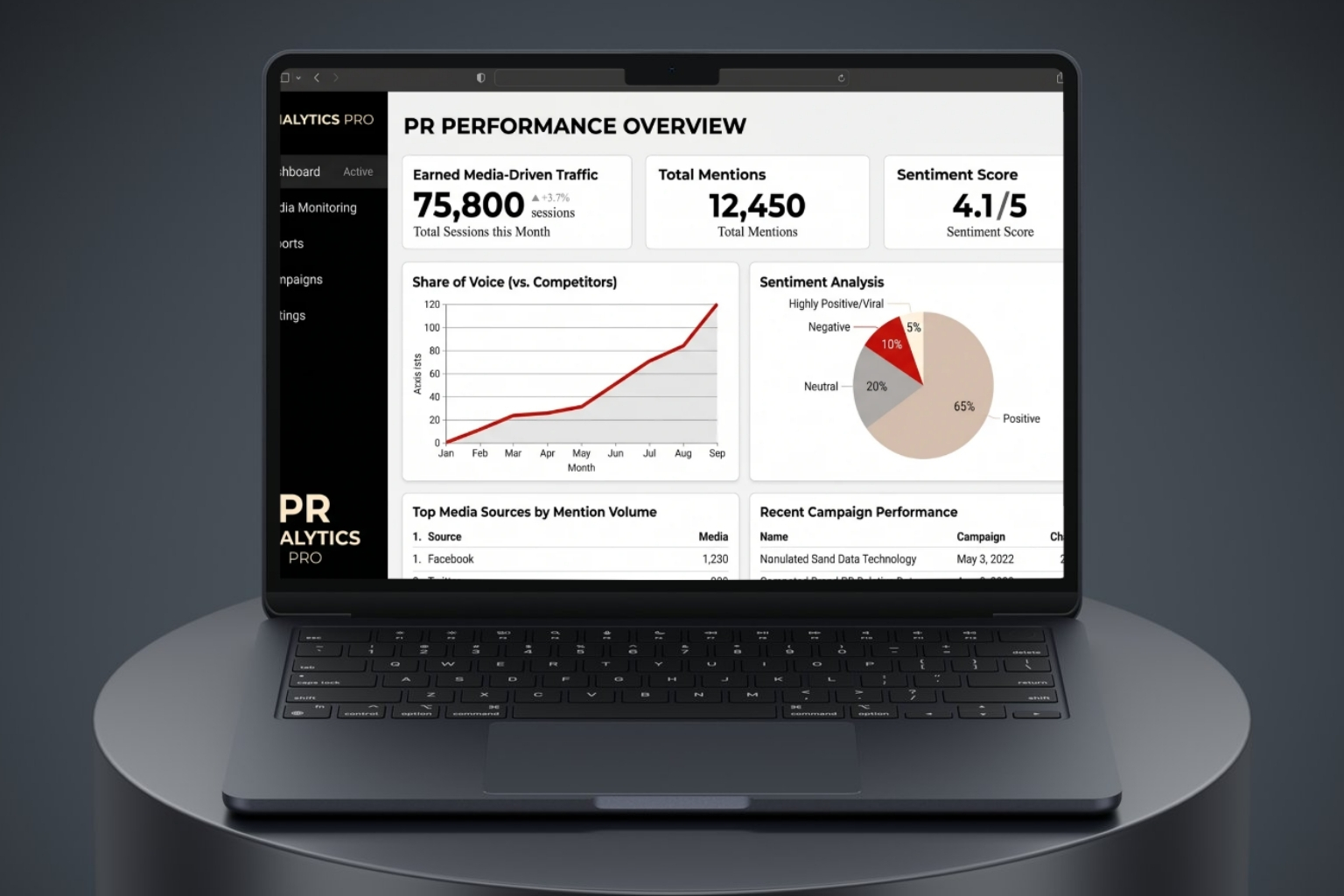
Measuring PR against performance marketing metrics. PR does not produce a cost-per-click or a 30-day ROAS. Its value is credibility, and credibility compounds over time. Judging PR on short-term numbers is like judging a foundation by how little of the building it shows.
Choosing tactics before defining goals. Most beginners jump straight to which publications they want to appear in before they have answered what they want people to believe about the brand. Tactics without strategy produce activity without direction.
A 2025 report by Cision found that 81% of communications leaders felt their biggest challenge was being too reactive rather than proactive. For a business just starting its PR journey, this problem is even more pronounced. Without a strategy in place, you will always be reacting to opportunities rather than creating them.
Before you think about a PR agency, a publication list, or a press release, answer these three questions. They form the foundation of everything that follows.
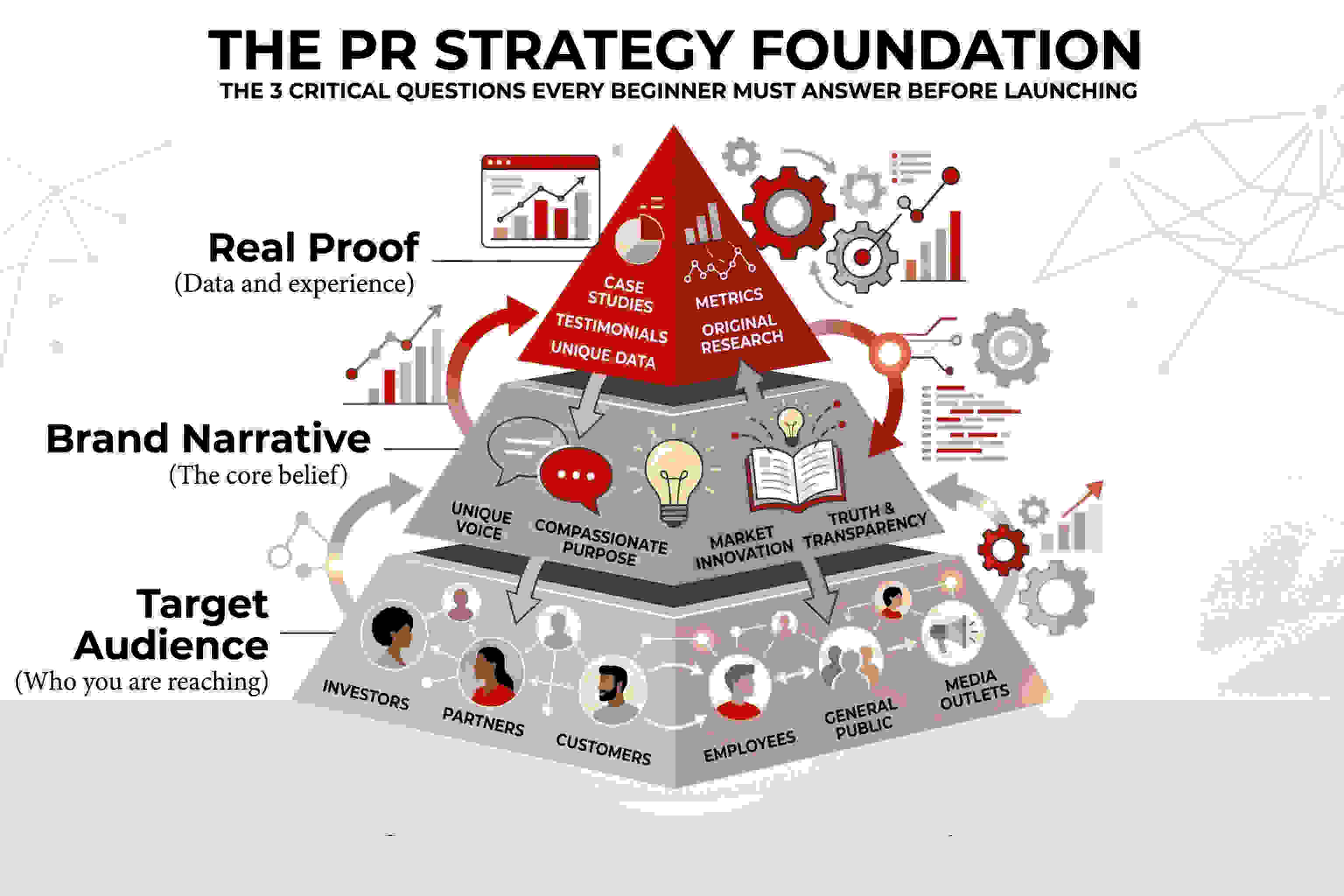
Not a general customer profile. Specifically, which audience are you trying to build credibility with right now? Potential customers, investors, talent, or partners? Each group reads different publications, trusts different voices, and responds to different stories. A PR strategy that tries to reach all of them at once, especially at an early stage, tends to reach none of them well. Pick the one audience that matters most to your business in the next six months and build around them.
This is not your tagline. It is a specific, honest belief you want to plant in your target audience’s mind. For example: “This company understands the Indian debt resolution space better than anyone else.” Or: “This manufacturer has been thinking about architectural innovation longer than most people in the industry.” That belief is your narrative anchor. Every PR activity, every placement, every spokesperson quote, should reinforce it. If an activity does not connect back to that anchor, it is probably not worth pursuing.
PR earns credibility through third-party validation. That validation has to rest on something real. What data does your business have? What experience? What perspective is genuinely yours and not available from a competitor? Competitors can match your product features and your pricing. They cannot replicate your specific experience, your original point of view, or the story behind why the business was built. That is the raw material of a PR narrative that holds up over time.
The first thing we ask a new client at Bridgers is not “what do you want from PR?” It is “What is your business trying to achieve in the next six to twelve months?” The answer to that question determines everything else.
There is no universal PR strategy. What works for a seed-stage fintech founder is not what works for a Series B D2C brand. The right PR services for your business depend on two things: where you are right now, and what you are trying to build next. Here is how to think through both.
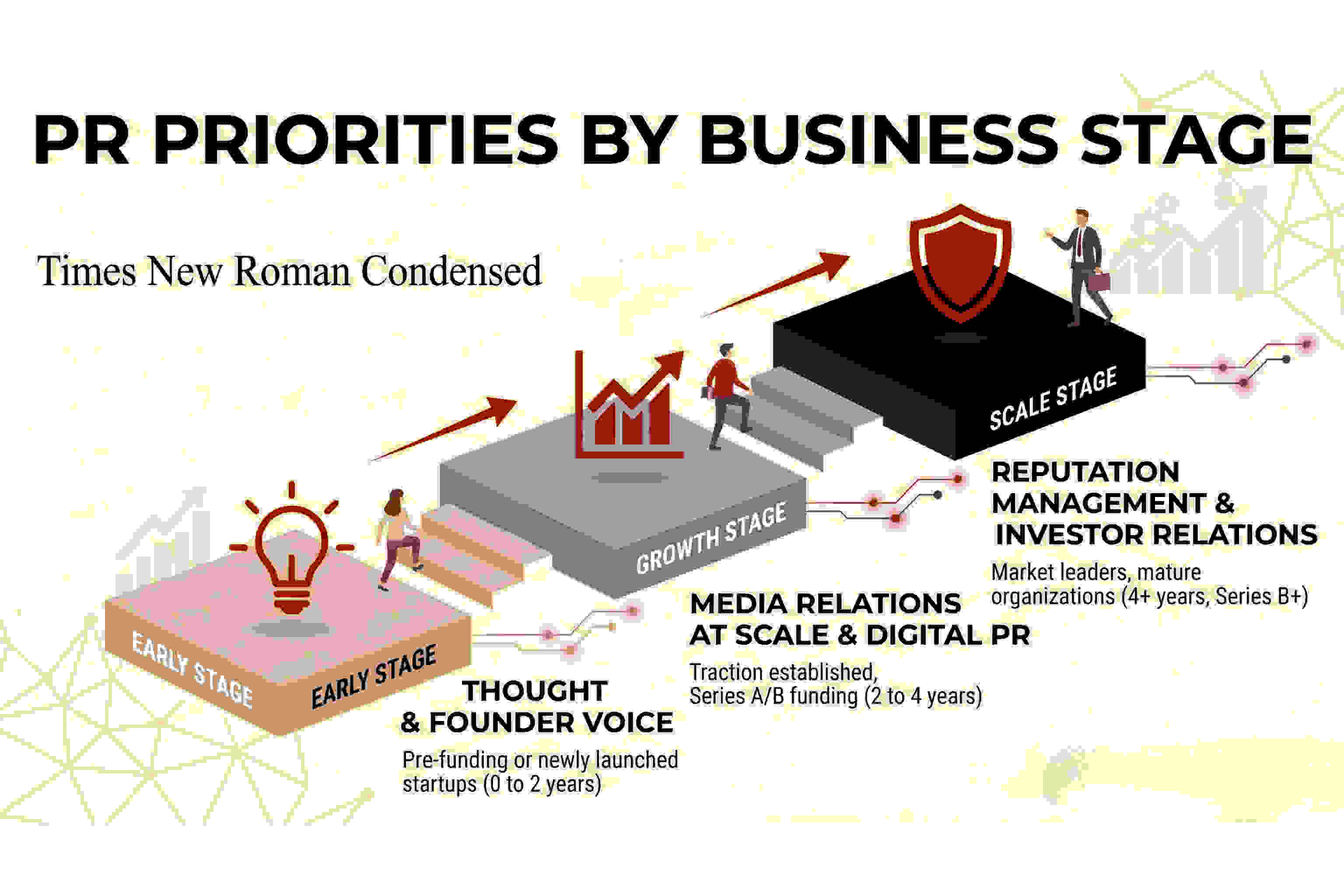
Your stage tells you the foundation. Your immediate goal tells you which PR service to prioritise within that foundation.
For most businesses starting, the right move is one goal, one audience, and one PR service done well for six months. Trying to run five PR tracks simultaneously without the infrastructure to support them produces diluted results across all of them.
Some businesses do not slot easily into a sector, and we see this pattern often at Bridgers. A company that helps individuals resolve debt disputes is not a bank, not a law firm, and not a financial product. An architectural materials manufacturer is not a construction company and not a consumer brand. Standard PR approaches that rely on sector-specific media and product-led narratives often do not work for these businesses.
For brands in this position, the most effective starting point is identifying the larger conversation your brand legitimately belongs to and earning your place in it through thought leadership and spokesperson visibility. When your brand cannot be described in a sentence, PR’s job is to build that description in the public mind over time.
Most businesses reverse this. They compile a list of publications they want to appear in, then figure out what to say. The result is a pitch that sounds like it was written for the publication rather than by someone with something genuinely worth saying. Your narrative comes first. Here is how to construct it.
“We help businesses manage their financial communication” is industry language. “We help companies tell a clear story to investors even when the numbers are complicated” is audience language. One of those will resonate with a journalist covering the business beat. The other will not. State the problem your brand exists to solve in the language your target audience actually uses, not the language your industry defaults to.
This is not a list of credentials. It is the specific reason a journalist should come to your spokesperson rather than to someone else when writing about this topic. Your track record, your original data, your unique experience, your ground-level perspective on something the industry has not yet acknowledged publicly. The more specific this is, the more it earns coverage.
No brand exists in isolation. What is the industry trend, regulatory shift, or market development that makes your story timely and relevant right now? PR works best when your brand narrative connects to a conversation that is already happening. You are not creating the conversation from scratch. You are positioning yourself as the credible voice within it.
The ROI question is the one every founder asks early, and every PR professional is asked to answer clearly. Here is the honest version.
PR ROI is not a number you calculate in week four. It is a pattern you recognise over six to twelve months. These are the signs it is working:
Investors mention they read about your company or founder before a meeting.
Enterprise prospects say they have heard of your brand before the sales call starts.
Journalists contact your team for comment rather than your team always initiating.
Organic search rankings improve as coverage generates backlinks to your website.
Strong candidates mention your media presence when accepting a job offer.
For a full framework on how to track PR metrics, set meaningful KPIs, and connect coverage to business outcomes, see our PR metrics and measurement guide. [internal link]
Consistency.
The businesses that build lasting credibility treat PR as a continuous function, not something that switches on for a product launch and off when things get busy. They stay present in their sector’s conversations, contribute a genuine point of view, and build journalist and audience relationships before they need them. When the big moment comes, they are already known.
A PR partner who shows up for your brand consistently will always outperform one who surges around launches and disappears otherwise. This is true regardless of budget. Sustained, focused PR effort over six to twelve months will produce more compounding credibility than sporadic bursts of high activity ever will.
A PR strategy does not require a large budget, a big team, or an existing media profile. It requires clarity about who you are trying to reach, what you want them to believe, and the discipline to stay committed to that goal over time.
The founders who build the strongest brands in India’s startup ecosystem are not the ones with the most press releases. They are the ones who got their narrative right early, chose the right PR services for their stage, and kept showing up long after most of their competitors had gone quiet.
The strategy is the starting point. Execution is what turns it into a reputation.
Ready to build a PR strategy that actually works for your business?
At Bridgers, we work with founders and growing businesses to build communication strategies that earn the right attention, in the right places, over the long term. We have helped brands that do not fit neat categories find their narrative, place their leadership in the publications that matter to their audience, and build the kind of credibility that compounds.
If you want to understand what a PR strategy looks like for your specific business, we would be glad to talk. Get in touch with Bridgers.
A PR strategy is a plan for how your brand will earn credibility with the people who matter to it, consistently over time. For beginners, it starts with three foundations: knowing who you are trying to reach, what you want them to believe about you, and what proof you have to support that. Without these, PR activity tends to produce isolated coverage rather than compounding credibility.
Start by defining your narrative before you touch any tactics. Identify your target audience, the belief you want to build in their minds, and the larger industry conversation your brand belongs to. Once that is clear, work with a PR professional to identify which publications your audience reads, which journalists cover your sector, and which PR services match your current business stage and goals.
It depends on your stage and goal. Early-stage businesses benefit most from thought leadership PR and targeted media relations in sector-specific publications. Growth-stage businesses should add digital PR for search visibility and begin building corporate communications. The right answer is always one goal, one audience, one PR service done well first, then expanded.
Initial coverage can appear within a few weeks of a well-planned effort. Meaningful, compounding results, such as consistent media presence, improved brand perception, and measurable effects on search visibility, typically take three to six months to become clear. PR builds the way a reputation does: slowly at first, then noticeably.
PR ROI shows up as a pattern over time rather than a single number. Signs it is working include investors mentioning your coverage before meetings, prospects arriving already familiar with your brand, journalists reaching out for comment rather than the other way around, and improved organic search rankings as coverage generates backlinks. Research by Advent PR (2025) found that companies with consistent media presence command 10% to 18% higher valuation multiples during fundraising in India.
Marketing drives awareness and sales through branded content and paid channels that your business controls fully. PR builds credibility through third-party coverage, where journalists and editors make independent decisions to cover your story. Both are necessary. PR builds the trust that makes your marketing more effective.
At an early stage, some founder-led activity is possible, particularly building a public voice through thought leadership on LinkedIn and in authored articles. As your business grows and the complexity of your communications increases, working with a PR agency that understands your sector, your audience, and the Indian media landscape becomes significantly more valuable than managing it alongside everything else.
Most Popular Blogs
Newsletter
Categories
About the author
Anubhav Singh: Founder & Managing Director, Bridgers
Anubhav Singh is the Founder and Managing Director of Bridgers, with over 15 years of experience in media relations and strategic corporate communications. He has worked with leading Indian brands across sectors and holds a degree in Mass Communication & Video Production along with an MBA in Marketing. Under his leadership, Bridgers has grown into one of India’s leading PR agencies, known for transparency, innovation, and quality.
Related Articles


