
What is crisis communication and why is it important?
25 May 2025


Most people hear the words "public relations" and assume it is just a fancy name for marketing. It is an easy assumption to make. Both involve communication, both involve promoting a business, and from the outside, they can look very similar.
But they are not the same thing. And once you understand what PR actually does, you will start to see it everywhere: in the way a brand handles a crisis, in the way a founder becomes the go-to voice in their industry, in the way a company no one had heard of six months ago suddenly seems to be everywhere.
Here is the simplest way to put it: marketing is how you tell your story. PR is how you get others to tell you. That distinction matters because a story told by someone else carries a kind of credibility that no advertisement can replicate.
This guide covers everything you need to know about public relations: what it is, how it works, the different types, how it compares to marketing and advertising, how to measure it, and what it looks like specifically for businesses in India. Whether you are new to PR or trying to figure out if it is right for your business, you are in the right place.
The Public Relations Society of America (PRSA) defines PR as a strategic communication process that builds mutually beneficial relationships between organisations and their publics. That is the textbook answer.
In practice, PR is the work of managing how your business is seen by the people who matter to it. Those people could be potential customers, investors, employees, partners, or the general public. PR shapes the story around your brand, builds trust over time, and steps in to protect your reputation when something goes wrong.
What makes PR different from other forms of promotion is where the message comes from. In advertising, the brand is the source. In PR, the goal is to get third parties, such as publications, industry voices, and media outlets, to carry your message. That third-party validation is what makes PR so effective at building credibility.
The global PR industry was valued at approximately USD 100 billion in 2024 and is projected to reach USD 132 billion by 2029 (The Business Research Company, 2025). In India, the industry recorded revenues of INR 2,500 crores in FY2023, growing 19% year on year, and is projected to reach INR 4,570 crores by FY2030 at a CAGR of 12.8% (PRCAI SPRINT 2024-25, published January 2025). These numbers reflect a shift that is happening across every sector: businesses are starting to treat reputation not as a side effect of doing good work, but as a strategic objective in its own right.
A common misconception is that PR is only about getting press coverage. Press coverage is one output. The actual job of PR covers four things:
Shaping your narrative: Deciding how your brand is described and understood by people outside your organisation, and working consistently to build that description in the public mind.
Building credibility: Getting third parties to speak positively about your brand. When someone else says you are good at what you do, it carries far more weight than when you say it yourself.
Managing perception: Influencing how different audiences interpret your decisions, actions, and values, especially when the situation is complex or sensitive.
Protecting reputation: Responding clearly and quickly when something goes wrong, before it causes damage that is difficult to undo.
To understand how PR works, it helps to understand the three types of media it operates across:
Paid media: Content you pay to place, advertisements, sponsored posts, paid promotions.
Owned media: Content you create and control. Your website, blog, social media accounts and newsletters.
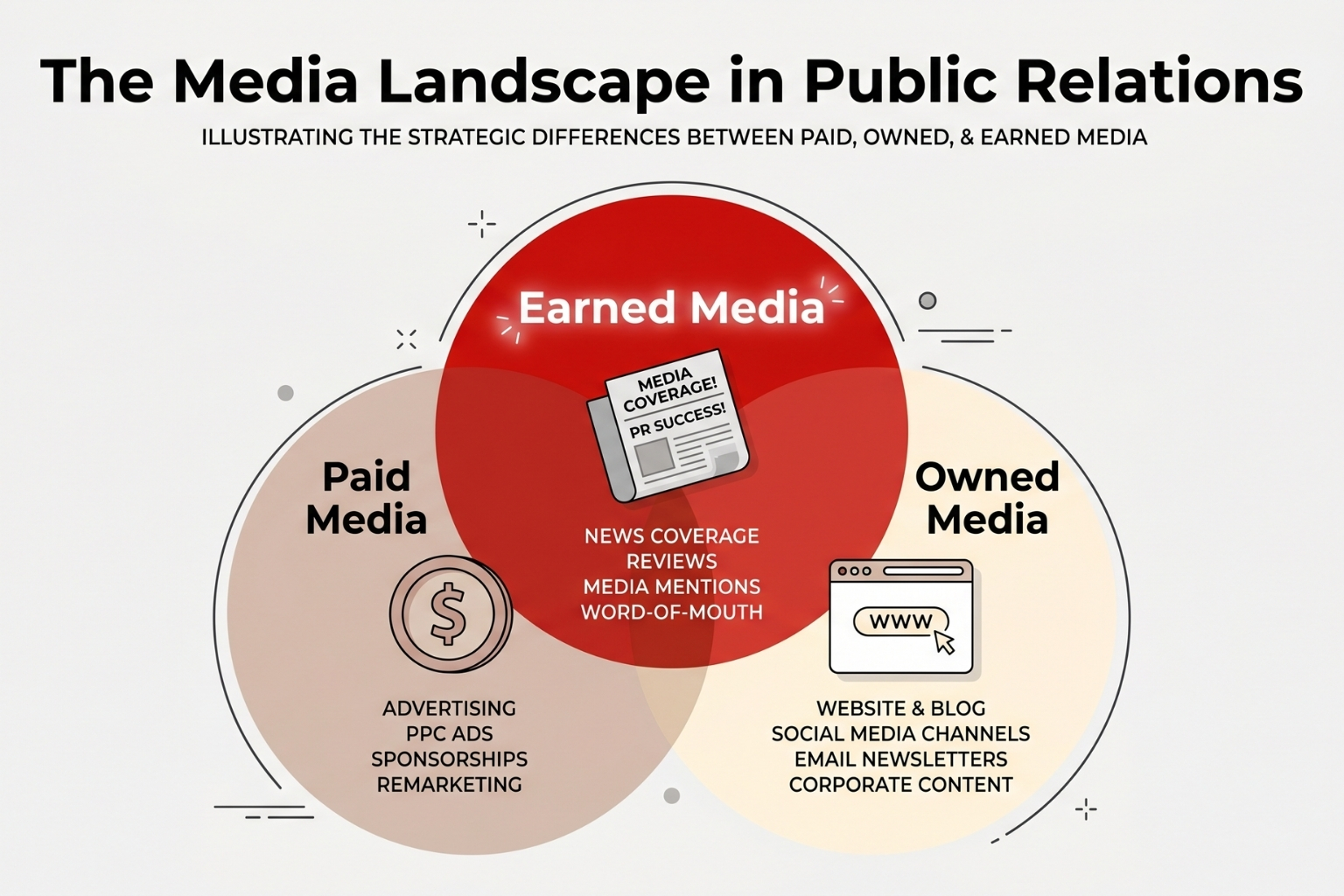
PR is not a single service. It is a family of related disciplines. Most businesses use a combination of these depending on what they are trying to achieve at any given time.
Media relations is about building genuine, ongoing relationships with journalists, editors, and media outlets. The goal is that when you have a story worth telling, the right people are ready to hear it. It involves pitching stories, setting up interviews, writing press releases, and making it easy for journalists to cover your brand accurately and fairly. Good media relations is less about sending press releases and more about becoming a reliable source that media professionals trust.
Press releases are probably the best-known PR tool, and also the most misunderstood. A press release is a written announcement in a structured format, sent to journalists and media outlets to let them know about something newsworthy. It works well for genuinely significant moments: a funding round, a major product launch, a notable hire, a data study you have commissioned. It does not work as a routine communication tool.
The most common mistake businesses make with press releases is treating them as the total of their PR activity. They are one tool in a much larger toolkit. A strong press release sent to the right journalist at the right time can generate good coverage. The same release sent to a generic list of hundreds of contacts typically generates nothing.
No business is immune to difficult moments. A product failure, a negative news story, a social media controversy, an employee issue that becomes public. Crisis communications is the discipline of managing your reputation when those moments arrive. How quickly you respond, how honestly you communicate, and how consistent your messaging is will determine how much lasting damage actually occurs.
A well-known example from India is Zomato's response to a 2019 incident where a customer asked to cancel an order because their delivery executive was non-Hindu. Zomato responded publicly, clearly, and without hesitation. They stood by their employee and stated their values plainly. That response was picked up widely across the media and public conversation. The goodwill it generated was significant and lasting. That is what good crisis communication looks like in practice: clear, fast, and human.
Corporate communications manages how an organisation communicates with all of its stakeholders, both inside and outside the company. Internally, this means keeping employees informed and aligned, especially during periods of change or uncertainty. Externally, it covers how the company presents itself to investors, regulators, and the broader public in terms of who it is and what it stands for.
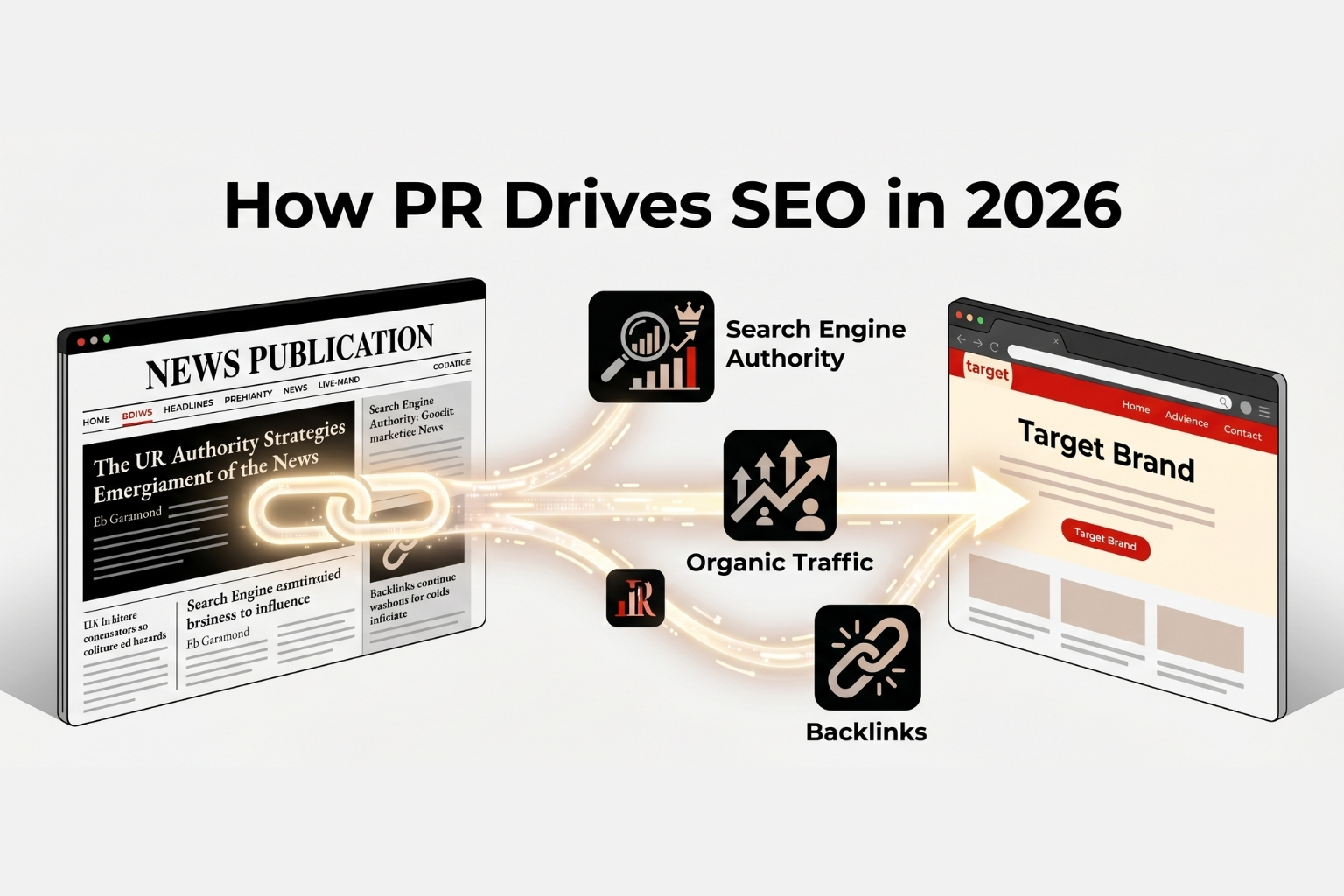
Digital PR applies the principles of public relations to online channels. It is closely linked to SEO because every article that covers your brand in a credible online publication creates a link back to your website. Search engines treat those links as signals of authority, which improves your rankings over time. This means PR coverage now has a direct, measurable impact on your organic search visibility. Link building through PR and the integration of PR and SEO are now central to how modern communications programmes are built and evaluated.
Thought leadership PR positions a founder, executive, or spokesperson as a credible and trusted expert in their field. This happens through authored articles in industry publications, expert commentary in news stories, conference speaking, podcast appearances, and consistent engagement with the conversations happening in your sector. The goal is not just to be visible. It is to be the voice people turn to when they need a perspective on something that matters in your industry. That kind of positioning takes time to build, but it compounds in value significantly over a sustained period.
Community and CSR PR manage how a brand communicates its role in society. This covers sustainability initiatives, community programmes, and corporate social responsibility activities. For businesses operating in sectors where public trust is critical, communicating this work well is not optional. It is part of how reputation is built and sustained.
These three terms get used interchangeably far too often. They serve related but distinct purposes, and understanding the difference helps you use all three more effectively.
These three terms get used interchangeably far too often. They serve related but distinct purposes, and understanding the difference helps you use all three more effectively.
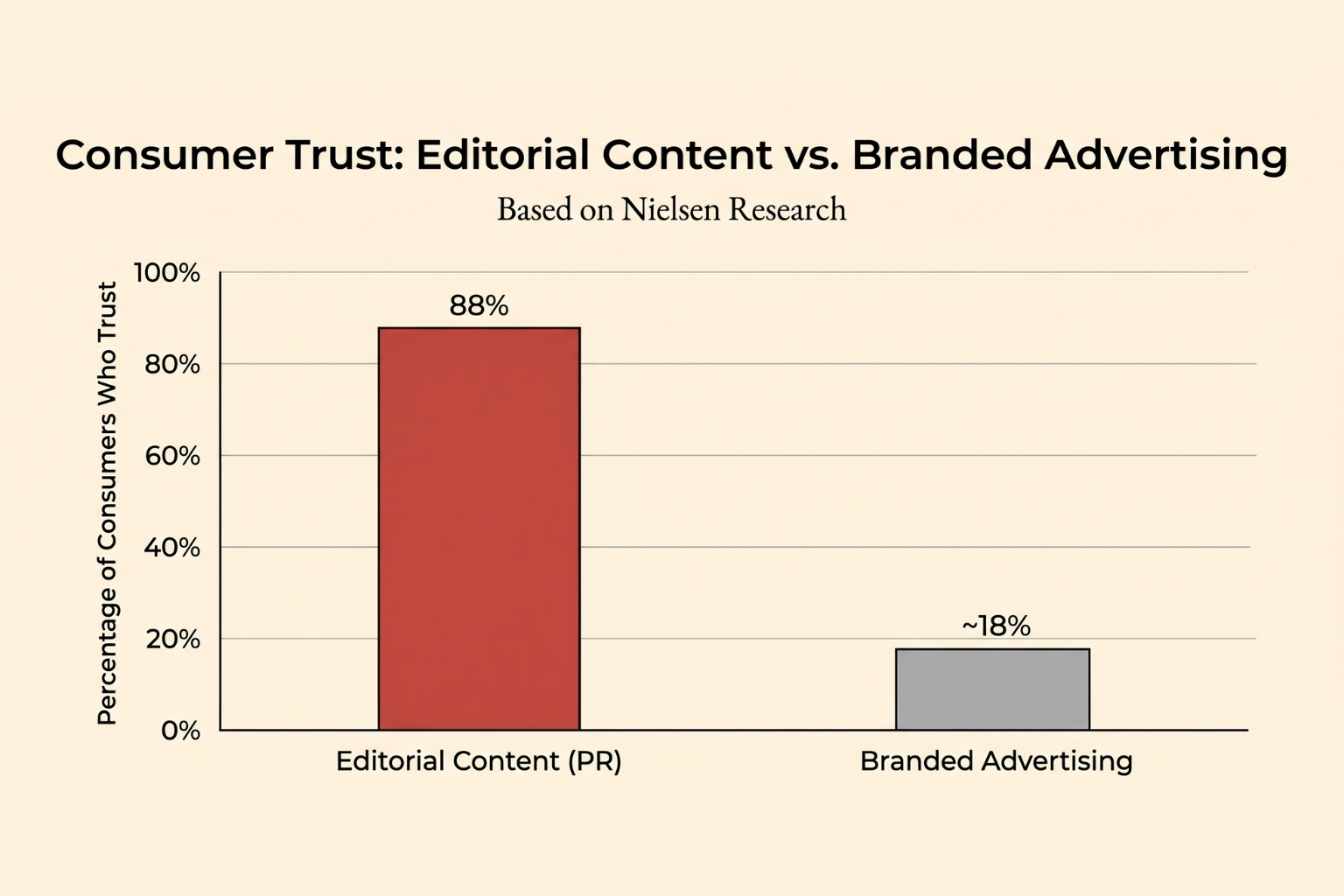
The trust difference in that table is worth sitting with for a moment. Nielsen research shows that 88% of consumers trust editorial content more than branded advertising. A feature about your company in a publication your audience reads will almost always carry more persuasive weight than an ad in the same space. Not because the ad is ineffective, but because readers understand the difference between an editorial decision and a paid placement.
This is not an argument for choosing PR over advertising. Both serve a purpose. PR builds the credibility that makes your marketing and advertising work harder. Marketing converts that credibility into preference and action. Advertising gives you immediate reach when you need it. The businesses that treat these as competing budget lines tend to underperform those that use them together.
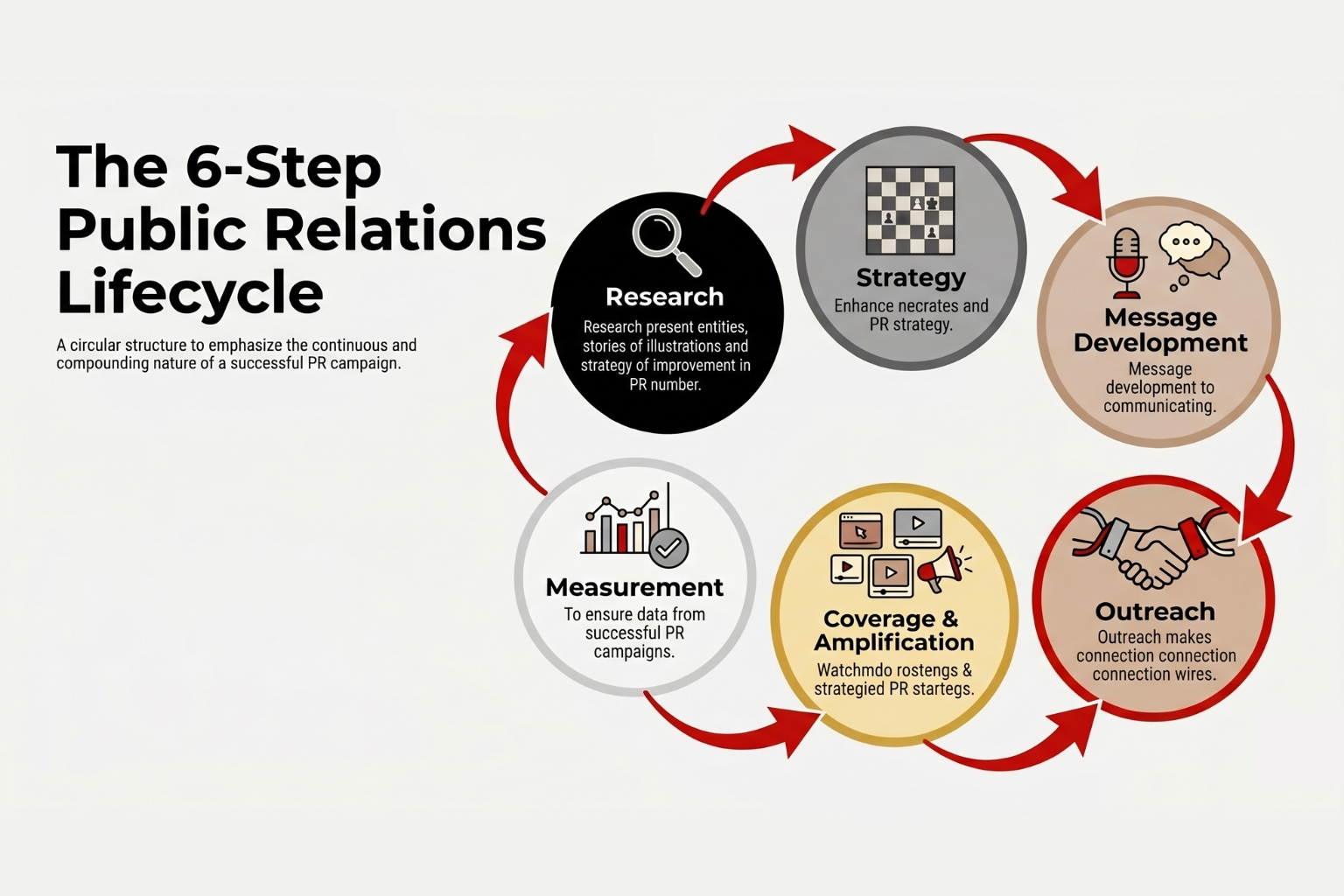
From the outside, PR can look like magic. A brand that was barely known starts showing up everywhere. A company that stumbled in public comes out of it with its reputation intact. None of that happens by accident. Here is what the actual process looks like.
Research: Understanding your media landscape before you start. Which publications does your target audience actually read? Which journalists cover your sector? What does the current public perception of your brand look like?
Strategy: Deciding what narrative you want to build, which audiences you need to reach, and what messages will resonate with each of them.
Message development: Writing the specific stories, proof points, and angles that support your strategy. This also includes preparing your spokespeople so they can communicate the narrative clearly in interviews and public settings.
Outreach: Pitching stories to journalists, placing authored articles, responding to media queries, and distributing press releases for genuinely significant announcements.
Coverage and amplification: Tracking what runs and sharing it through your own channels. Earned coverage works harder when your team amplifies it through social media, email, and your website.
Measurement: Reviewing performance against the goals you set at the start, and using those findings to improve the next cycle.
Every PR programme follows this logic, whether it is built around a product launch, an ongoing media relations effort, or a thought leadership programme for a founder or executive.
The fundamentals of PR have not changed. Credibility still has to be earned. Relationships still matter. A good story still beats a forced one. What has changed is the environment PR operates in. Here are the four shifts that are shaping how PR is practised right now.
Across India's business landscape, founder visibility has become one of the most powerful PR tools available. Research published by IndianTelevision.com (April 2026) found that companies with visible, credible founders consistently generate more earned media coverage, build customer trust faster, and attract stronger investor perception than companies that communicate only through brand channels. When a founder speaks with genuine expertise on an industry issue, it lands differently than a press release. People pay attention differently.
This is why thought leadership PR has become one of the highest-value activities for growth-stage businesses. A founder who contributes original perspectives to industry conversations is building a public asset that compounds in value over time.
AI-powered tools are increasingly the first place people go to get answers. If someone asks an AI assistant about your industry, your competitors, or your brand, what comes back is shaped by what high-authority sources have already written about the topic. PR Week (December 2025) describes the emerging discipline of Generative Engine Optimisation (GEO), which is about ensuring your brand is accurately and positively represented in AI-generated responses. The most effective way to achieve this is the same as for search: earn coverage in credible publications that these systems draw on as sources.
AI tools have made it easy to produce large amounts of content quickly. The result is that media channels are flooded with generic material. Editors and audiences have responded by raising the bar for what they give their attention to. Original research, a genuine point of view, a story grounded in real experience: these are what cut through now. Reputation Today (February 2026) notes that in 2026, authenticity and original perspective are outperforming output volume. This is good news for brands willing to say something real.
Most foundational PR content is written from a Western perspective. The Indian media landscape is structured differently, and those differences affect how PR should actually be planned and run here.
India has hundreds of national and regional publications, a large and growing vernacular press across Hindi, Tamil, Telugu, Kannada, Malayalam, and other languages, and an expanding base of digital-first outlets running alongside legacy print and broadcast media. A PR programme that only targets English-language national publications is reaching a fraction of the total available audience. For brands whose customers are outside the major metros, regional and vernacular placements are not secondary. They are central to the strategy.
According to the PRCAI SPRINT 2024-25 survey, conducted in collaboration with Ipsos and Astrum Reputation Advisory, India's PR industry is growing at 1.4 times the rate of GDP, which significantly outpaces global benchmarks. The industry is projected to reach INR 4,570 crores by FY2030. This growth is driven by the rise of India's digital media ecosystem, the expansion of the startup economy, and a growing recognition that reputation is not a side effect of business success. It is something you build deliberately.
One pattern that comes up repeatedly in the Indian market is businesses that are genuinely difficult to describe in a single sentence. A company that helps individuals resolve debt disputes is not a bank, not a law firm, and not a financial product. An architectural panel manufacturer is not a construction company, not a real estate brand, and not a consumer product. Standard PR approaches, which rely on clear sector categories and product-led narratives, often do not work for these businesses.
For brands in this position, the most effective PR approach is to find the larger conversation your brand legitimately belongs to and earn your place in it. This might mean covering borrower rights and consumer protection trends rather than talking about the service itself. Or covering green building standards and architectural innovation rather than manufacturing specifications. Thought leadership and spokesperson visibility become the primary vehicles. When a brand cannot be described easily, PR's job is to build that description in the public mind.
In 2019, Zomato faced a public moment when a customer posted on social media asking to cancel an order because their delivery executive was non-Hindu. Zomato responded publicly, immediately, and without ambiguity. They stood by their employee and stated their position plainly. The response felt human, not corporate. The earned media and public goodwill it generated significantly outweighed what any equivalent advertising spend could have produced. That is what PR can do at its best: it creates conditions for your brand's actual values to be seen and trusted by people who were not necessarily looking for you.
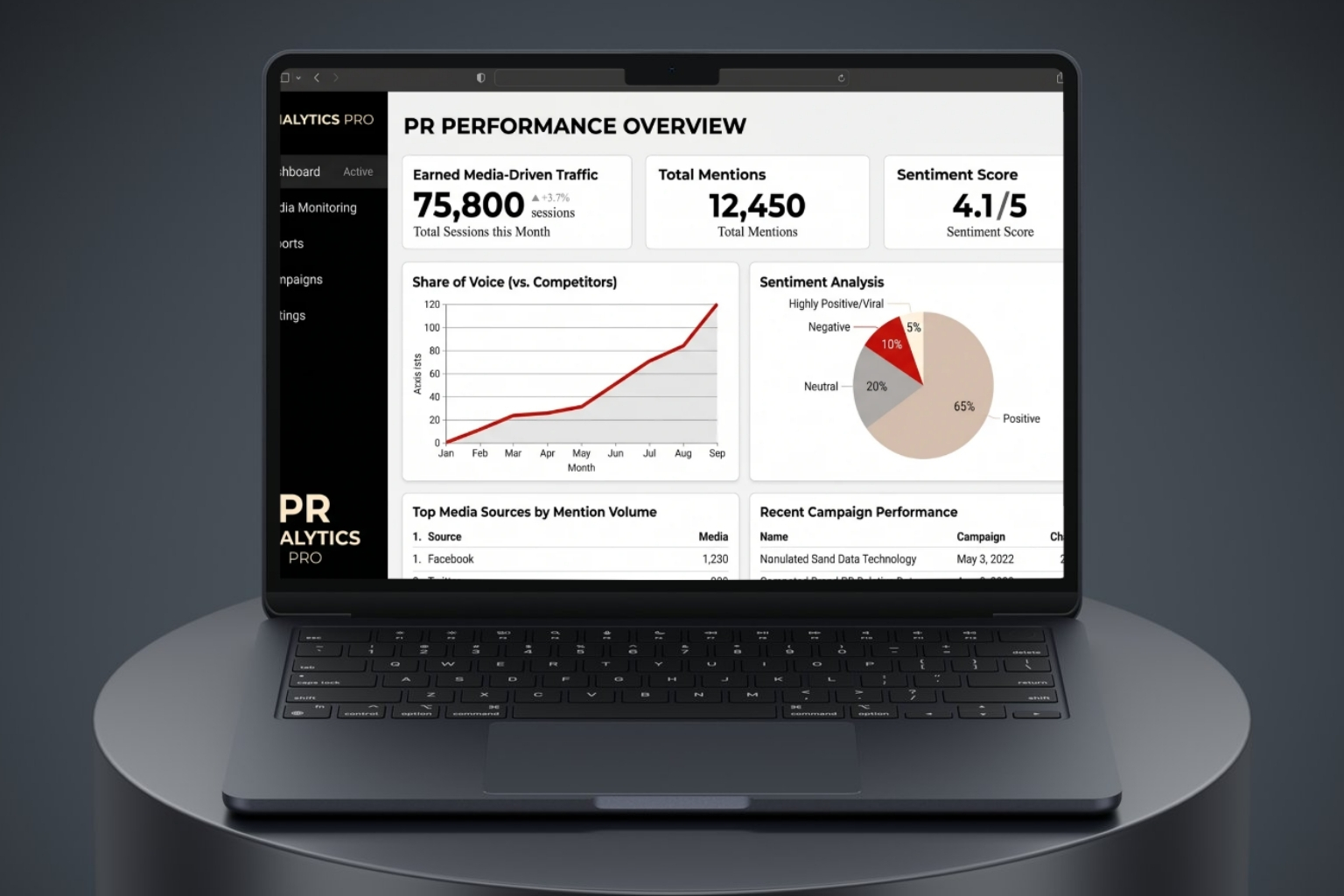
One metric worth addressing directly is Ad Value Equivalency, or AVE. This tries to calculate what your earned coverage would have cost if you had bought the same space as advertising. Some teams still use it, but it is widely questioned. The AMEC (International Association for the Measurement and Evaluation of Communication) recommends against using AVE as a primary PR metric because it treats earned and paid media as if they have equal trust value. They do not, and that difference is precisely the point of earning coverage in the first place.
The most reliable approach is to agree on your PR goals before a programme starts and connect your metrics to those goals from the beginning. A business trying to attract investors needs to measure different things than one trying to build consumer awareness.
PR is genuinely powerful. It is also genuinely limited. Being clear about both from the start will save time, money, and a lot of frustration.
PR cannot fix a bad product or service. Good PR amplifies what already exists. If the product is poor or the customer experience is bad, more visibility will spread that reality faster, not slower.
PR cannot build trust overnight. Credibility is built through consistent, honest communication over time. A brand that has invested in PR for six months will always have more earned credibility than one that ran a single campaign.
PR cannot guarantee coverage. Journalists and editors make their own editorial decisions. A well-crafted pitch to the right person at the right time will often land. The same pitch on a different day might not. This is the nature of earned media, and it is also what makes it valuable.
PR is not a replacement for marketing or advertising. Each discipline does a different job. PR builds the credibility that makes marketing and advertising more effective. They work best as a system, not as substitutes for each other.
PR is not a short-term fix. If you need results in four weeks, advertising is the more appropriate tool. PR's value is cumulative and typically shows meaningful, compounding results over a three to six-month horizon.
Public Relations is a Long Game. That is Exactly the Point.
Most businesses want results quickly. That is understandable. But the brands that are genuinely trusted, the ones people recommend, the ones journalists call for a quote, the ones that seem to be everywhere without obviously advertising, got there through consistent, patient, strategic communication.
That is what public relations builds. Not overnight visibility, but lasting credibility. The kind that holds up when things go wrong, compounds when things go right, and quietly shapes how every new person who encounters your brand decides whether to trust it.
The businesses that treat PR as a long-term investment rather than a short-term tactic are the ones that build something difficult to replicate. A reputation is not a campaign. It is everything you have said, done, and stood for, seen through the eyes of the people who matter to your business.
If there is one thing to take from this guide, it is this: PR is not about getting coverage. It is about deserving it.
PR stands for Public Relations. In some contexts, it is also used as shorthand for Press Release, though these are distinct things. Public Relations is the broader discipline. A press release is one specific tool within it.
PR works by identifying the stories and perspectives that a brand can honestly and credibly own, and placing them in front of the right audiences through channels those audiences trust. In practice, this means building relationships with journalists, crafting compelling pitches, preparing spokespeople, placing authored articles, and managing how a brand is represented across media over time. The output is earned credibility, not paid placement.
Marketing drives awareness and sales through branded content and paid channels. PR builds credibility through third-party coverage and earned media. Marketing controls the message fully. PR earns it through editorial decisions made independently by journalists and publishers. Both are necessary, and neither replaces the other.
No. PR works at any company size, though the approach differs at each stage. Early-stage businesses benefit most from founder-led thought leadership and targeted media relations in relevant publications. As a business grows, PR typically expands to include corporate communications, investor relations, and broader-scale campaigns.
The main types are media relations, crisis communications, corporate communications, digital PR, thought leadership PR, and community and CSR PR. Most organisations use a combination, weighted towards whatever their current communication objectives require.
Initial coverage can appear within a few weeks of a well-planned outreach effort. Compounding results, such as consistent media presence, improved brand perception, and measurable effects on search visibility and business outcomes, typically take three to six months to become clear. PR is a long-term investment, not a one-off activity.
Most Popular Blogs
Newsletter
Categories
About the author
Anubhav Singh: Founder & Managing Director, Bridgers
Anubhav Singh is the Founder and Managing Director of Bridgers, with over 15 years of experience in media relations and strategic corporate communications. He has worked with leading Indian brands across sectors and holds a degree in Mass Communication & Video Production along with an MBA in Marketing. Under his leadership, Bridgers has grown into one of India’s leading PR agencies, known for transparency, innovation, and quality.
Related Articles


