
What is crisis communication and why is it important?
25 May 2025

A press release is one of the most misused tools in PR. Most businesses write them too long, send them to the wrong people, and lead with the least interesting information. Then they wonder why nothing gets covered.
Writing a press release well is not complicated. It requires a clear news angle, a structure that respects a journalist's time, and the discipline to say what needs to be said without saying anything extra. This guide covers exactly that, step by step.
If you want to understand the different types of press releases and how they work before writing your first one, start with our press release writing guide. This guide picks up where that one ends.
The single biggest reason press releases fail is not bad writing. It is the absence of a genuine news angle. No amount of polished language can turn an internal update into a story a journalist wants to cover.
Before writing a word, run your announcement through three questions:
Would a reader who has never heard of your company care about this?
Does this affect anyone beyond your internal team?
Is there a specific reason this matters right now, not just to you?
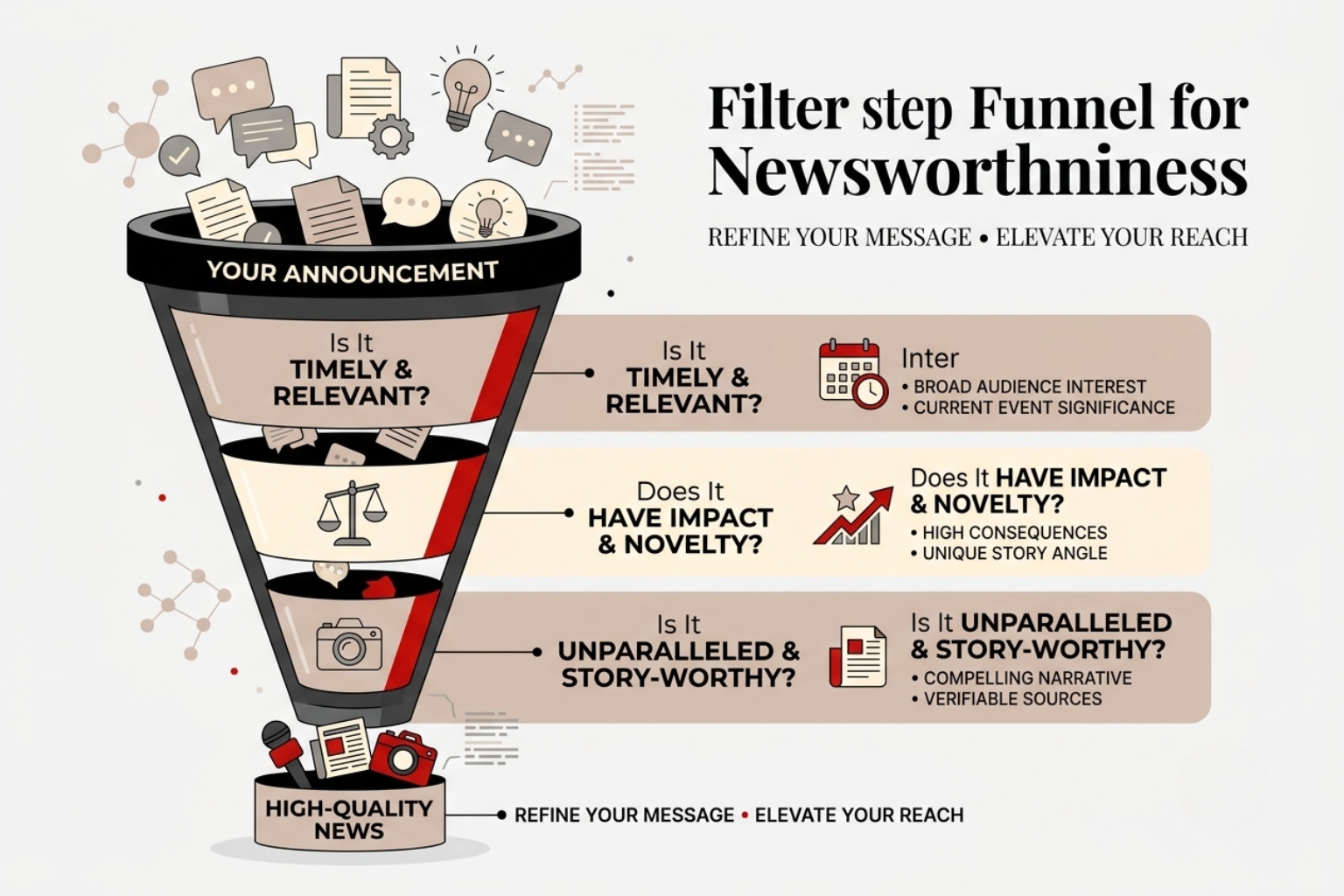
If the answer to any of these is no, the announcement is not yet press release material. It belongs in a blog post, a social update, or an internal newsletter. Sending a press release that fails this test does not just produce no coverage. It trains journalists to ignore your name in their inbox.
Once you are confident the news passes the test, you are ready to write.
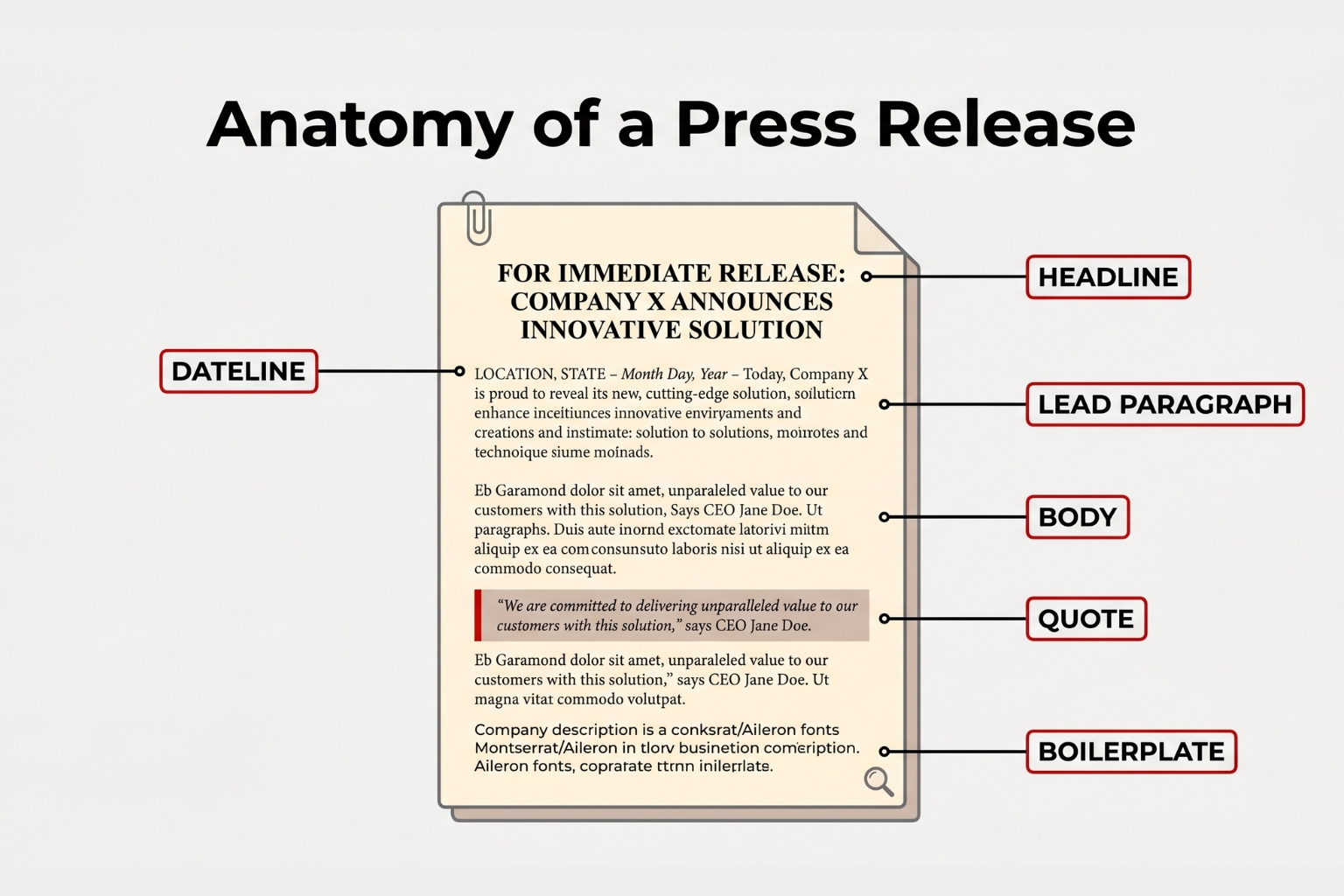
Every press release, regardless of type, follows the same structure. Here is a quick reference before we go through each part in detail.
How to Write Each Section
Most people write the headline first. That is why most press release headlines are vague. Write the body of the release first. Once you know exactly what the story is, the headline writes itself far more accurately.
A strong press release headline states the news directly using active verbs. It answers what happened, not what to feel about it. It includes a number where one is relevant, because numbers signal specificity. Keep it under 70 characters.
The dateline opens the first paragraph. It states the city of origin in all caps, followed by the date and release status. Use For Immediate Release if the news can be published straight away. Use a specific date and time if you are sending under embargo.
For Indian businesses, use the city where the company is headquartered or where the news originates. Indian publications pay attention to this for regional relevance. A Mumbai-based company announcing a Pune office expansion should use a deadline from Mumbai, not a generic India tag.
The lead paragraph is where most press releases fail. Businesses write three sentences of background context before getting to the actual news. Journalists read the first paragraph and nothing else if that paragraph does not earn their attention.
The lead must answer the five Ws: who, what, when, where, and why. Keep it to 35 words or fewer. The very first sentence should address why this matters right now, in no more than 15 words. That single constraint, applied honestly, will make your lead paragraph significantly stronger.

The body supports the lead with detail, data, and context arranged in descending order of importance. The most critical information first. Supporting detail below. Background and history last.
This structure, known as the inverted pyramid, exists because journalists frequently cut from the bottom when space is tight. If your essential story is not told in the first two paragraphs, it may not survive the editing process.
A practical test: remove the last paragraph of your body. If the story still makes sense, the structure is right. If removing it changes the story, move that information higher.
Keep the body to two or three paragraphs. Each paragraph should add something new. If a paragraph summarises what the previous one already said, cut it.
Every press release needs at least one quote from the founder, CEO, or the most senior person connected to the announcement. If anyone could have written the quote, rewrite it.
A weak quote expresses enthusiasm. A strong quote expresses a specific, original point of view that only this person could credibly say. Journalists need something they can pull directly into their story. A generic quote forces them to either paraphrase you or cut your voice from the piece entirely.
The quote approval process matters. Draft the quote yourself based on what the spokesperson would say, then have them review and refine it. Never publish a quote the spokesperson has not approved. A journalist who fact-checks and finds a discrepancy will not cover you again.
The boilerplate is a short, standard paragraph at the bottom of every release. Journalists use it to write the attribution line in their story. Write it once and keep it consistent across all releases.
It should cover: what the company does, who it serves, when it was founded, and a link to the website. It must not contain superlatives, marketing claims, or anything that requires a journalist to verify. Factual, current, and free of promotional language.
List the name, direct email address, and direct mobile number of the person handling media queries. This is the person who will answer the phone at 6 pm when a journalist is on deadline for a morning edition. Do not list a general inbox. Do not list the CEO unless they are also the communications contact.
The following is a complete, annotated press release for a fictional Bengaluru-based B2B SaaS startup. Every section is labelled. The commentary after each section explains what it is doing and why.
Most press release guides are written from a Western perspective. The Indian media landscape has specific characteristics that affect how you write, time, and distribute a release.

India has national English-language publications like The Economic Times, Business Standard, and Mint. It also has hundreds of regional language outlets across Hindi, Tamil, Telugu, Kannada, Marathi, Gujarati, and other languages, and a growing base of digital-first publications that have significant reach in specific sectors. A press release strategy that targets only national English outlets is missing the majority of the available audience for most Indian businesses.
For a company based in Coimbatore, Ahmedabad, or Bhubaneswar, regional and vernacular media will deliver significantly more relevant coverage than a national English publication. Build your media list to match your actual audience, not the publications you aspire to appear in.
Send press releases on Monday or Tuesday mornings for the best chance of coverage. Friday afternoon releases are reliably overlooked. Beyond the day of the week, India has specific news cycle considerations that most international guides ignore entirely.
Budget week in February, quarterly results season, and major festival periods all affect journalist availability and editorial priorities. A strong product launch press release sent during Budget week will compete with significantly more important news for the same column inches. Time it for a quieter week, and the same story has a substantially better chance of coverage.
Indian journalists receive a very high volume of generic press release blasts. A short, personal covering note in the email body, three to four lines written in plain conversational language and referencing one specific piece of their recent coverage, dramatically improves response rates compared to a cold distribution blast.
The release goes below the pitch note. Never send a press release as an attachment. Paste it directly into the email body. Journalists do not open attachments from senders they do not recognise. An attachment-only email is an email that does not get read.
At Bridgers, every release we distribute for a client goes with a personalised covering note tailored to each journalist's beat. The time investment is significant. So is the difference in pickup rates.
The mechanics of a press release are learnable. The mistakes that kill coverage are almost always about judgment, not format.
Sending something that is not genuinely newsworthy. This is the most common and most damaging mistake. An internal milestone reframed as market news, a product feature update presented as a launch, a partnership that affects no one outside the two companies involved. Sending these trains journalists to filter out your name. The test is simple: would a journalist's reader care about this if they had never heard of your company? If the answer is no, do not send it.
Burying the news in the opening paragraph. The most important information should be in the first sentence, not the third. Every sentence of context or background that appears before the actual news reduces the chances the release gets read past the first paragraph.
Writing a quote that sounds like a quote. Corporate enthusiasm, superlatives, and generic forward-looking statements signal to a journalist that a committee wrote the quote. A quote that sounds like a real person said a real thing is the one that ends up in the story.
Sending the release as an attachment. Journalists do not open attachments from unknown senders. Paste the full release into the email body below the pitch note. Always.
Wrong or missing contact information. A journalist on deadline who cannot reach a human being within the hour will move on. List a direct mobile number, not just an email. And make sure the person listed is actually available.
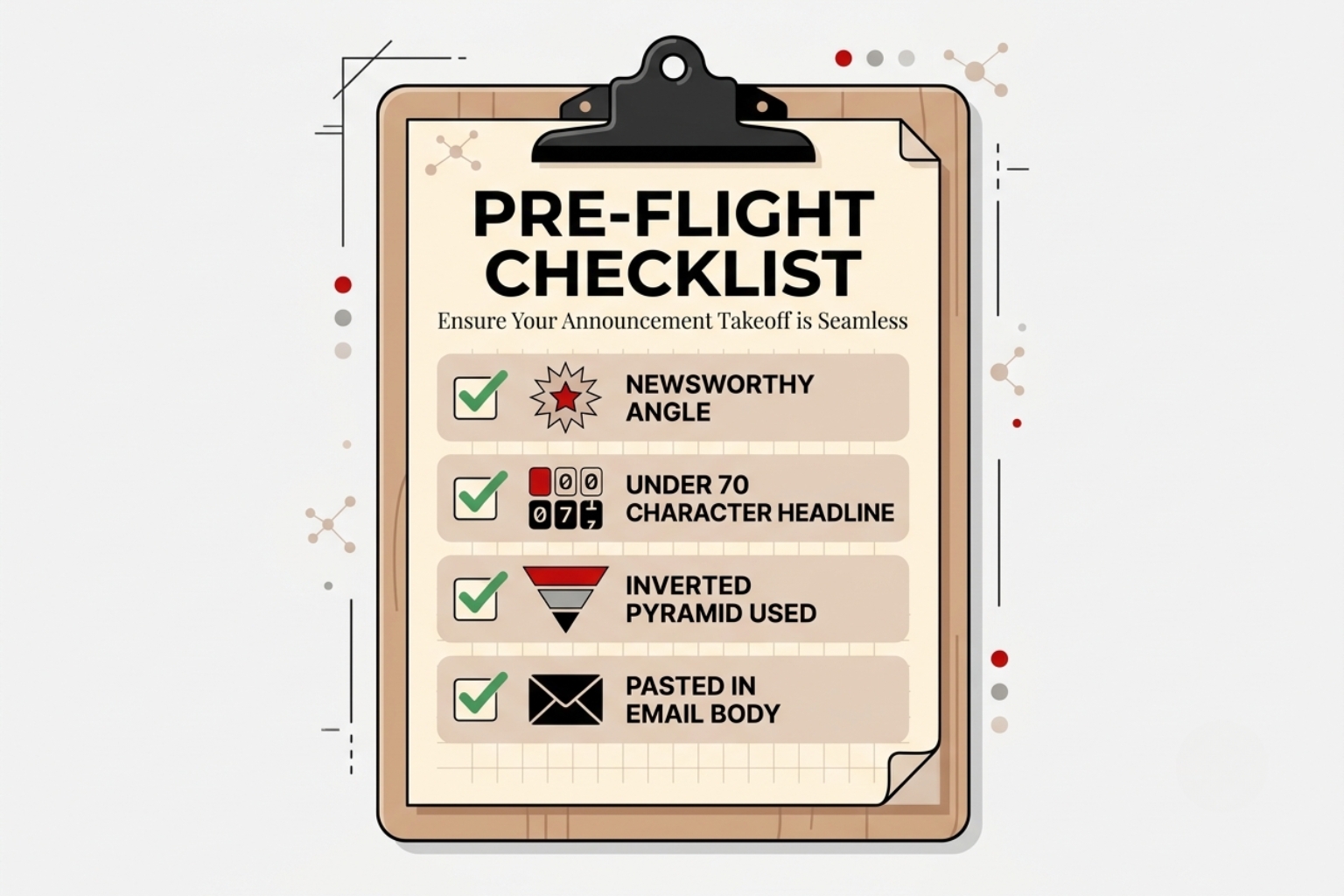
Run through this before distributing any release. A release that fails three or more of these checks is not ready to send.
The announcement passes the newsworthiness test: a reader who does not know the company would care about this
The headline states the news clearly in under 70 characters using active verbs
The first sentence of the lead answers why this matters now in 15 words or fewer
The lead paragraph answers who, what, when, where, and why in 35 words or fewer
The body follows the inverted pyramid: most critical information first
The quote says something specific that only this person could credibly say
The quote has been reviewed and approved by the spokesperson
The boilerplate is current, factual, and free of marketing language
Contact information lists a named individual with a direct email and mobile number
Visual assets are ready and linked, not attached as files in the email
The release is pasted into the email body, not sent as an attachment
The covering pitch note is personalised to each journalist, not a generic introduction
The downloadable press release template below includes this checklist. Download the Bridgers Press Release Template
A well-written press release gets you in front of the right journalist. What happens after that depends on the strength of your news, the quality of your relationship with that journalist, and how easily you do their job of covering the story.
The businesses that earn consistent coverage are not the ones that write the most press releases. They are the ones that write the right ones, send them to the right people, and build the kind of relationships that make journalists want to cover them even when they are not pitching.
Write less. Target better. Follow up with respect for the journalist's time. Those three things will do more for your coverage rate than any improvement to your press release format.
Need help writing a press release that earns coverage?
At Bridgers, we write press releases built around genuine news angles, targeted to the publications and journalists that matter for your specific business, and distributed in a way that builds relationships rather than burning them. If you have an announcement coming up and want to make sure it lands, we would be glad to help.
Get in touch with Bridgers
Between 300 and 500 words for most announcements. Funding releases and research releases sometimes run slightly longer when the supporting detail genuinely adds to the story. 600 words is a practical ceiling for any type. Every word beyond what is needed to tell the story tests a journalist's patience.
A press release follows seven sections in order: headline, dateline, lead paragraph, body, quote, boilerplate, and contact information. The lead paragraph should answer the five Ws in 35 words or fewer. The body follows the inverted pyramid, with the most important information first. The quote should be specific and genuinely attributed to the named spokesperson.
Paste the full press release into the email body below a short, personalised pitch note of three to four lines. Never send it as an attachment. Address each journalist by name. Reference one specific piece of their recent coverage to show you have chosen them deliberately. Send on Monday or Tuesday morning for the best response rate. Avoid Budget week, quarterly results season, and major festival periods.
A pitch is the short, personal email you write to a journalist to introduce the story and explain why it is relevant to their audience. The press release is the full announcement that follows below the pitch or is sent alongside it. The pitch earns the journalist's attention. The press release gives them everything they need to cover the story. Both are necessary. The pitch is often more important.
Always paste it in the email body. Never send it as an attachment. Journalists do not open attachments from senders they do not recognise. An attachment-only email is an email that does not get read, regardless of how strong the story inside it is.
Ask three questions: Would a reader who has never heard of your company care about this? Does this affect anyone beyond your internal team? Is there a specific reason this matters right now? If the answer to any of these is no, the announcement is not yet press release material. The most common mistake is sending a press release about something that matters internally but has no external relevance.
At a minimum, one quote from the most senior person connected to the announcement. For partnership releases, one quote from each organisation is standard. For research releases, one quote from the author or a relevant industry expert adds credibility. Every additional quote beyond what is genuinely necessary dilutes the impact of the ones you keep.
Most Popular Blogs
Newsletter
Categories
About the author
Anubhav Singh: Founder & Managing Director, Bridgers
Anubhav Singh is the Founder and Managing Director of Bridgers, with over 15 years of experience in media relations and strategic corporate communications. He has worked with leading Indian brands across sectors and holds a degree in Mass Communication & Video Production along with an MBA in Marketing. Under his leadership, Bridgers has grown into one of India’s leading PR agencies, known for transparency, innovation, and quality.
Related Articles


