What is crisis communication and why is it important?
25 May 2025

Somewhere between your first pitch deck and your first press mention, something changes. People stop searching for your company and start searching for you. An investor doing diligence types your name into Google before they type your startup's. A future co-founder decides whether to join based on what they have heard about you, not your product roadmap. This is personal reputation management: building and protecting how you, specifically, are seen and trusted, separate from and connected to your company's name.
Most founders treat this as vanity work, something to think about once the fundraiser is closed. The research does not support that order of priorities. In India, a founder's personal conduct now shows up in shareholder agreements, court filings, stock exchange disclosures and AI-generated search summaries long before it shows up in a press release. This guide walks through why that happened and what a founder can actually do about it, starting with the legal reality most founders underestimate.
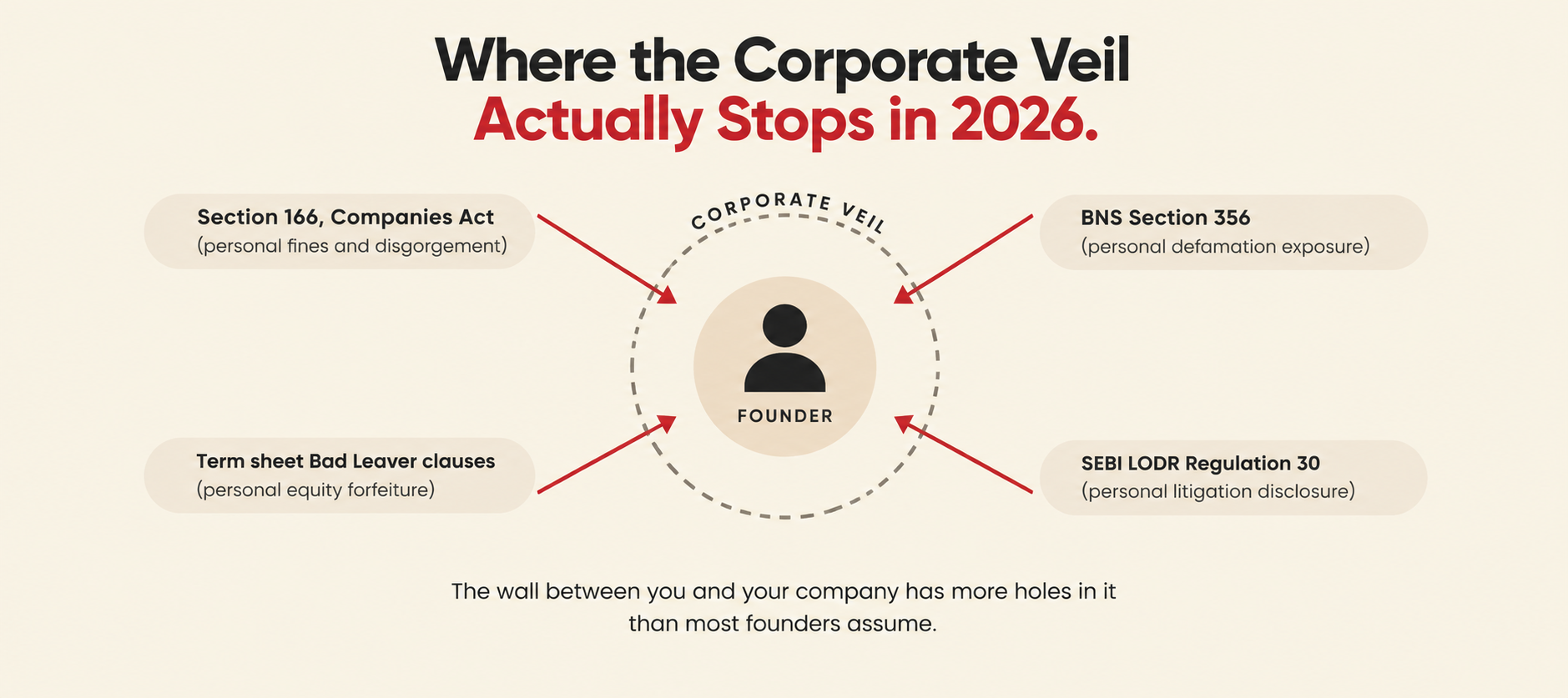
The corporate veil is supposed to be a wall. It separates you from the company you run, so that if the business fails, your personal assets stay protected. In India's current regulatory and investment climate, that wall has developed some very specific, well-documented holes.Start with Section 166 of the Companies Act, 2013, which requires directors to act in good faith. Section 166(5) prohibits a director from taking undue personal gain from their position. Breach it, and you face fines of up to ₹5 lakh along with disgorgement, a court order to hand back whatever advantage you took. That is not a company penalty. It is a personal one, with your name on the order.
The shift in defamation law works against you differently. Section 356 of the Bharatiya Nyaya Sanhita, 2023, which replaced Section 499 of the old Indian Penal Code, carries up to two years in prison for criminal defamation, and kept something called the First Exception. This is where it gets counterintuitive: truth alone is not a complete defence. The publisher also has to show the statement served the "public good." That gives you leverage against private, true information that serves no public purpose. It also means that if a journalist can tie your conduct to a company the public has a stake in, your private life becomes fair game.
Your term sheet shows how seriously investors take this now. The Zostel v. OYO arbitral award, upheld through Supreme Court dismissals in 2025, established that a 'non-binding' term sheet can still be enforced if a founder acts as though the deal is moving forward. And Indian VC term sheets in 2025 and 2026 aggressively use "Bad Leaver" and morality clauses, where 'cause' for forfeiting unvested equity now includes personal reputational damage, not just fraud. If your conduct damages the brand, an investor can argue you breached your Section 166 duty and trigger that clause.
A company optimises for product discovery and conversion. A founder optimises for something harder to measure: trust and authority among a small, concentrated audience of investors, journalists and the talent you are trying to hire. That audience does not search the way it used to.
Two findings explain why. The Edelman Trust Institute found that 70% of people globally carry what it calls an insular mindset, unwilling to trust someone whose values or background differ from their own, and 88% consider trust in a brand's leadership a genuine dealbreaker. Separately, PRCAI and Ipsos' SPRINT 2026 study found that 83% of Indian communication professionals now believe earned media matters more than ever, because large language models favour credible third-party coverage over anything a founder pays to publish. Seventy percent already treat Generative Engine Optimization, or GEO, shaping what AI tools say about you, as a distinct strategy.
When an investor's associate runs an informal check on you today, they are reading an AI-generated summary of everything public about you. A summary built entirely from polished, self-published content with no independent validation behind it reads thin.
This is the trap the executive ghostwriting industry has built around itself. Solo ghostwriting services generating over $10,000 a month make it easy to post polished LinkedIn content daily. But 66% of PR professionals warn that presenting manufactured content as organic thinking damages trust once spotted, and it is spotted more often than founders assume.
Beyond casual search results, Indian institutional investors and executive search firms now run something closer to a full audit before committing capital or a board seat to you. This has moved well past a routine criminal record check.
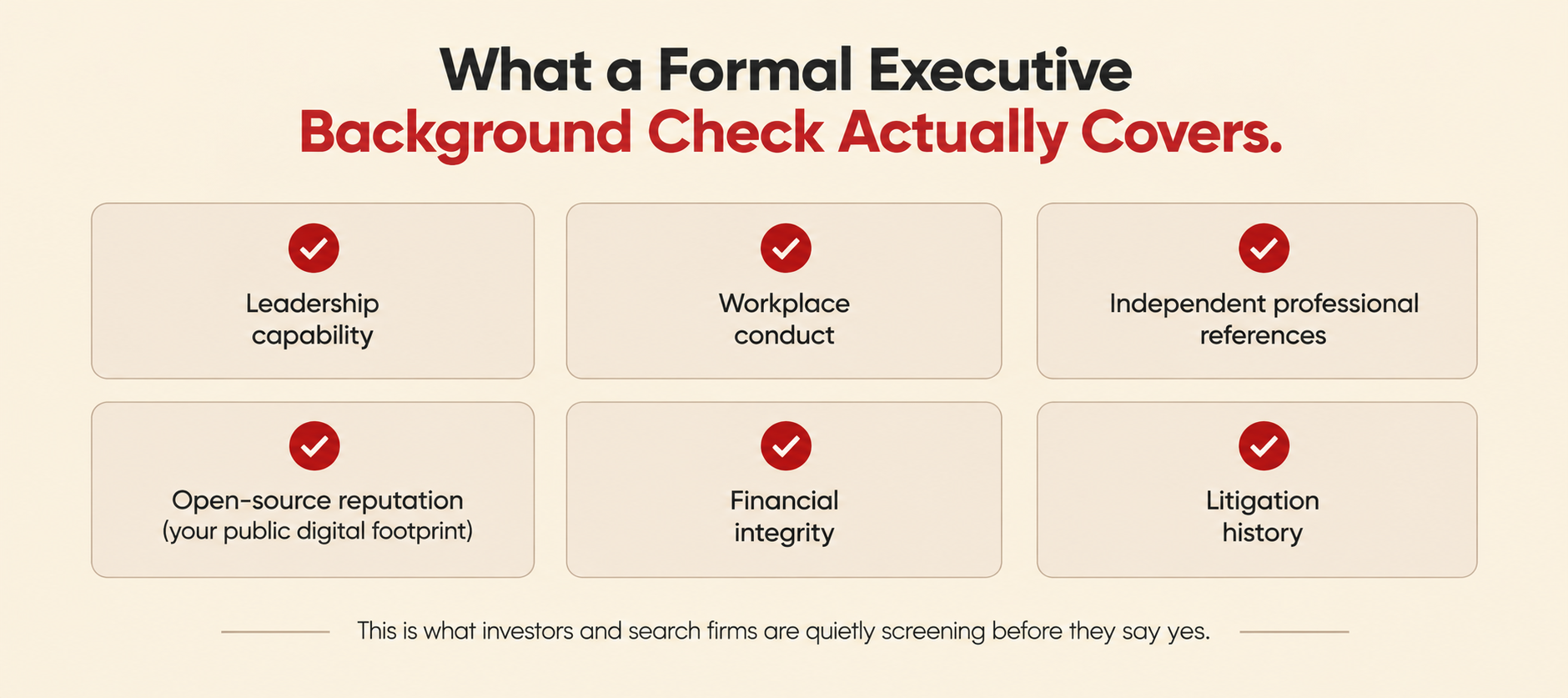
The "Workforce Fraud Files 2025" report from AuthBridge found a 6% background discrepancy rate among white-collar hires in India, with 17% of resumes not matching actual credentials and 5% found moonlighting undisclosed. Applied to a founder being vetted for a Series B, even a fraction of that rate is a serious fiduciary risk, which is why formal screening products for leadership now exist. AuthBridge's AuthLead product evaluates six dimensions: leadership capability, workplace conduct, independent professional references, open-source reputation, financial integrity and litigation history.
What checks look for has also changed. Top-tier firms including Egon Zehnder and Korn Ferry are shifting criteria toward systems thinking and adaptability, the ability to distribute power under ambiguity, now the strongest predictor of leadership success. A check surfacing micromanagement or abrasive conduct works against these traits and can derail a round without any legal wrongdoing on record.
Founder-led communication consistently outperforms brand-led communication in India, which creates an obvious temptation to just post more. The data on what works points the other way.
The same PRCAI and Ipsos SPRINT 2026 study found that 61% of Indian PR consultancy heads warn AI is commoditising creativity, and 80% flag AI-generated misinformation as a major reputational risk. The founders whose visibility actually builds trust are backed by real, independent validation, not volume.
There is a cautionary example worth sitting with. After Narayana Murthy's comments about a 70-hour work week drew national attention in 2023, L&T Chairman SN Subrahmanyan proposed a 90-hour work week in late 2024 and faced sustained backlash into 2025. The comment was not dishonest or manufactured, just tone-deaf to the country's economic mood. Visibility without reading the room does more damage than staying quiet. Founders who get thought leadership right in 2026 step back from high-frequency posting and invest in long-form podcasts and unscripted interviews, formats where genuine expertise is harder to fake.
Media exposure is an asymmetric risk for a founder. A good interview improves your standing marginally. One badly judged statement can trigger a crisis that follows you for years.
The Edelman Trust Barometer describes the skill founders now need as trust brokering, engaging audiences with different values without triggering the grievance an insular, economically anxious public tends to default to. Traditional media training, focused on pivoting away from hard questions, does not teach this. It requires stress-testing what you are about to say against the current public mood first, which is precisely where SN Subrahmanyan's comment above went wrong.
Spokesperson readiness now also includes a threat that barely existed a few years ago. The same PRCAI SPRINT 2026 survey found that 46% of corporate communicators faced a fake news incident in 2025-26, up from 28% the year before, and 80% now name AI deepfakes a top reputational risk. A founder needs a rehearsed protocol for dismantling a synthetic media attack in real time, because a convincing deepfake spreads on X or WhatsApp faster than the legal system can issue a takedown.
The hardest test of personal reputation management arrives when a founder leaves, whether by choice, acquisition, or being pushed out. Your name has to survive independently of the company it was built inside.
When an exit is classified as a "Bad Leaver" under a founder's own term sheet and shareholder agreement, it legally flags them for cause, fraud or gross misconduct, following them into every future fundraising conversation. Two very different, genuinely instructive Indian recovery paths show what founders do next.
Ashneer Grover was ousted fr
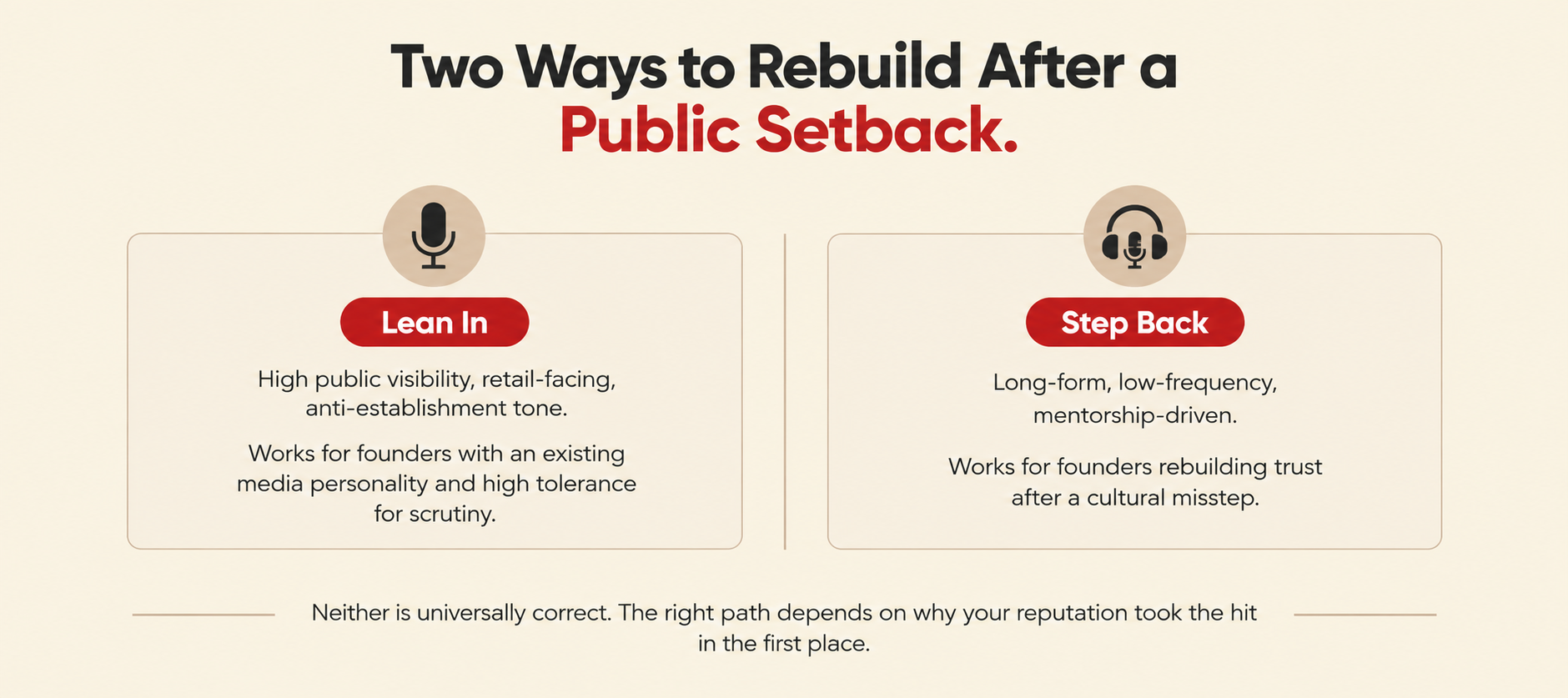
om BharatPe amid allegations of financial misconduct, a textbook Bad Leaver scenario. Rather than staying quiet, he leaned into an anti-establishment, populist persona and launched Third Unicorn's CrickPe using retail fame rather than institutional VC funding. It worked because he optimised for public relevance over institutional trust, a strategy that depends on a pre-existing media personality and is hard for a more private founder to copy.
Shantanu Deshpande took the opposite route. After his LinkedIn post demanding 18-hour workdays triggered nationwide backlash, he stepped back and instead launched "The BarberShop," a podcast where he positioned himself as a listener and mentor. His rehabilitation was slower, built on demonstrated empathy over time. Both paths worked. Neither would have worked for the other's situation, which is the real lesson: a departure narrative has to be engineered around who you actually are, because silence lets the market write the story for you.
Founders often assume a personal dispute or private litigation stays separate from their professional standing. For any founder running a listed company, or one backed by institutional capital, that assumption does not hold up.
SEBI LODR Regulation 30 requires listed companies to disclose material events to the exchanges, including the arrest of, or significant personal litigation against, key managerial personnel or promoters. A personal dispute or an unrelated arrest can become a mandatory filing that moves the share price and demands an immediate response.
The BNS Section 356 "public good" exception cuts the same way here. It protects a journalist exposing a genuine gap between a founder's private conduct and public corporate values, such as championing sustainability while privately investing in polluters. The practical guidance from communications practitioners in 2026 is blunt: assume there is no real privacy left once your name is tied to your company's brand.
If the legal exposure is not convincing, the financial numbers should be. Weber Shandwick and RepTrak's research puts the figure at 44% to 45%: the share of a company's market value executives globally attribute to the CEO's personal reputation. That is how much of your company's valuation is sitting inside your own name.
India has a more precise version of this number. A PRCAI and Ipsos white paper published in September 2026 estimates the Indian PR industry influences US $545 billion in economic value annually, of which US $265 billion is isolated as reputation management's specific impact. The same study found a poorly handled reputational crisis costs an average 1.5% erosion in market capitalisation. A personal reputation audit deserves the same discipline as a financial one, tracked over time rather than checked only after something has gone wrong.
None of this requires becoming a full-time media personality. It requires treating personal reputation as a deliberate, ongoing discipline rather than something that only gets attention after a crisis. A workable starting plan looks like this.
Run your own background check first. Search your name the way an investor would, including AI search summaries, before diligence does it for you.
Read your term sheet's morality and Bad Leaver clauses closely. Know what conduct could trigger equity forfeiture before you sign, not after a dispute begins.
Prioritise earned media over ghostwritten volume. One credible, independently reported interview outweighs a month of polished, self-published posts.
Stress-test statements against the current mood, not just the message. Ask how it will land against the country's present economic and cultural climate.
Decide your departure narrative before you need one. Plan how you will tell that story rather than letting the market write it for you.
This is also where an outside communications partner earns its place. At Bridgers, the founders we work with rarely need help writing about their companies. What they usually need is a more objective read on how their own name is holding up in the market, and a plan for keeping it that way before a funding round or a crisis forces the question. Personal reputation management is not vanity work. In India in 2026, it is a compliance issue, a financial asset and a career strategy, all filed under the same name: yours.
Is personal reputation management the same as personal branding?
No. Branding is largely about visibility, what you post and how often. Personal reputation management is broader: your legal exposure under the Companies Act and the BNS, what background checks and AI search summaries surface about you, and how your conduct is treated in investor term sheets. Branding is one input, not the whole discipline.
Can a founder really lose equity over personal reputational damage in India?
Yes, through "Bad Leaver" clauses now standard in Indian VC term sheets. If an investor argues a founder's conduct breached their good faith duty as a director, it can trigger a Bad Leaver classification and forfeiture of unvested equity.
Does truth protect me if someone publishes something damaging about my personal life?
Not completely. Under the First Exception to BNS Section 356, a true statement is protected only if the publisher can also show it served the public good, a threshold often judged met when a founder's conduct is tied to their company's public standing.
What is Generative Engine Optimization (GEO) and why should a founder care?
GEO is shaping how AI search tools summarise and cite you, rather than optimising only for traditional rankings. It matters because investors and search firms increasingly rely on AI-generated summaries during checks, and those summaries weight independent, third-party coverage far more heavily than self-published content.
How much does a founder's personal reputation actually affect their company's valuation?
Global research from Weber Shandwick and RepTrak attributes 44% to 45% of a company's market value to its CEO's reputation. In India, a 2026 PRCAI and Ipsos white paper found reputation management influences US $265 billion in economic value, and a poorly handled crisis costs an average 1.5% in market capitalisation.
Can a founder recover their reputation after being pushed out of their own company?
Yes, though the path depends on why it was damaged. Founders leaving under governance disputes have rebuilt through public visibility and retail relevance. Founders damaged by a cultural misstep have rebuilt through quieter, long-form formats that demonstrate empathy over time. Staying silent is consistently the worst option.
Most Popular Blogs
Newsletter
Categories
About the author
Anubhav Singh: Founder & Managing Director, Bridgers
Anubhav Singh is the Founder and Managing Director of Bridgers, with over 15 years of experience in media relations and strategic corporate communications. He has worked with leading Indian brands across sectors and holds a degree in Mass Communication & Video Production along with an MBA in Marketing. Under his leadership, Bridgers has grown into one of India’s leading PR agencies, known for transparency, innovation, and quality.
Related Articles


