What is crisis communication and why is it important?
25 May 2025

Somewhere between shipping your product and closing your first real customers, someone leaves a bad review, or a stranger tags your company in a complaint thread, and you realise nobody prepared you for this part. It is not in your pitch deck. It rarely comes up on an investor call. And by the time it happens, most founders are improvising, in public, under pressure.
That is not bad luck so much as a genuine blind spot in how the Indian startup ecosystem prepares founders. Accelerators and VCs publish detailed guidance on sales, fundraising, and go-to-market. Reputation and crisis response are treated as a Series B problem, something you hand off once you finally have a marketing department. Until then, you are working it out alone.
This guide is the piece that is usually missing: what actually applies when you have little or no budget, no communications team, and a reputation that is, for now, indistinguishable from your own. If you have not yet read our complete guide to reputation management, start there for the fundamentals. This picks up exactly where a founder actually stands.
A brand-new company has no track record yet. What it has, from day one, is a founder who can be seen and checked. That is where reputation starts.
Blume Ventures’ own playbook for early founders argues that credibility here comes far more from personal networks than digital advertising. In practice, that plays out on LinkedIn: founders who write honestly about what they are building, setbacks included, attract early believers faster than any paid campaign, because it reads as a real relationship forming in public. Those early readers become the people who defend you the first time someone else does not.
The tool most marketing advice recommends first, Mention.com, is not built for a startup budget. Its only usable plan runs $599 a month, roughly ₹50,000, billed annually with no monthly option. It is right for a company with a dedicated communications team, and the wrong first purchase for almost everyone else.
Of the paid options, Zoho Social suits an Indian startup best, because it is built for this market. It bills in rupees, runs on Indian data centres, and its Premium tier at ₹3,000 a month adds sentiment analysis and a Brand Health Dashboard plugged into Google Business Profile. Awario is the cheaper global alternative if Zoho does not fit, though its regional filtering skews US-heavy and its billing locks you into an annual term with no refunds.
If you sell B2B, none of this will show you much, since your buyers are on IndiaMART, not Instagram. A Mini Dynamic Catalogue listing runs ₹40,000 a year with lead alerts included. To track competitor ratings without paying for that, a tool called Apify runs an IndiaMART scraper pulling reviewer names and star ratings for roughly ₹125 per 1,000 rows, though it will not give you the review text, which IndiaMART blocks from scraping.
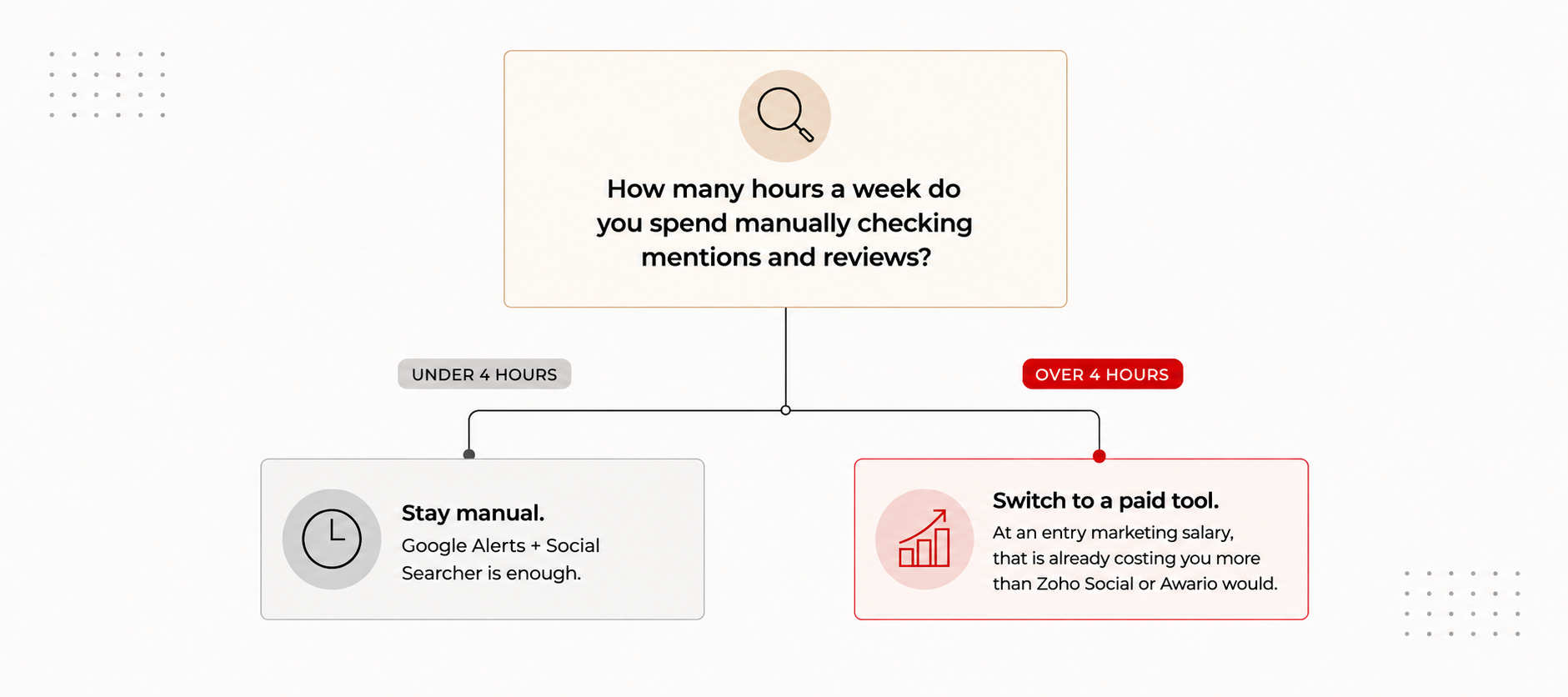
There is a genuine breakpoint where paying beats doing it by hand. At an entry-level Indian marketing salary of roughly ₹25,000 to ₹30,000 a month, four hours a week logging mentions manually already costs the business ₹2,000 to ₹2,500 in labour. Past that, a ₹600 to ₹3,000 monthly tool is a saving, not a cost.
Every startup gets its first bad review eventually, and the instinct to argue back publicly or delete it is exactly wrong. The response that works follows a specific order.
Acknowledge the specific complaint, not a generic one. Naming the exact issue the reviewer raised signals you actually read it. A copy-pasted apology template does the opposite.
Move the conversation offline immediately. A direct email, phone number, or WhatsApp link is not about solving the issue publicly. It is about showing you have a real channel for it, and containing the thread before it becomes a debate.
Close the loop in public once it is resolved. Go back to the original review or thread and note, briefly, that it has been sorted. That is what future customers actually read, not the complaint itself.
Do not threaten legal action against a reviewer, even an unfair one. It is the most reliable way to turn a small complaint into a much bigger story, because the attempt to silence criticism becomes the new headline. This pattern is well documented enough to have a name, the Streisand Effect, and it punishes startups hardest, since they have the least attention to spare defending a bigger fire.
Eggoz, the D2C egg brand, is a good model for how fast a response can genuinely be. In December 2025, a popular YouTube testing channel alleged its eggs contained a banned antibiotic marker, and the claim spread through fitness WhatsApp groups within hours. Within 48 hours Eggoz posted a technical explanation of how trace environmental markers can appear without antibiotic use, founder Abhishek Negi took personal ownership on LinkedIn with the line “ban means ban, no jugaad,” and within three days the company posted independent, NABL-accredited lab reports on X. FSSAI confirmed the eggs were safe. Speed and evidence outran the rumour.
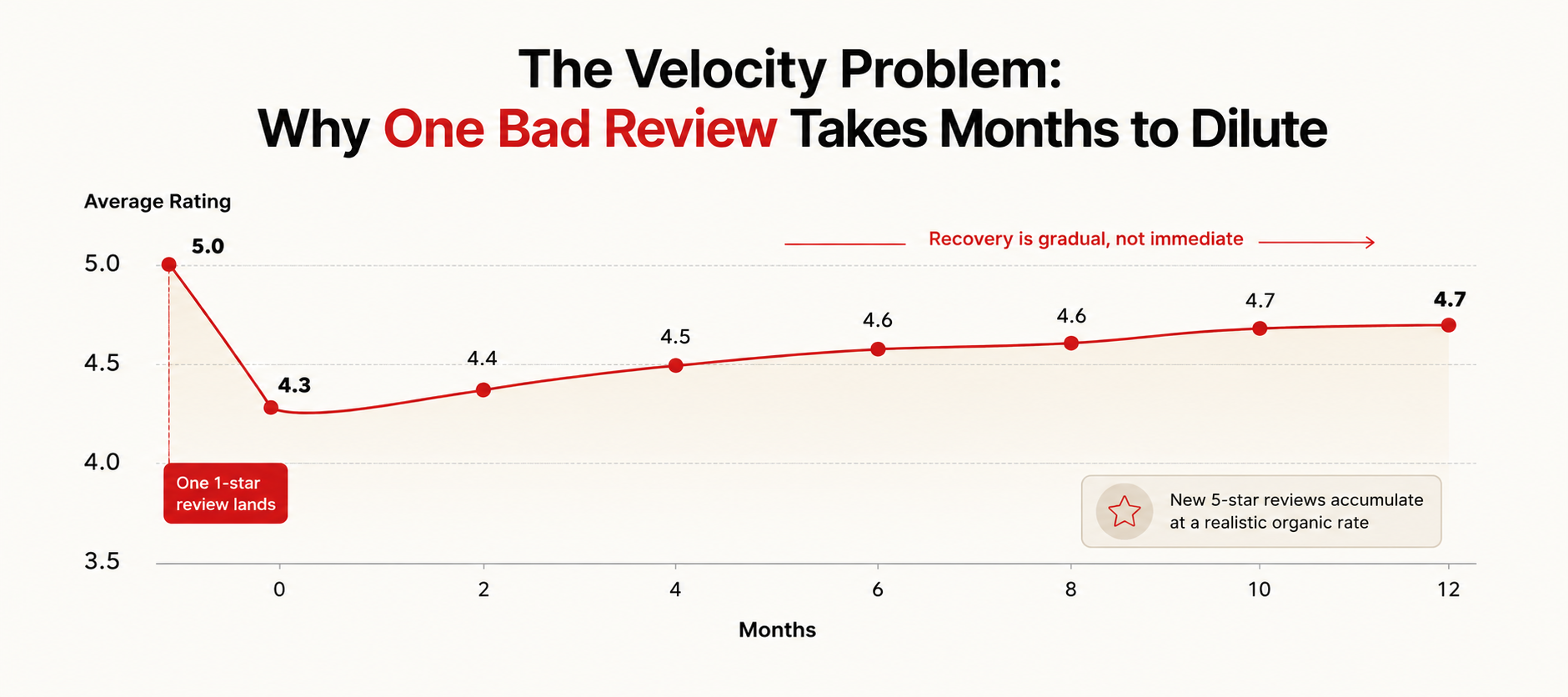
This is the question founders ask most, and most guides answer it dishonestly. The real answer is mathematical.
Founders with their first bit of budget are also the easiest for a bad agency to oversell. Three things are worth specifically avoiding.
“Guaranteed placement” retainers. Any agency promising a fixed article count a month is almost always buying advertorial space or syndicating the same release across low-quality sites. It looks like coverage. It does not build trust.
Enterprise listening suites before product-market fit. A ₹50,000-a-month tool solves a volume problem you do not have yet pre-PMF.
Review-generation services. Illegal under IS 19000:2022, and a sudden unnatural review spike is the exact pattern platforms flag first.
What actually works here is smaller and slower, and often more effective than a campaign. Instead of trying to be visible everywhere, find the two or three niche communities where your customers already gather, a subreddit, a local WhatsApp group, an industry forum, and become genuinely useful there. A handful of real advocates outperforms a broad, thin campaign, because they defend you unprompted.
The same logic applies to mistakes. The instinct when something goes wrong is to minimise it. The stronger move, when the business genuinely can, is to document what happened and what changed as a result. Radical transparency reads as competence precisely because so few companies do it.
Most founders outgrow the DIY stage around the seed to Series A transition, when there is more happening than one person can track. Indian agency pricing at this stage is more transparent than founders expect, once you know where to look.
For context, a mid-level in-house PR manager with five to eight years of experience costs roughly ₹67,000 to ₹1,25,000 a month before benefits. A ₹1.5 lakh agency retainer typically buys a blended team of two to three people, existing media relationships, and surge capacity for a launch or crisis. Below roughly ₹500 crore in revenue, that trade generally favours the agency.
Two red flags are worth remembering before you sign anything. Any agency quoting sharply below ₹50,000 for full-service PR is almost certainly running junior staff and templated outreach to stay profitable at that price, and the placements will show it. And any agency promising to remove a legitimate negative Google review is promising something that is not actually possible without violating the platform's own terms.
Two Crises, One Lesson About Access Control
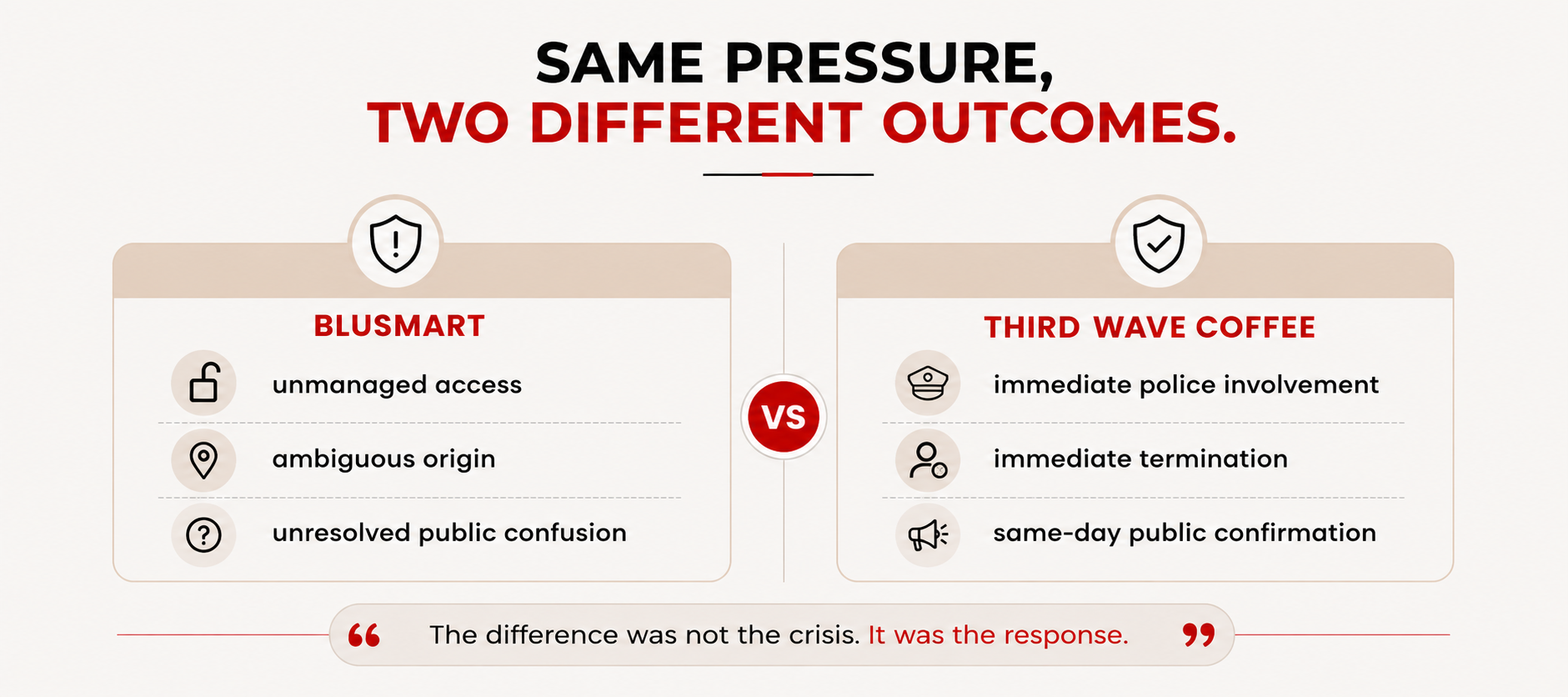
In mid-2025, ride-hailing startup BluSmart’s verified X account posted a message alleging its own founders had committed fraud, days after SEBI restrained them over governance issues. Whether it was a hack or a departing employee who kept login access was debated for weeks, and it did not matter to the damage. The lesson is blunt: revoke social and admin access the day someone leaves, because an unmanaged credential is a live reputational risk sitting in your inbox.
A few months earlier, a Third Wave Coffee outlet in Bengaluru faced a serious incident when an employee hid a phone in the women’s washroom. The response is instructive: the outlet identified the staff member immediately, called the police without hesitation, fired the employee on the spot, and confirmed all of it publicly on X the same day. The crisis was real and the brand still absorbed it, because it moved fast and told the truth.
Put the two together and the pattern is simple. The startups that come through a crisis intact are not the ones with the best messaging. They are the ones with the least to hide and the fastest, most literal response to the actual event.
If a genuine crisis feels imminent, our guide to protecting reputation during a crisis covers preparing a response before you need one. And since the founder and the company are the same story at this stage, our guide to personal reputation management for founders and CEOs picks up from here.
You do not need a Series B budget to do this well. You need a founder willing to be visible, a habit of asking happy customers to say so, and the discipline to respond to bad news with the truth, fast, before someone else writes the story for you.
Building this from zero and want a second opinion on where to start?
At Bridgers, we work with founders from the earliest stage, including the ones who are not yet ready for a full retainer and just need a clear, honest read on what actually matters right now.
Start free with Google Business Profile alerts and Social Searcher. Past roughly four hours a week of manual tracking, Zoho Social's Premium tier at ₹3,000 a month is the most India-suited paid option, with rupee billing and domestic data centres. Awario is a cheaper global alternative at roughly ₹2,400 a month. Avoid Mention.com here, its only real plan runs about ₹50,000 a month and suits a company with a dedicated comms team, not a startup.
Lean on the founder's own visibility before the brand has any. Honest, regular LinkedIn writing about what you are building, setbacks included, attracts early believers faster than paid advertising. Pair that with a small number of genuine customer stories rather than volume ratings, since manufacturing early reviews is now a legal violation under IS 19000:2022, with fines up to ₹10 lakh.
Acknowledge the specific complaint, move the conversation to a private channel like email or WhatsApp instead of debating it publicly, and once resolved, close the loop in public. Never threaten legal action against a reviewer, even an unfair one, since it typically amplifies the story rather than ending it.
Slower than most founders expect. A single 1-star review against a small existing base drops the average sharply, and recovering it needs a meaningful run of new positive reviews, not a quick fix. For a startup with 20 transactions a month and a typical 5% organic review rate, that realistically takes 8 to 12 months. Politely prompting satisfied customers to review you is the only legitimate way to speed it up; paying for reviews is illegal.
Agencies guaranteeing a fixed volume of media placements, which usually means paid syndication rather than genuine coverage; enterprise-grade monitoring software before you have product-market fit; and any review-generation service, which is illegal under IS 19000:2022 and easily flagged by platforms as an unnatural spike.
Most Popular Blogs
Newsletter
Categories
About the author
Anubhav Singh: Founder & Managing Director, Bridgers
Anubhav Singh is the Founder and Managing Director of Bridgers, with over 15 years of experience in media relations and strategic corporate communications. He has worked with leading Indian brands across sectors and holds a degree in Mass Communication & Video Production along with an MBA in Marketing. Under his leadership, Bridgers has grown into one of India’s leading PR agencies, known for transparency, innovation, and quality.
Related Articles


