What is crisis communication and why is it important?
25 May 2025

Type your company name into Google and look at what comes back. Very little of it was written by you. There will probably be a Justdial listing you never claimed, an AmbitionBox page where former employees rated your management, review snippets pulled into a panel on the right of the screen, and somewhere among all of it, the website you spent months getting right.
That page, assembled by platforms you do not own and cannot edit, is what a customer, a job candidate or an investor sees before anything you choose to show them. Managing it is a discipline in its own right.
This guide covers what online reputation management involves, which platforms matter in India and for which sectors, the counterintuitive truth about star ratings, what can realistically be monitored, and what the law here allows you to remove. If you want the wider strategic picture first, our complete guide to reputation management covers how reputation forms and why it now shows up in financial terms.
Online reputation management, usually shortened to ORM, is the practice of monitoring, influencing and managing how a business is perceived across digital channels. It sits at the intersection of public relations, search optimisation, customer experience and, more often than people expect, legal strategy.
The discipline emerged in the early 2000s because digital content is permanent and algorithmically ranked in a way print coverage never was. A newspaper article about your company in 2011 was read for a day. It then physically disappeared, while the same article online is still sitting on page one of your brand search fifteen years later and will stay there until something better outranks it.
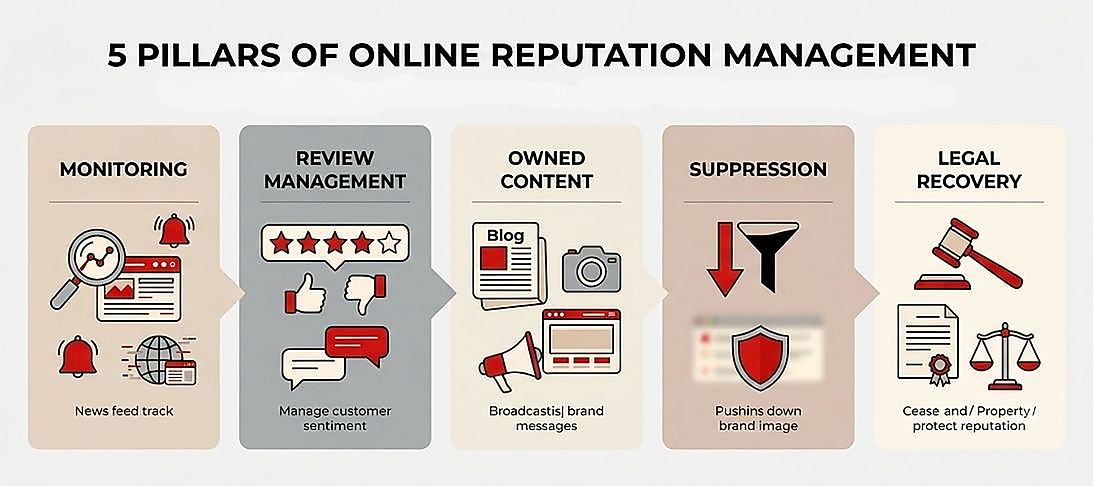
Practitioners generally split the work into five components, and it is worth knowing all five because most businesses only think about the second.
Monitoring. Tracking mentions, sentiment and visibility across channels, so problems reach you through your own systems rather than through a customer.
Review management. Auditing, responding to and encouraging ratings across the platforms your sector actually uses.
Owned content and profiles. Building and ranking material you control, so it occupies the results people see first.
Suppression. Publishing useful, high-authority content to push negative material down the results, since removal is usually impossible.
Legal recovery. Using takedown notices, grievance mechanisms and, where necessary, court orders against content that is demonstrably false or unlawful.
The boundaries matter as much as the components. ORM is not search optimisation, because ordinary SEO optimises for traffic while ORM optimises for what a results page looks like when somebody searches your name. It is not social media management, which builds an audience, whereas ORM watches the same channels for risk. And it is not customer service, which resolves a complaint privately, while ORM concerns how that complaint and your response look to everyone else reading.
This is the question most people arrive with, and the distinction is cleaner than it first appears. Public relations works through third parties, earning coverage and shaping narrative where editorial decisions are made by somebody else. Online reputation management works on the artefacts that activity leaves behind, meaning the search results, profile pages, ratings and AI summaries that persist long after the story has run. The two are closely connected because good PR generates exactly the credible material ORM needs in order to outrank the bad, but they are not interchangeable. You can have excellent media coverage and still lose a customer to a two-star Justdial listing you did not know existed.
Most ORM advice tells you to monitor your brand online without saying where. In India, that is unhelpful, because reputation is distributed across a specific set of platforms that vary sharply by sector and several of which are barely known outside the country.
Review infrastructure in India is overwhelmingly consumer-facing, which leaves B2B and industrial businesses in an odd position, because a manufacturer in Coimbatore or a components supplier in Pune will rarely accumulate review volume anywhere. Buyers do not leave star ratings after a procurement cycle.
IndiaMART functions as the reputation layer for those businesses instead, and it runs on completely different signals. TrustSEAL verification, catalogue accuracy and response times to enquiries together do the job that reviews do in consumer sectors, which means a supplier answering requests for quotation within the hour is building reputation in the only currency that the market recognises.
In 2025, Zomato changed its data-sharing policy to give restaurant partners access to customer phone numbers. That sounds administrative, but it altered reputation work in the food sector completely, because a restaurant can now reach a dissatisfied customer on WhatsApp and resolve the problem before it becomes a public one-star review. The discipline moves from managing complaints after publication to intercepting them before they are published.
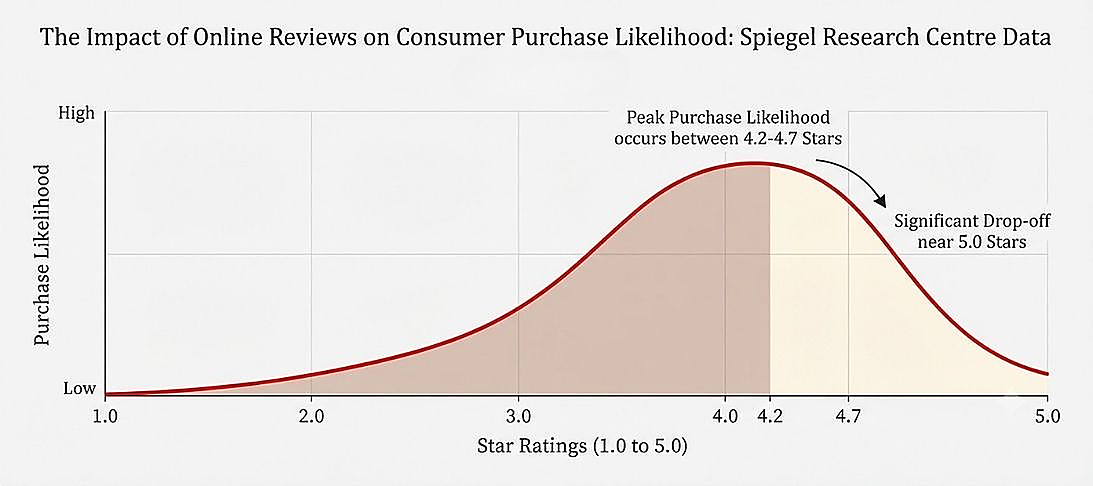
Most businesses chase a perfect score, and the research says that is a mistake. Northwestern University's Spiegel Research Centre analysed extensive ecommerce data and found that purchase likelihood peaks when a business holds an average rating between roughly 4.2 and 4.7 stars, then drops as the score climbs towards a flawless 5.0, because consumers read perfection as manipulation and are usually right to.
The same body of research found that 82% of shoppers deliberately seek out negative reviews in order to understand the worst plausible outcome before committing. A scattering of criticism, visibly and politely addressed, establishes that the ratings are real, whereas a wall of identical five-star praise establishes the opposite.
Monitoring tools range from free alerts to enterprise platforms that scrape at scale, but the category matters less than one weakness that catches out Indian businesses using global software.
Most international listening tools handle English competently and everything else poorly. India generates enormous volumes of mixed-script conversation, and a tool that cannot parse Hinglish or Tanglish will report neutral sentiment on a thread that is actually furious. Indian platforms have built for this, with Locobuzz processing over 4.8 million conversations a month and claiming support for more than 200 languages with native context, including the sarcasm and slang that break simpler models.
There is also a hard limit worth being honest about. Monitoring tools can only reach publicly available data, which makes closed WhatsApp groups, private Telegram channels and encrypted messaging effectively invisible. That is a significant blind spot in a country where a great deal of reputational damage circulates exactly there, and any agency promising complete coverage is describing something that does not exist. Managing those channels is a legal problem rather than a monitoring one.
Most reputation problems are handled through content and response, but a minority require the law, and Indian businesses are often unaware of how much machinery now exists.
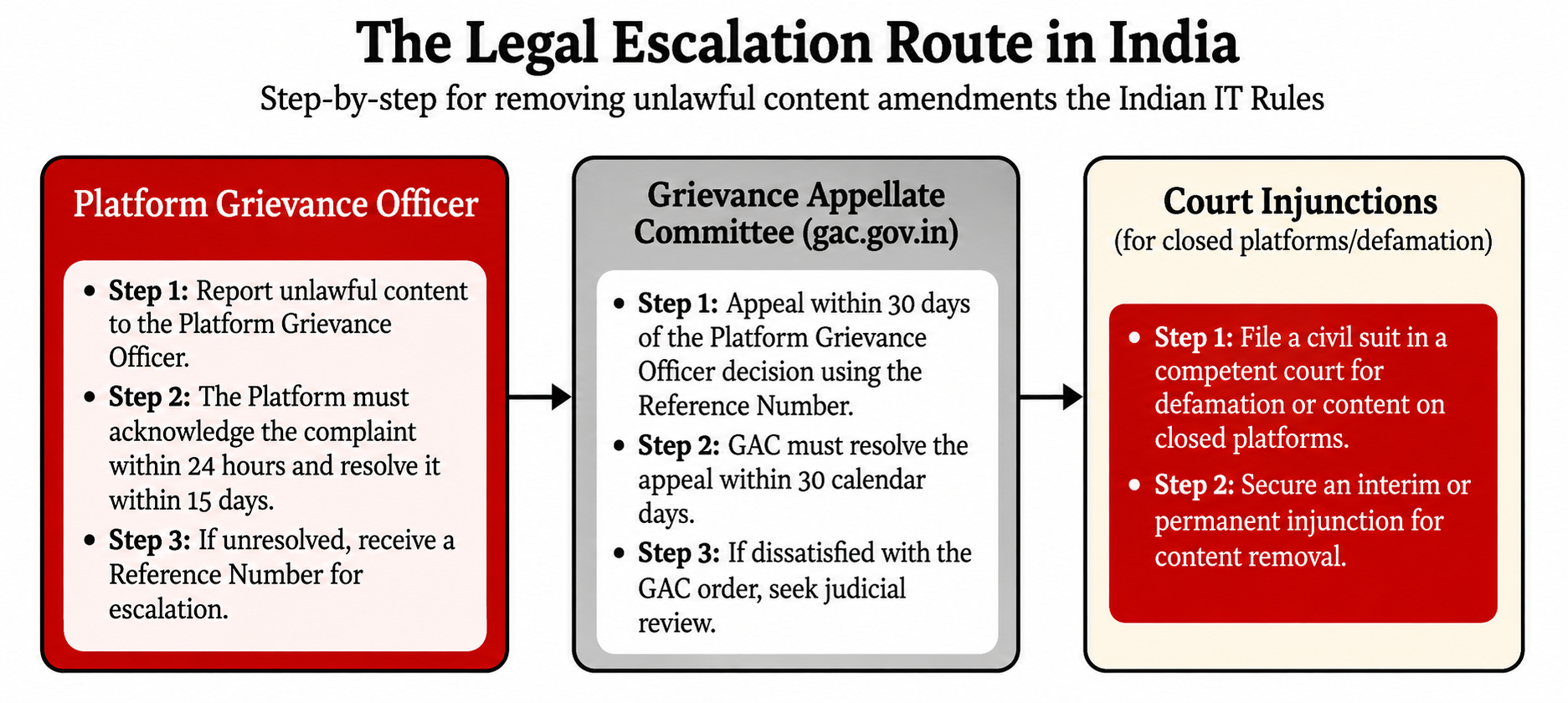
Under the 2026 amendments to the IT Rules, intermediaries must remove unlawful content within three hours of a valid order and synthetic media such as deepfakes within two hours, with non-compliance risking their safe harbour protection. If a platform's grievance officer rejects a legitimate request, appeals go to the Grievance Appellate Committee through the government portal at gac.gov.in, a statutory body whose orders bind platforms. Very few businesses know this route exists, and it sits usefully between doing nothing and going to court.
Digital defamation falls under Section 356 of the Bharatiya Nyaya Sanhita 2023, and succeeding requires proving the statement was false, that it referred to you specifically, and that it was published to a third party. The bar is deliberately high, and truthful criticism made in good faith is generally protected.
The Bombay High Court's 2020 ruling in Marico Limited versus Abhijeet Bhansali is the reference point for brands facing influencer criticism. A YouTuber's video about Parachute Coconut Oil was found to have crossed from honest opinion into disparagement, and an injunction followed, establishing that the line exists while also showing how far a critic can go before reaching it.
In 2024, fraudsters impersonated the venture capital firm Peak XV Partners across Telegram and WhatsApp, running bogus investment platforms in its name. No amount of monitoring could have caught it because none of it was public. Peak XV secured a John Doe injunction from the Delhi High Court, compelling the takedown of the accounts and websites without needing to identify the individuals behind them. For impersonation on closed platforms, that court order is realistically the only route.
The Central Consumer Protection Authority has become considerably more aggressive, and it now treats manipulative design as a consumer rights violation. In 2025, it fined the edtech company PhysicsWallah ₹5 lakh for automatically adding charity donations to carts. It fined McAfee ₹1 lakh for making users click a button reading “Accept Risk” in order to cancel a subscription. In June 2025, it directed all ecommerce platforms to self-audit for dark patterns and fake reviews within three months. Your checkout flow is now a reputation risk with a rupee value attached.
A growing share of first impressions now form inside AI assistants rather than search results, and the mechanics differ enough to matter. Large language models do not hold facts about your company but assemble answers from sources they treat as authoritative, which in practice means Wikipedia and Wikidata, structured data on your own site, major business databases and tier-one news coverage.
That has two consequences worth acting on. Earned coverage in credible publications has become more valuable rather than less, because it now feeds both search and AI discovery, and correcting a falsehood in an AI answer is not a support ticket you can raise because there is nobody to raise it with. You correct it by fixing the underlying sources, which means keeping entity data consistent across databases and getting the record right in the places these systems trust. Our guide to Google reputation management covers the search side in detail.
The single most useful thing to understand before hiring anyone is the difference between suppression and deletion, because vendors routinely blur the two.
Legitimate ORM works through suppression rather than deletion. You publish genuinely useful, credible content on properties you control or earn, and you rank it well enough that it occupies the results people see first. The negative material still exists, but it stops being the first thing anyone encounters. The approach is slow, and it works.
Any vendor promising guaranteed removal of a negative article or review is describing something that is not technically possible. Unless a court orders it or the content clearly violates a platform's published policy, nobody can force its removal. Treat that promise as a disqualifying signal.
There is also an ethical objection worth taking seriously rather than dismissing. When ORM pushes valid consumer complaints onto page two, it sanitises the record at the expense of the next customer, who can no longer easily find a warning that was genuinely useful. The honest position is that suppression is defensible when the material is misleading or disproportionate, and much harder to defend when it reflects a real failure the business has not fixed.
Parul University is a useful illustration of doing this well. Facing a legacy 2.3 out of 5 rating on MouthShut, the institution did not attempt deletion. Still, it systematically encouraged verified current students to review it on education platforms, building enough recent, authentic volume that the historical material stopped defining the picture. Dilution through genuine activity is almost always more durable than removal, and it is available to everyone.
If you have never done any of this, the first step is not buying software but searching your own company name in an incognito window and recording what you actually find, including the profiles you never claimed. Most businesses discover that their problem is not criticism but absence, because nobody ever filled in the page that ranks second for their own name. Our guide to building a reputation management strategy from scratch covers the full sequence.
Online reputation management is not about controlling what people say. It is about making sure that what they find is accurate, current, and fairly represents a business you would be happy to be judged on.
Want to know what people actually find when they look you up?
At Bridgers, we audit and manage online reputation for Indian businesses across search, review platforms and emerging AI discovery, starting with an honest picture of where you currently stand and which parts of it are worth changing first.
Online reputation management or ORM, is the practice of monitoring and shaping how a business is perceived across digital channels, including search results, review platforms, employer review sites and AI assistants. It covers five areas: monitoring mentions, managing reviews, building owned content, suppressing negative material through better-ranking alternatives, and pursuing legal removal where content is genuinely unlawful.
It depends entirely on your sector, though Google Business Profile and Justdial matter for almost any business with a local presence. Zomato and Swiggy dominate restaurants, Amazon and Flipkart dominate ecommerce, AmbitionBox and Glassdoor decide employer reputation, Practo governs healthcare, and IndiaMART is where B2B and industrial reputation actually live. MouthShut carries significant weight in consumer goods, real estate and education.
Not as good as you would expect. Research from Northwestern University's Spiegel Research Centre found that purchase likelihood peaks when the average rating sits between roughly 4.2 and 4.7 stars and falls as it approaches 5.0, because consumers read perfection as manipulation. The same research found that 82% of shoppers actively look for negative reviews to judge credibility. A slightly imperfect rating with visible, well-handled criticism converts better than a flawless one.
Most Popular Blogs
Newsletter
Categories
About the author
Anubhav Singh: Founder & Managing Director, Bridgers
Anubhav Singh is the Founder and Managing Director of Bridgers, with over 15 years of experience in media relations and strategic corporate communications. He has worked with leading Indian brands across sectors and holds a degree in Mass Communication & Video Production along with an MBA in Marketing. Under his leadership, Bridgers has grown into one of India’s leading PR agencies, known for transparency, innovation, and quality.
Related Articles


