What is crisis communication and why is it important?
25 May 2025

If something went badly wrong at your company tomorrow, who would give you the benefit of the doubt?
Most leaders picture loyal customers and investors who trust the numbers. It is a comfortable belief, and much crisis advice quietly assumes it. Researchers have tested it, and the results are mixed. A good name helps, but less than you might hope, and sometimes it makes the fall harder.
This guide to reputation management during a crisis covers what your good name will and will not do for you, what two Indian cases show, which legal clocks can start the moment something goes wrong, and how to tell when you have recovered. The short version is that the most useful work happens before the crisis, and the last section shows what that work looks like.
What a good name really does for you in a crisis
So does a good name protect you? Four research findings give partly different answers.
Coombs and Holladay ran two studies on exactly this question. In their 2006 paper, they found a halo effect, but only within a limited range, for organisations with very favourable reputations. Their data also supported the idea that a good name acts as a shield that reduces the damage itself, over the idea that people simply blame the company less and give it the benefit of the doubt.
Other experiments found something less comforting. A SAGE encyclopedia entry on the velcro effect describes studies where good and neutral reputations did about the same, and only a bad reputation changed the result. A bad name made blame stick, which is where the word velcro comes from. The entry adds that this rests on two experiments with made-up scenarios, so hold it loosely.
Then there is the finding that surprises people. Rhee and Haunschild looked at US car recalls from 1975 to 1999 and found that carmakers with strong reputations took bigger market penalties than less admired ones. Their explanation is that a strong name raises what customers expect, so a defect lets them down harder. The penalty was smaller when a carmaker had few rivals with a similar reputation, or a narrow product line.
The good news comes from Morgan and Minor, who studied how stock prices reacted to product recalls at S&P 500 companies. Firms with high corporate social responsibility ratings fared better, which the authors call reputation insurance. I could read only the abstract, so I cannot tell you how strong the effect is.

So what should you take from all this? A bad reputation hurts you. A good one helps less than people assume, and it can raise the price of a failure if it promises too much. Responsible conduct before a crisis may soften the market's reaction. None of these studies comes from India, most use US data or made-up scenarios, and I found no Indian study that tests them. Use them to question your assumptions. They cannot tell you what will happen to your company.
Reputation management during a crisis depends on who is judging you
A crisis puts your reputation in front of several judges at once, including customers, regulators, investors, employees and the press, and each group asks its own question. Customers want to know whether it is safe to keep buying. Regulators want to know whether you broke a rule. Investors want to know what it will cost. Employees want to know whether you will tell them the truth.
Each question needs a different answer, and the answers come from different parts of your company. A customer needs a clear action, such as stop using the product, return it or expect a refund by a stated date. A regulator needs documents and quick access to the people who know the facts. An investor needs to hear what is known, what is not known yet and when you will say more. An employee needs to hear it from you before they read it in the news. Keep one fact sheet that all four messages draw from, so the facts do not drift between them.
India adds another layer. Edelman's 2026 India findings show a 16-point gap in trust between higher-income and lower-income groups, and say that nearly half the population (48 percent) is unwilling or hesitant to trust people who differ from them. These are national figures, so they cannot describe your own audience. They do suggest that one statement will land differently with different groups. Find out which groups matter most to your business and where they get their information.
What two Indian product cases tell us
Both cases involve large Indian food brands, so they will not fit every business. They still show how a crisis unfolds when a regulator gets involved.
Start with Maggi. In January 2015 it held 77 percent of the instant noodles market, according to Nielsen figures reported by Business Standard. In June 2015, FSSAI banned it, calling it unsafe and hazardous after finding lead above the permitted limit. The product stayed off shelves for five months and returned in November after court and government lab clearances.
The cost was heavy. Nestlé India's April to June 2015 quarter ended with a loss of ₹64.40 crore, its first quarterly loss in 15 years, after an exceptional item of ₹451.66 crore, which the company said covered estimated losses on withdrawn stock and related costs. Recovery took longer than the return to shelves. Maggi's share was 42 percent in January 2016, and by April 2016 it had regained leadership of its segment, though with a share well below its old level. By October 2016 Nestlé said Maggi held 57 percent, against about three-quarters before the crisis. I could not find a source that explains why Maggi bounced back, so I would not credit any single cause.
The second case started abroad. On 5 April 2024, Hong Kong's Centre for Food Safety said it had found ethylene oxide, a pesticide, in three MDH spice mixes and one Everest mix and told vendors to pull them. Singapore's food agency ordered a recall of the Everest product on 18 April. MDH responded on 27 April, calling the allegations baseless, untrue and lacking any substantiating evidence, and said it had received no communication from either regulator. I could not find a statement from Everest in the pages I opened, so I will not say whether it replied.
Then, on 21 May 2024, the Food Safety and Standards Authority of India (FSSAI) said 28 lab reports on samples from MDH and Everest facilities found no ethylene oxide, with six reports still awaited. No ban or recall followed in India. Whether any of this hurt sales or customer trust, I cannot say, because I found no published data.
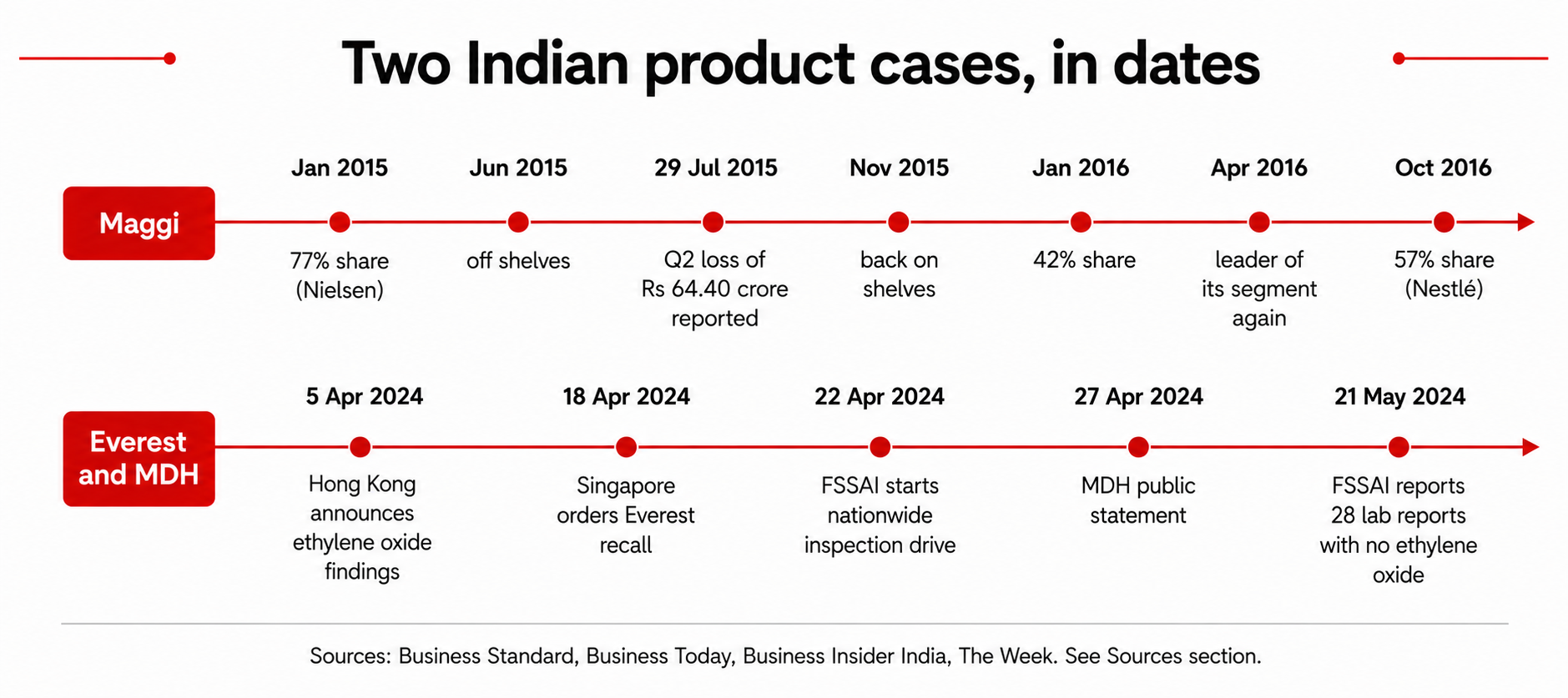
What do the two cases have in common? Look at who moved first. In the spice case, a foreign regulator spoke before the company did. FSSAI's lab results came 46 days after Hong Kong's announcement, and MDH's statement, the earliest I found, came 22 days after it. In a gap that long, other people's accounts shape the story. Maggi's return also followed court and lab clearances. From what I read, laboratories, regulators and courts moved both stories more than the companies' own statements did.
The practical lesson is to prepare. Keep the documents that settle a question, such as test reports, batch records and supplier certificates, where your team can find them on the day someone asks.
Keep the limits in mind. Both cases involve large, long-established food brands, and in both the regulator was the main actor. If you run a young direct-to-consumer (D2C) brand or a service business, customers, creators or journalists may take the regulator's role instead. I found no Indian study comparing how different kinds of companies fare, so these cases show what can happen. They do not show what is likely.
The first few days, and the legal clocks that may start
What should you do in the first few days? Start by finding out what is true. Name one person who owns the facts, and keep one fact sheet that records what you know, what you do not know yet, and when each item was last checked. Every message to customers, regulators and staff should draw from that sheet. Call anything still unknown unknown, because every statement can be quoted back to you later.
Next, check what you have already promised. Look at the claims on your packs, ads, website and certificates, and pause anything the crisis has made doubtful. Then commit only to what operations can deliver, such as a refund date or a replacement, because customers will hold you to it. Keep a dated record of what you said and did, since regulators, journalists and customers will compare the two. For the messaging side, the Bridgers guide to crisis communication covers the types, the team and the toolkit.
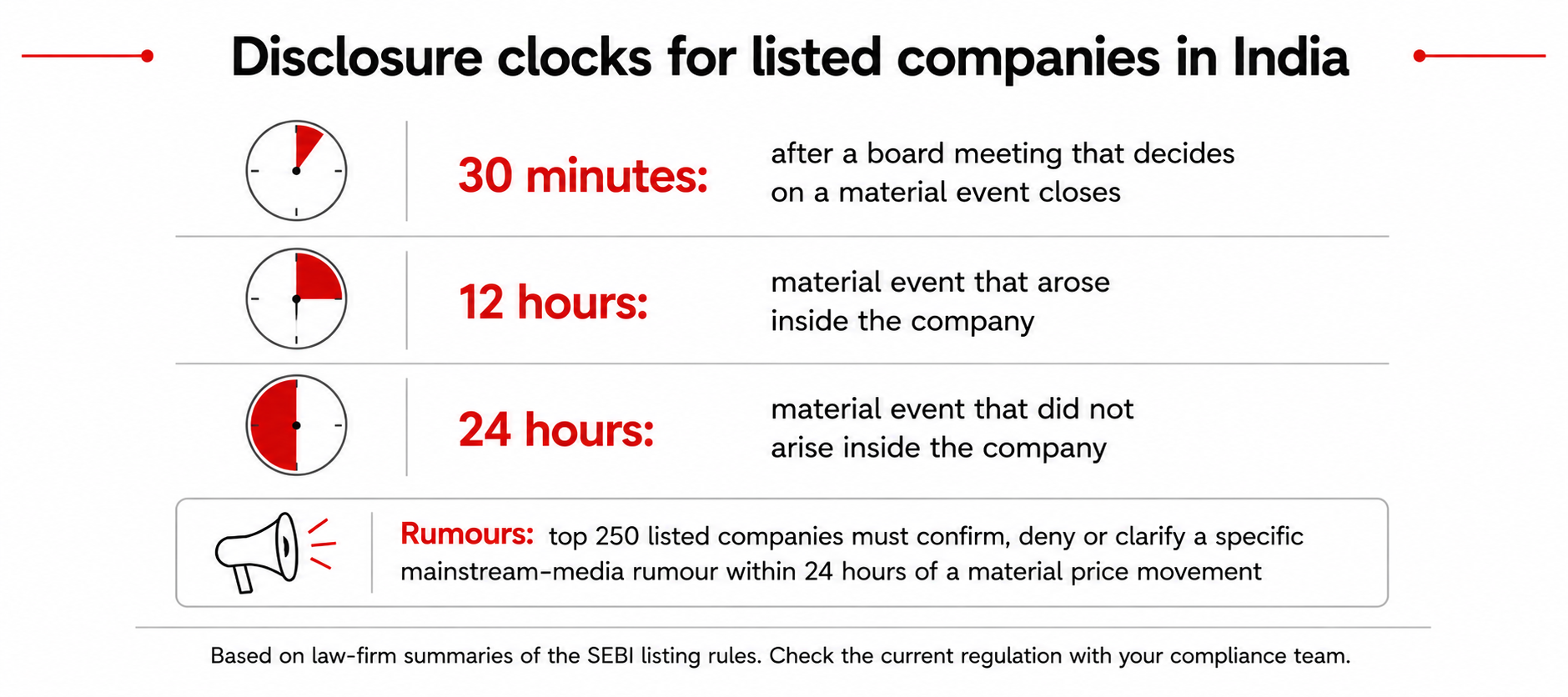
Does the law start a clock for you? If you run a listed company, it may. Under the listing rules of the Securities and Exchange Board of India (SEBI), as amended in 2023, a company must tell the stock exchanges about a material event within 12 hours if it arose inside the company, and within 24 hours if it did not. After a board meeting that decides on such an event, the allowed time is 30 minutes from the close of the meeting. Not every crisis counts as material, so ask your compliance team where you stand.
What if you sell food or consumer goods? Then a regulator can take the lead. FSSAI's recall rules require a business to stop distributing the affected food at once, even before it gets formal instructions, and allow FSSAI or a state commissioner to direct a recall. More broadly, Section 20 of the Consumer Protection Act, 2019 lets the Central Consumer Protection Authority order the recall of dangerous, hazardous or unsafe goods, and the repayment of their price to buyers, after hearing the company. In both situations the regulator sets the pace, and your communication follows it.
Listed companies also face a rule on rumours. According to a law-firm alert, the top 250 listed companies must confirm, deny or clarify a specific rumour in mainstream media within 24 hours of a material price movement. The rule covered the top 100 companies from June 2024 and the top 250 from December 2024, and vague rumours do not trigger it. The rules in this section come from law-firm and legal-site summaries and may have changed since, so check the current text with your compliance team before you rely on them.
And what about rumours that have nothing to do with a share price? Many start in WhatsApp groups. The best public study I found, by Garimella and Eckles, looked at politically oriented WhatsApp groups in India before the 2019 national election and found that about 13 percent of shared images were known misinformation. It appeared in the Harvard Kennedy School Misinformation Review in 2020. The study covers politics, so it says nothing direct about brands, and I found no public research on brand rumours on WhatsApp. It does show that false images circulate in Indian WhatsApp groups. Private groups are hard for any monitoring tool to see, so ask your sales, support and distributor teams what they are hearing.
How to tell whether you have recovered
How will you know when you have recovered? You will often read that a reputation takes 3.2 years to recover. That number comes from a Burson-Marsteller survey of 685 executives, analysts, journalists and officials in 65 countries, who were asked what they believe recovery takes. It records opinion. It does not measure how long companies actually took, and the page I found does not date the survey.
Measured evidence is thinner. In a 2018 conference study of a handful of large companies, including Volkswagen, Toyota, Starbucks and Target, Matt Tidwell compared RepTrak and Harris Reputation Quotient scores before and after crises. About half did not return to their earlier scores, and those that did took about two years on average. The sample is small and the release names no journal, so it can warn you but cannot settle the question. Maggi, covered above, fits that pattern, since its share was still well below the old level about a year after relaunch.
So decide what recovery means before you need it, using numbers you already track. Useful ones are complaint volumes by cause, ratings on your listings, what appears when someone searches your name, sales or market share, and the questions you get from regulators and distributors. Write down where each stood before anything went wrong. Without that baseline, "recovered" means whatever people feel like saying. If you sell direct to consumers, the complaint and rating checks in the Bridgers guide to reputation management for D2C brands in India apply here too.
What to do while nothing is wrong
Since a good name protects you less than most people hope, spend the calm period fixing specific weaknesses. Start with what you already know is fragile, such as a supplier you do not audit, a claim on your pack that you cannot prove, or a complaint pattern nobody has acted on. These are natural places for a crisis to begin.
Keep your promises realistic, too. Rhee and Haunschild's result suggests that the higher you set expectations, the harder a failure lands, so advertise only what you can deliver every time. Then write down your obligations and who owns each one, including disclosure duties, recall duties and your regulators' contact points. A written reputation management strategy is the natural home for all of this.
Then rehearse once. Pick a plausible failure for your business, such as a defective batch, a data leak or a notice from a regulator, and walk through it on paper. Who learns about it first? Which documents would you need, and where are they? Which legal clocks would start? Where do your baseline numbers live? An hour spent on this will show you the gaps while fixing them is still cheap.
If you would like a second view on where your company's reputation is thin, Bridgers can help you plan this groundwork, from reputation strategy to crisis readiness.
Frequently asked questions
Does a good reputation protect a company in a crisis?
Only partly. Coombs and Holladay found a halo effect in a limited range for very favourable reputations, while other experiments found that only a bad reputation changed the outcome. Rhee and Haunschild found larger market penalties for highly reputed carmakers after recalls. The evidence is mixed and mostly from outside India.
How long does it take to recover a reputation after a crisis?
No fixed answer exists. The popular 3.2-year figure comes from a survey of what executives believe. In a small 2018 study, about half the large companies did not return to earlier reputation scores, and the rest took about two years. Maggi reached a 57 percent share about a year after relaunch.
What is the difference between crisis management and reputation management?
Crisis management deals with the event itself, including operations, legal steps and communication. Reputation management looks at how customers, regulators, investors and employees judge the company before, during and after it. The two overlap in a crisis, and the Bridgers guide to crisis communication covers the response side.
Do listed companies in India have to respond to media rumours?
Some do. According to a law-firm alert, the top 250 listed companies must confirm, deny or clarify a specific mainstream-media rumour within 24 hours of a material price movement. Vague rumours do not trigger the rule. Check the current SEBI text with your compliance team.
Can a company be forced to recall a product in India?
Yes. FSSAI's recall regulations let FSSAI or a state commissioner direct a food recall. Under Section 20 of the Consumer Protection Act, 2019, the Central Consumer Protection Authority can order dangerous, hazardous or unsafe goods recalled and the price repaid to buyers, after it hears the company.
How do you rebuild a damaged reputation?
Start by fixing the cause and showing what changed, with documents where you can. Maggi's return to shelves in November 2015 followed court and lab clearances, and it was leader of its segment again by April 2016. Then track the measures you set before the crisis, such as complaints, ratings and market share, because recovery shows up in those numbers.
Most Popular Blogs
Newsletter
Categories
About the author
Anubhav Singh: Founder & Managing Director, Bridgers
Anubhav Singh is the Founder and Managing Director of Bridgers, with over 15 years of experience in media relations and strategic corporate communications. He has worked with leading Indian brands across sectors and holds a degree in Mass Communication & Video Production along with an MBA in Marketing. Under his leadership, Bridgers has grown into one of India’s leading PR agencies, known for transparency, innovation, and quality.
Related Articles


