What is crisis communication and why is it important?
25 May 2025

Imagine a shopper who has never heard of your brand. They find your product on Flipkart, see the star rating and scroll straight to the three newest reviews. They skip your brand story. They want to know whether orders like theirs turn up on time and match the photos. For them, those reviews are your reputation, and most of what they say was settled long before anyone on your team wrote a post or a press note. That is why reputation management for D2C brands in India starts with how you run orders, and then moves on to how you talk about them.
This guide argues that a D2C brand's reputation is mostly the result of how well it runs delivery, returns and customer support. Regulators are now checking those same areas too. Communication still matters, and it works best on top of operations that hold up. Along the way, the guide covers what you can and cannot control on a marketplace, what the new e-commerce rules change, and where to look first when ratings slip.
The most useful evidence is what Indian shoppers complain about when they are annoyed enough to escalate. In 2025 the National Consumer Helpline received more than 5.1 lakh complaints against e-commerce and quick-commerce platforms, according to a written reply by the Minister of State for Consumer Affairs in the Lok Sabha. That was up roughly 14 percent from 4.4 lakh in 2024.
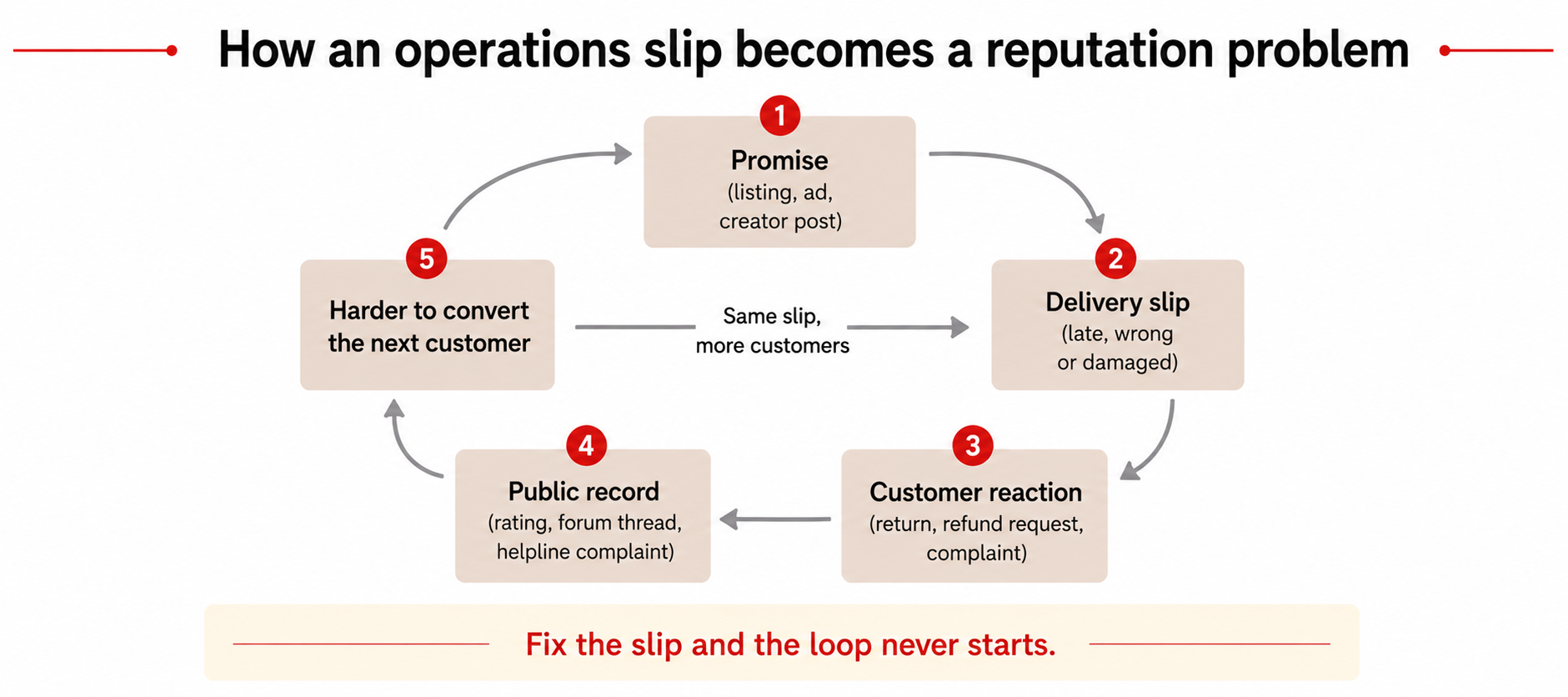
Look at what the complaints were about. The four biggest categories were non-delivery of products (79,818), wrong products delivered (75,426), replacement or refund not given (61,056) and defective or damaged products (60,969). Adding those four gives roughly 2.8 lakh complaints, a little over half the total. Each one is about getting the right product to the customer, or fixing it when that goes wrong.

Two cautions apply. These are complaints against platforms, so they cover sellers of every size, and the data does not isolate D2C brands. Complaint counts also rise with a platform's size, so a big number does not by itself mean poor service.
Even so, the pattern is hard to argue with. The customer who never received the order, or received the wrong one, or could not get the money back, is the customer who writes the one-star review, starts the thread or files the complaint. The public record of a D2C brand is largely the record of its logistics and support. That is why, in reputation management for Indian businesses, this guide puts operations ahead of messaging.
What you control on marketplaces, quick commerce and your own store
Where the customer buys decides how much of this you can manage. Bain and Flipkart's 2026 report found that quick commerce is already 16 to 17 percent of e-commerce sales value, and smaller cities supplied about half of the growth in online orders in 2025. A growing share of your customers will decide in minutes, on a small screen, with a star rating to go on.
On a marketplace you do not own the review page, the ranking logic or the complaint desk. You own the product, the packaging, the dispatch time and the way you respond. Customers tend to blame your brand for all of it. The same Lok Sabha reply breaks complaints down by platform, with Flipkart at about 1.3 lakh, Amazon at 91,248, Meesho at 29,284 and Myntra at 25,384. That order probably reflects platform size more than service quality.
Platforms say little about how they use your ratings internally. Agency guides describe fill-rate targets and quality penalties on quick-commerce apps. Those guides come from agencies that sell onboarding services, and I could not find thresholds published by the apps themselves. Treat any specific number you read as an estimate, and ask your category manager. On someone else's platform, the one thing you fully control is whether the order arrives right. Your own store is where you control the whole experience, and where the new rules may apply to you directly.
The next question is usually how much extra revenue a better rating brings. I looked for an India-specific answer and did not find a study I would trust. Global figures circulate widely, and many of them trace back to vendor surveys, so I have left them out of this guide.
Your own data is the better source anyway. If you sell similar products at different ratings, compare conversion on listings sitting at 4.5 stars with those at 3.8, and keep price and traffic source as close as you can. A few weeks of that comparison tells you what a tenth of a star is worth to your business, and it carries more weight in a budget meeting than someone else's percentage.
Returns show you where what a brand promised and what arrived drifted apart. Unicommerce's 2026 D2C report looked at more than 410 million shipments from over 6,000 brands on its platform. It found that cash-on-delivery orders were returned at 58 percent in the festive quarter, against under 15 percent for prepaid orders.
Treat that figure with care. Unicommerce sells order-management software, the report gives no exact date range for the festive quarter, and it tells you how often orders came back but gives no reasons. A high return rate can come from impulse orders, careless addresses or a product that looked different from its listing, and the report does not separate them. Even so, a gap that wide is worth checking in your own data, split by payment method.
For reputation, the practical point is this. Many returned orders come from customers who were disappointed, and some of them leave a review on the way out. If returns spike after a campaign, check what the campaign promised before you check the courier. That check costs nothing, and it can explain a rating dip faster than any monitoring tool.
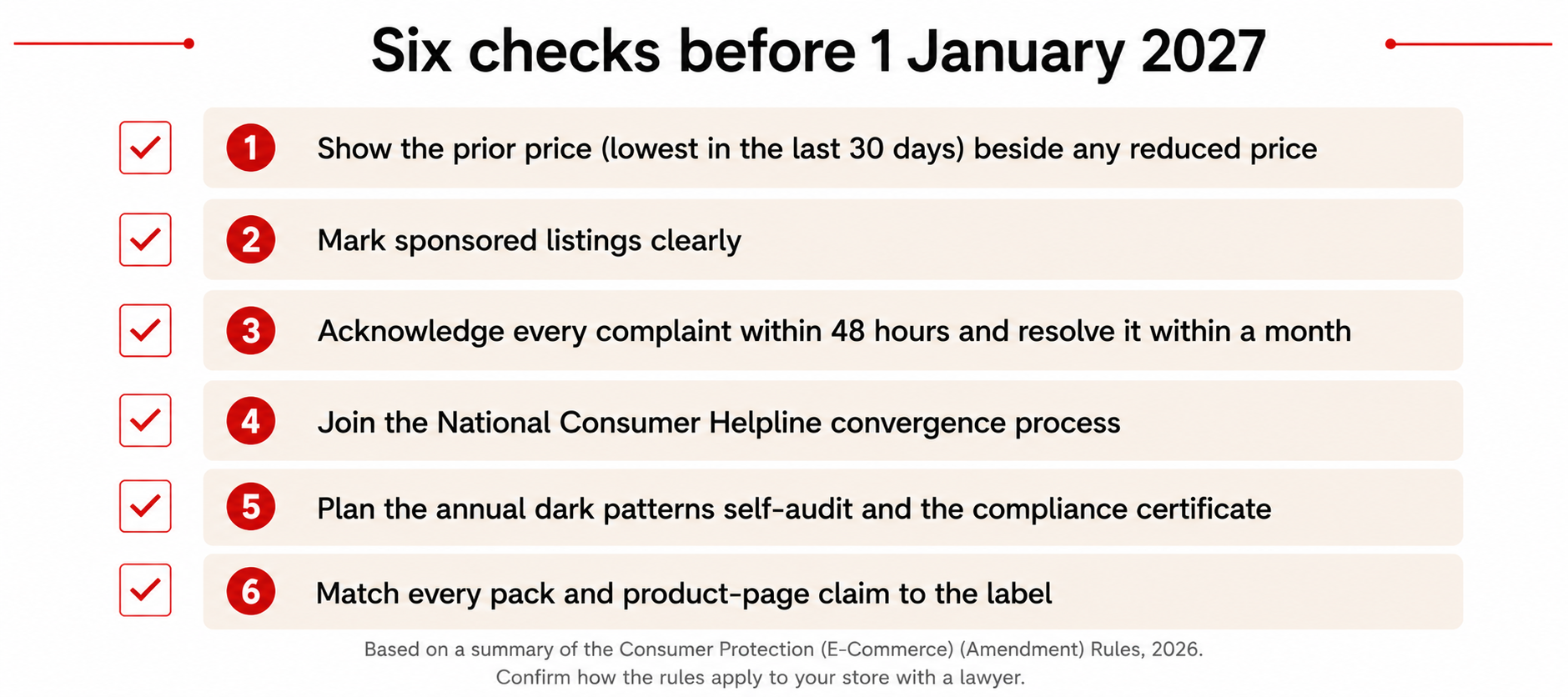
For years, the regulatory risk most brands worried about was an advertisement that overpromised. That list is getting longer. The Consumer Protection (E-Commerce) (Amendment) Rules, 2026 were notified on 9 September 2026 and come into force on 1 January 2027. A legal summary of the rules says e-commerce entities must follow the dark patterns guidelines, which cover design tricks that push customers into choices they did not intend. They must also complete annual self-audits and display a compliance certificate prominently.
Other provisions touch everyday D2C practice. A reduced price must appear beside the prior price, which the rules define as the lowest price in the preceding 30 days. Sponsored listings must be clearly marked. Grievance officers must acknowledge complaints within 48 hours and resolve them within a month. Entities must also take part in the National Consumer Helpline's convergence process.
Whether your own store counts as an e-commerce entity depends on how the rules define the term, so ask a lawyer before you assume either way. The summary also says some details are still undefined, including how the self-audit works and what the certificate looks like. Nobody can hand you a finished checklist yet.
Regulators are not waiting for 2027 to act on misleading presentation. In an order dated 18 June 2026, the Central Consumer Protection Authority fined Storia Foods and Beverages and Mrs. Bectors Food Specialities ₹1 lakh each over "100%" claims. Storia's pack said "100% Tender Coconut Water" while its ingredient list showed coconut water concentrate at 9.6 percent. Mrs. Bectors' "100% Whole Wheat" claim sat against a product that contained 87 percent whole wheat flour. Both were told to withdraw the claims from packs, websites and digital platforms.
Neither company is a D2C start-up, but the principle applies to anyone whose product page promises more than the label supports. The authority has also gone after interface design. In September 2026 it fined ride app Rapido ₹10 lakh for confirm shaming and interface interference. Confirm shaming means wording that makes a customer feel bad for saying no, and interface interference means a layout that steers the customer's choice. Uber and Ola are under examination.
A regulator's order is public, and anyone can quote it. No statement removes it afterwards. So the sensible step comes early and is unexciting. Read your product pages the way a regulator would, check every claim against the label, and look at what your checkout screens nudge customers to do.
Creators are one of the main ways D2C brands build trust, and they are also a source of regulatory risk. The Advertising Standards Council of India's FY26 report found that 97.3 percent of the influencer ads it reviewed violated advertising guidelines and needed modification. It also named brands whose creators had not disclosed paid partnerships, including Behrouz Biryani (12 cases), Parag Milk Products (5) and ITC (4).
Notice who gets named. ASCI flags the advertiser as well as the creator, so a missing or buried disclosure becomes a problem for the brand's name. The fix starts in the contract. Make disclosure a condition of payment, and ask to see drafts before anything goes live.
A short brief makes this easier to enforce. List the claims the creator may make and the ones they may not, because a creator's exaggeration becomes yours. Ask for a clear disclosure at the start of the post. Keep the proof for every claim, such as a test report or the final label copy, in one shared folder. When a regulator or a curious customer asks, you can then answer within a day.
Spotting trouble early without an enterprise tool
You do not need an enterprise listening platform to see trouble coming. Start with a weekly complaint log. Give every complaint, review and public comment one cause tag, such as late, wrong, damaged, refund pending or support silent. Those tags mirror the helpline categories above, so you can see whether your problems look like the national pattern. Then check your marketplace seller dashboards, where return reasons and rating trends sit. Finally, set up Google Alerts for your brand name alongside words like "refund" and "fake".
When one cause starts climbing, treat it as an operations alert before it turns into a rating problem. If delivery complaints rise, pause the paid campaigns that send new customers into the same delay. If you move support to WhatsApp, judge it by your own resolution times, because I found no public data on whether it resolves complaints faster.
Answering a complaint while others are watching
When a customer complains in public, many more people are reading the reply than the one who wrote the complaint. They are deciding whether to trust you with their own order. A good reply gives them three things in plain words. It repeats the problem the customer described, so they can see a person read it. It offers a next step with a date on it, such as a refund by a stated day. And it moves the order number and phone details into a private channel.
Then someone should come back to the same thread once the issue closes, because that final update is what later readers will find. The 48-hour acknowledgement in the new rules is a sensible internal target for every public complaint, whether or not the rules reach your store. Handling one-star reviews in detail is a topic of its own.
Who inside the company owns reputation
In many D2C teams, reputation is split across three people who rarely sit together. Logistics owns delivery, support owns refunds and replies, and marketing owns the claims and the creators. Each of them sees one slice of the same complaint, and nobody sees the whole. That is how a rating can slide for weeks while every team reports that its own numbers look fine.
The fix is small. Pick one person, often the founder in a young company or the head of customer experience in a larger one, to read the weekly complaint log and chase the owner of each cause. You do not need a new hire. You need a standing half-hour where logistics, support and marketing look at the same page. Reputation improves when someone has the job of connecting those slices.
A sensible order of work for the next 90 days
1. Tag your last 100 complaints and reviews by cause. The biggest tag is your real reputation problem.
2. Fix that cause in operations before spending on communication. A better courier, a clearer listing or a faster refund each do more than a statement can.
3. Review your product pages, packs and checkout screens with a lawyer, against both the label and the 2027 rules.
4. Rewrite creator contracts so that disclosure and claim checks are conditions of payment.
5. Name an owner for the 48-hour complaint response, and start the weekly log.
Communication comes in once those pieces hold. Public statements, press coverage and replies to reviews carry more weight when the facts behind them are in order, and a reputation management strategy built on that base is easier to defend. If you are starting from scratch, the guide to online reputation management and the notes on reputation management for startups cover the groundwork. If a rating dip or a regulator's notice has already started the conversation, Bridgers can help you plan the communication side of the response.
Frequently asked questions
Do the new e-commerce rules apply to my own D2C website?
The 2026 amendment applies to e-commerce entities. Whether a brand that sells only through its own site counts depends on how the rules define that term, so read the notification summary with a lawyer before assuming either way. The changes take effect on 1 January 2027, which leaves time to check.
What is the prior price rule?
When a seller announces a price reduction, the reduced price must appear next to the prior price. The rules define the prior price as the lowest price of the product in the preceding 30 days. It is aimed at sale prices that follow an inflated list price.
What happens when a customer complains to the National Consumer Helpline?
The helpline records the complaint and seeks a resolution from the company concerned. Between April 2025 and June 2026 it facilitated refunds worth ₹91 crore. Under the 2026 amendment, e-commerce entities must also take part in its convergence process, so answer fast and keep a record of every message.
Is a brand responsible for what influencers post about it?
ASCI's FY26 report named brands, not only creators, for undisclosed paid partnerships. Legal liability depends on the facts, but the reputational exposure sits with the brand. Make disclosure a condition of payment and check every product claim before the post goes live.
Do I need a paid reputation monitoring tool?
Not at the start. A weekly complaint log sorted by cause, your marketplace dashboards and free alerts for your brand name catch most early problems. Paid tools help once volume across channels is too high to read by hand. Prices vary widely, and some vendors quote only on request.
Is a drop in my product rating or brand rating an operations problem or a communications problem?
Sort the recent complaints behind the drop by cause. For a product rating, check that one listing. For a brand rating, check your seller-level reviews and complaints. If most mention late, wrong, damaged or unrefunded orders, the problem is operational. If customers like the product but misread an offer or policy, communication is the fix.
Most Popular Blogs
Newsletter
Categories
About the author
Anubhav Singh: Founder & Managing Director, Bridgers
Anubhav Singh is the Founder and Managing Director of Bridgers, with over 15 years of experience in media relations and strategic corporate communications. He has worked with leading Indian brands across sectors and holds a degree in Mass Communication & Video Production along with an MBA in Marketing. Under his leadership, Bridgers has grown into one of India’s leading PR agencies, known for transparency, innovation, and quality.
Related Articles


